

Tarsonemid mites
Tarsonemus
Description
How to identify
Tarsonemid mites (family Tarsonemidae) are microscopic pests, often known as thread-footed mites. They are extremely small, usually measuring between 0.1 and 0.3 mm in length, which makes them invisible to the naked eye.
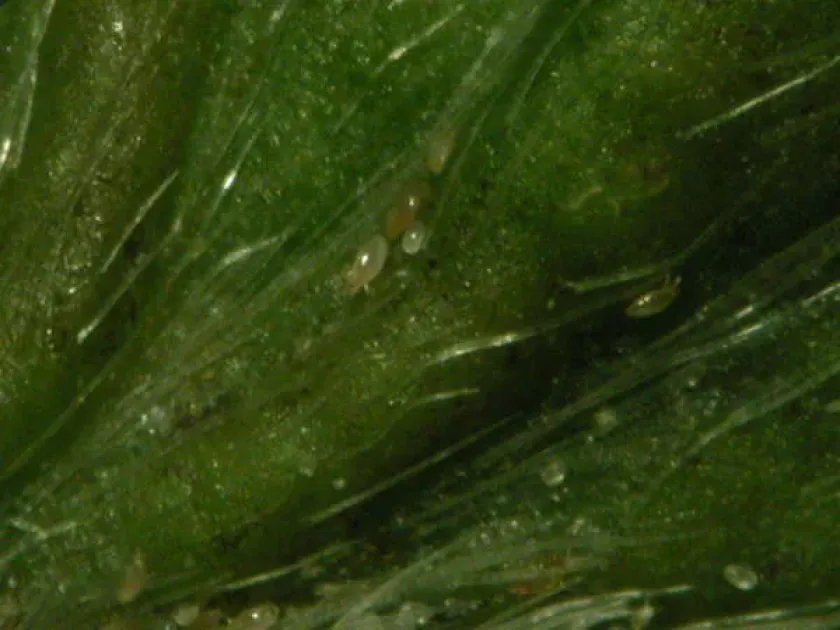
These mites have an oval, transparent or yellowish body. Their anatomy allows them to hide effectively in the smallest crevices of plants, making early detection a significant challenge for growers.
The life cycle involves an egg stage, a larval stage, and an adult stage. Under warm and humid conditions, the population can multiply exponentially, completing a full life cycle in about a week.
They thrive in environments with high relative humidity and protected spots. These mites are often found deep within the central whorls of plants or hidden inside developing flower buds.
Dispersal occurs via passive means, including wind currents, splashing water during irrigation, and handling by workers or farm equipment, allowing them to spread throughout a greenhouse rapidly.
What it damages
These pests target a variety of high-value crops, including strawberries, peppers, tomatoes, and various ornamental plants. They specifically feed on the most succulent, meristematic tissues.
Feeding damage prevents normal cell expansion, resulting in severe plant deformation. Leaves often become twisted, brittle, and take on a glossy, bronze, or metallic discoloration.
The primary symptom is the suppression of terminal growth. Plants often develop a stunted, bushy appearance, as the main growing point is frequently killed or severely inhibited by the mite feeding.
Crop loss occurs due to reduced fruit set, malformed fruit development, and overall decreased vigor of the plant. In strawberry production, these mites can lead to significant yield reduction and poor plant health.
Secondary infections are common in mite-infested areas. Damaged plant tissues provide easy entry points for various bacterial and fungal pathogens, further complicating the recovery process.
Control measures
The first line of defense is the use of pest-free propagation material. Inspecting new plants before introducing them into the greenhouse is essential to prevent colony establishment.
Cultural management involves regulating greenhouse climate. Maintaining lower humidity levels and ensuring good ventilation can inhibit the rapid reproduction of tarsonemid populations.
Chemical control requires the use of effective acaricides. Products containing active ingredients like abamectin or spirodiclofen are often recommended, as they provide systemic or translaminar activity to reach the mites inside buds.
Rotational use of different chemical classes is necessary to manage resistance. Growers must ensure thorough coverage, especially targeting the inner parts of the canopy and developing shoots.
Sanitation is critical after harvest. Removing all plant debris and weeds from the greenhouse environment eliminates the overwintering sites for these mites, reducing the initial pest load for the next cycle.
Content graph
Connections · Tarsonemid mites
Most often together:
Marketplace
Products · 1
Biology
Taxonomy
- Latin name
- Tarsonemus
- Order
- Mites
- Family
- Tarsonemidae
- EPPO code
- TARSSP
Community
Discussion
No discussions yet — be the first.