
American red squirrel
Tamiasciurus hudsonicus
Description
How to identify
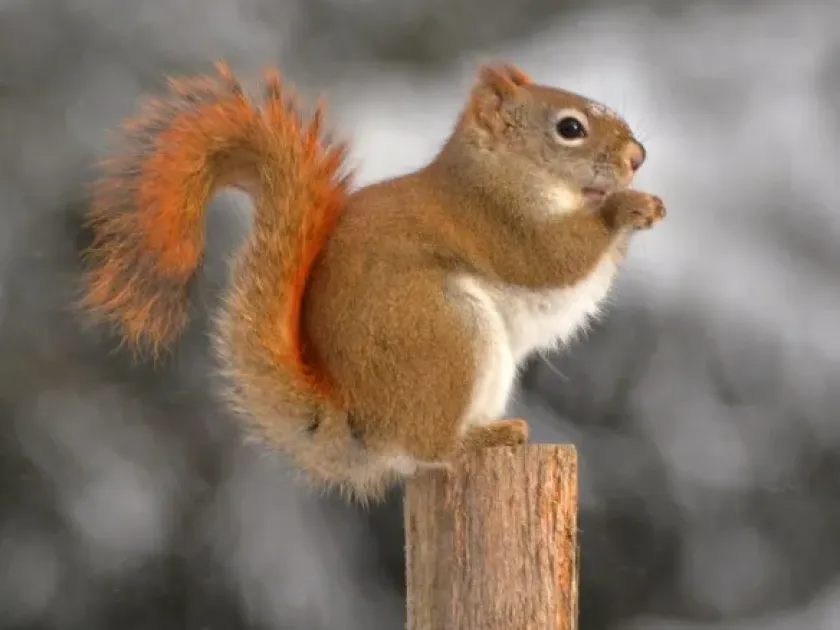
The American red squirrel (Tamiasciurus hudsonicus) is a small, energetic member of the squirrel family (Sciuridae). Known for its distinct reddish coat and white underbelly, it is a highly territorial rodent found across North America.
This species is well-recognized by its aggressive behavior and high-pitched vocalizations. Adults measure between 27 and 38 centimeters in length, making them perfectly adapted for maneuvering in dense canopy environments.
A key biological trait is the creation of «middens» — large refuse piles consisting of cone scales, seeds, and fungal remains. These structures serve as a primary indicator of a established squirrel population in an area.
Despite their small size, red squirrels are prolific breeders, with females capable of producing two litters per year, leading to rapid population surges in favorable habitats.
Their high metabolic rate requires constant food intake, which drives their activity in both natural forests and managed agricultural plots, marking them as significant agricultural pests.
What it damages
The primary impact of the red squirrel is on conifer species such as spruce, pine, and fir. By stripping cones before maturity, they drastically reduce the available seed bank for natural reforestation.
In early spring, squirrels often feed on the cambium layer of tree bark. They strip bark from young stems and branches, leading to top dieback and potential tree mortality in young plantations.
Orchard crops, particularly apples, pears, and walnuts, are frequently targeted. Squirrels can consume or ruin large portions of the harvest well before the fruit reaches technical maturity.
Mechanical damage to stems caused by feeding creates entry points for fungal pathogens and wood-boring insects, further compromising the structural integrity and health of the timber.
In ornamental nurseries, these squirrels cause deformities in tree growth by pruning leaders, rendering nursery stock commercially worthless and impacting overall productivity.
When it appears
American red squirrels are active year-round as they do not hibernate. Their activity level remains consistently high throughout the four seasons, dictated by food availability and reproductive cycles.
Spring is a critical period for damage, as squirrels focus on the nutrient-rich cambium of young conifers when other food sources are scarce after the winter months.
During the summer months, they shift their focus toward maturing fruits and vegetables in gardens, coinciding with the peak development period of many horticultural crops.
Autumn is the peak season for harvesting and hoarding behavior, where squirrels aggressively collect seeds, nuts, and cones, often devastating potential seed collection efforts.
Winter activity is focused on feeding on buds and stored reserves, ensuring their survival but continuing the slow stress and damage to the apical shoots of trees.
Signs of infestation
The most diagnostic sign is the presence of middens — large piles of cone scales and debris scattered around the base of trees or in hidden corners of a forest site.
Visible bark stripping on tree trunks and branches is a clear symptom of squirrel feeding, leaving fresh light-colored wood exposed where the cambium was removed.
A littered forest floor or orchard ground covered in cut, green, unripe cones indicates that red squirrels are actively pruning the canopy to collect seeds.
Audible indicators include aggressive chattering and chirping sounds. A squirrel defending its territory will often vocalize repeatedly when a human or predator is nearby.
The death of terminal leaders on conifers, resulting in a yellowing and eventual browning of the top of the tree, is a hallmark of intense feeding pressure.
Control measures
Mechanical exclusion is the most effective control strategy. Installing metal flashing or guards on tree trunks prevents squirrels from climbing and reaching the canopy.
In orchard settings, the use of hardware cloth or wire cages around young or vulnerable trees can protect them from bark stripping and fruit harvesting by rodents.
Repellents, such as those containing capsaicin, can be applied to bark or fruit surfaces to deter feeding, though these require frequent reapplication, especially after rain.
Sanitation practices, such as removing excess debris and fallen fruit, reduce the attractant levels, making the managed area less appealing for squirrel habitation.
- Use of live traps for humane relocation where legally permitted.
- Maintenance of clear zones around high-value orchard plots.
- Encouraging avian predators through the installation of nest boxes.
Taxonomy
- Latin name
- Tamiasciurus hudsonicus
- Order
- Rodents
- Family
- Sciuridae
- EPPO code
- TMSCHU
Discussion
No discussions yet — be the first.