
European ground squirrel
Citellus citellus
Description
How to identify
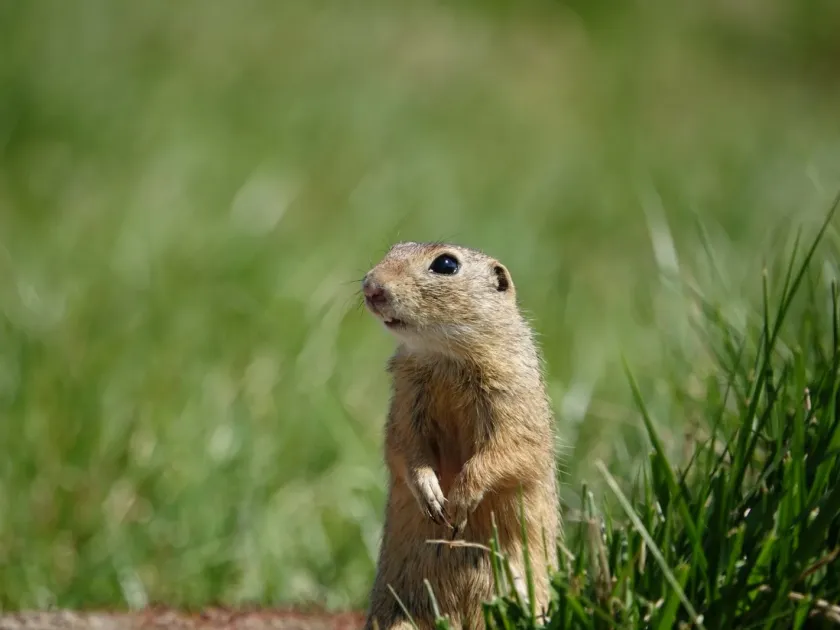
The European ground squirrel (Spermophilus citellus), often identified by the synonym Citellus citellus, is a small rodent belonging to the squirrel family (Sciuridae). Adults typically measure 20 to 25 cm in length with a short, sparsely haired tail.
Their coat color ranges from brownish-grey to yellowish, frequently featuring faint light spots on the back. They possess large, high-set eyes and small, rounded ears, which are classic adaptations for burrowing life in open grasslands.
These animals are strictly diurnal and colonial, constructing elaborate burrow systems that can reach depths of up to two meters. These burrows serve as essential refuges and hibernacula for the winter.
They prefer open habitats such as dry meadows, pastures, and uncultivated fields. As highly alert animals, they rely on vocal whistles to warn the rest of the colony of potential predators or human activity.
Biologically, they are part of the order Rodentia. While protected in various parts of Europe due to population declines, they remain a significant agricultural pest in many regions where their density is high.
What it damages
European ground squirrels primarily damage cereal crops like wheat, barley, and rye. They consume seeds at the sowing stage and can clear entire sections of young seedlings, severely reducing plant density.
During the growing season, they feed on stems and grain heads, causing direct yield losses. Vegetables, particularly root crops and melons, are also susceptible to severe gnawing damage.
Pastures suffer from ground squirrels as they selectively graze on the most nutritious grasses and seeds. This grazing pressure can lead to the degradation of grazing land and a decrease in fodder quality.
Their burrowing activities create mounds of excavated soil that interfere with agricultural machinery. These obstacles can damage the precision components of seeders and harvesting equipment during field operations.
In orchards, ground squirrels may chew the bark of young fruit trees, especially in late winter when food is scarce, potentially girdling and killing young saplings.
When it appears
The activity cycle of the European ground squirrel begins in early spring as soon as the snow melts and the soil warms. This is the period of highest energy requirements for emergence from hibernation.
Late spring and early summer represent the peak period of pest activity. During this time, the squirrels are most visible and cause the greatest damage to rapidly developing agricultural crops.
By mid-summer, as vegetation dries out, the animals begin to shift their behavior toward fat storage. Their presence on the field surface gradually decreases as they prepare for dormancy.
By late summer or early autumn, the entire colony retreats into deep burrows for hibernation, which lasts throughout the cold season until the next spring.
Effective management strategies should be executed early in the spring season when the animals first emerge, as this prevents population buildup before the crop growth cycle reaches its critical phase.
Signs of infestation
The most reliable sign of an infestation is the appearance of soil mounds, known as squirrel mounds, near the entrances of their burrows. These are easy to spot on flat or recently tilled fields.
Damaged crop areas often show irregular patches of thin or destroyed vegetation. These spots appear where the rodents have focused their feeding activity, leaving little or nothing of the crop behind.
Observation during sunny hours reveals the presence of squirrels. They frequently stand in an upright, "picket-fence" posture on their hind legs to scan the surrounding area for danger.
Short, high-pitched whistling sounds heard across the field are clear evidence of a colony. These sounds act as alarm signals when the squirrels are feeding or moving between burrow entrances.
Evidence of gnawed plant stems or remnants of roots left at the burrow entrance provides clear confirmation that the site is currently occupied by active ground squirrels.
Control measures
Deep plowing during the autumn is a primary agronomic control method. This practice disturbs the burrow systems and destroys the overwintering chambers, significantly reducing the survival rate of the colony.
Frequent mechanical soil disturbance, such as harrowing and cultivating, creates a hostile environment that encourages the colony to migrate away from the disturbed field to more stable areas.
Encouraging natural predators by installing raptor perches near the fields can provide sustainable biological control. Birds of prey, such as hawks and eagles, effectively monitor and reduce rodent numbers.
Chemical control via rodenticides should be considered a last resort and used strictly according to regional environmental and agricultural regulations to avoid non-target impact.
- Practice crop rotation.
- Keep field borders free of tall weeds.
- Monitor population density regularly.
- Use mechanical deterrents where necessary.
Taxonomy
- Latin name
- Citellus citellus
- Order
- Rodents
- Family
- Sciuridae
- EPPO code
- CITECI
Discussion
No discussions yet — be the first.