
Black-tailed prairie dog
Cynomys ludovicianus
Description
How to identify
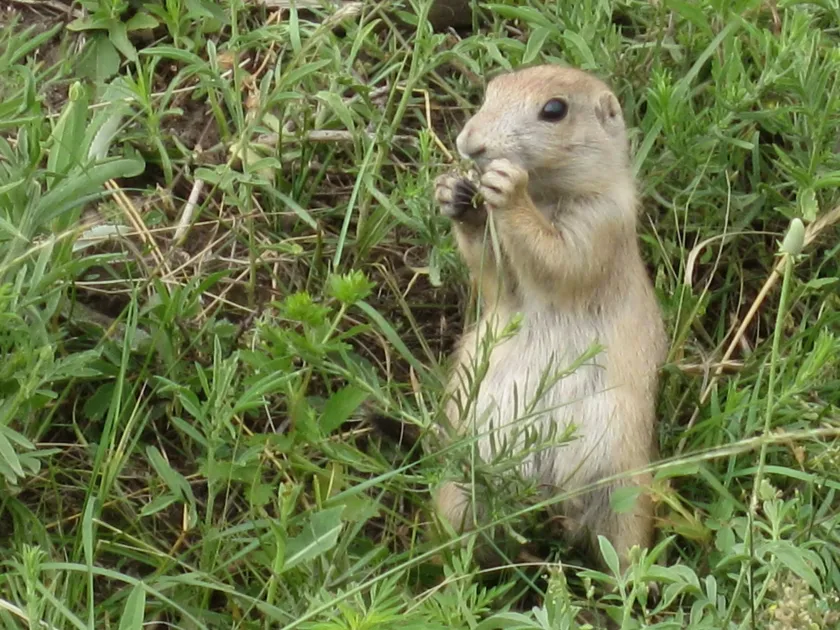
The black-tailed prairie dog (Cynomys ludovicianus) is a rodent belonging to the Sciuridae family. These highly social animals live in expansive colonies known as "towns."
Adults typically measure 35 to 45 cm in length and are easily identified by their tan-colored fur and a distinctive black tip on their tails.
They possess robust bodies and short, powerful limbs equipped with sharp claws, which are perfectly adapted for excavating complex underground tunnel systems.
The colony utilizes a sophisticated system of vocalizations, including distinct alarm calls, to warn others of predators or human intrusion.
Their burrow architecture is highly complex, featuring specialized chambers for sleeping, nursery areas for offspring, and ventilation shafts that maintain airflow.
What it damages
Prairie dogs primarily impact agriculture by consuming large quantities of forage grasses on pastures, reducing available feed for livestock.
In croplands, they cause significant losses by consuming emerging seedlings, vegetables, and alfalfa, often destroying entire patches of crops.
Their extensive burrowing activity creates hazardous mounds of soil that can damage farm machinery and hinder efficient harvesting operations.
By denuding large areas of vegetation around their burrow entrances, they contribute to soil erosion and the degradation of fertile topsoil.
Furthermore, their presence can drive away livestock from high-quality grazing areas, leading to reduced livestock weight gain and significant economic strain.
When it appears
Activity begins in early spring, as prairie dogs emerge from their winter dormancy or period of lethargy to seek out fresh spring forage.
The breeding season occurs during the spring, leading to a rapid surge in the colony's population once the young emerge from the burrows.
Summer marks the peak of feeding activity, as the colony works to sustain its members and prepare for the coming autumn months.
During the fall, they prioritize high-intensity feeding to accumulate critical fat reserves required to survive the winter season.
Winter activity is limited; however, in regions with milder climates, they may surface periodically during warm spells to forage on remaining vegetation.
Signs of infestation
The most prominent sign of an infestation is the presence of numerous cone-shaped soil mounds surrounding burrow entrances located in close proximity.
Areas of bare, vegetation-free ground signify a well-established colony that has depleted all available forage within their immediate territory.
The sound of high-pitched, repetitive warning barks upon the approach of a person or vehicle is a reliable indicator of their presence.
Damage to agricultural equipment or the risk of injury to livestock due to collapsed burrow openings is a common issue in heavily infested fields.
Direct sightings of the animals near their mound entrances during daylight hours confirm the location of an active colony site.
Control measures
Mechanical destruction of burrow systems through deep plowing can be a disruptive method for managing localized or small-scale colonies.
Registered rodenticides and fumigants may be used within the burrows, provided that all local environmental regulations and application guidelines are strictly followed.
Installing physical barriers around high-value agricultural plots can help prevent prairie dogs from encroaching onto the cultivated land.
Encouraging natural predators, such as hawks, owls, and coyotes, to inhabit the area can help provide a natural mechanism for population control.
- Routine monitoring of colony size and expansion
- Application of approved burrow fumigants
- Rotation of crops to minimize feeding appeal
- Maintenance of natural nesting sites for raptors
- Strategic landscape management to reduce burrowing success
Taxonomy
- Latin name
- Cynomys ludovicianus
- Order
- Rodents
- Family
- Sciuridae
- EPPO code
- KYMSLU
Discussion
No discussions yet — be the first.