
Ground squirrel
Citellus
Description
How to identify
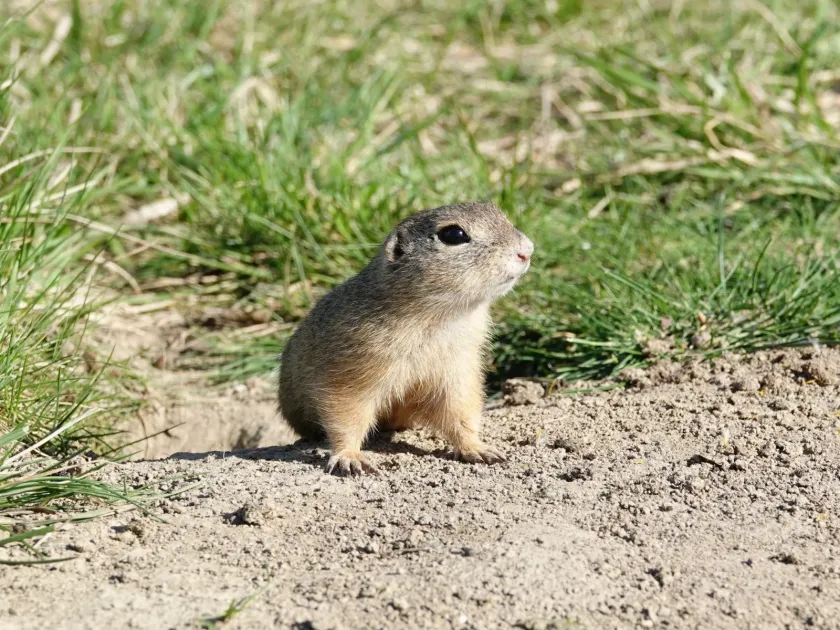
Ground squirrels are small rodents of the Sciuridae family, perfectly adapted to terrestrial life. They feature a sturdy body, short limbs with strong claws for digging, and a tail that is noticeably shorter than that of tree squirrels.
A key identifying feature is the presence of internal cheek pouches used to store and transport food. These rodents are highly social animals that live in organized colonies with complex underground burrow systems.
Their coloration typically ranges from sandy-yellow to grey-brown, which provides excellent camouflage against the soil and dry vegetation of their natural habitat.
Ground squirrels are diurnal, meaning they are active exclusively during the day. When sensing danger, they stand upright on their hind legs and emit high-pitched whistles to alert other colony members.
They possess sharp vision and keen hearing, allowing them to detect potential predators or farm machinery from a considerable distance, making them difficult to approach undetected.
What it damages
Ground squirrels cause significant economic damage to agriculture by feeding on almost all types of cereal and vegetable crops. They are especially destructive during the early germination stage.
They consume newly sown seeds and young seedlings, leading to sparse crop stands that often require replanting. As the season progresses, they also feed on ripening grains and vegetative plant parts.
Beyond direct feeding, ground squirrels cause extensive mechanical damage to farmland. Their constant digging and burrowing create large mounds of earth that interfere with planting, harvesting, and irrigation.
In grazing lands, they damage productive forage grasses, promoting the spread of less nutritious weeds. This significantly reduces the carrying capacity of pastures for livestock.
When present in large numbers, colonies can create large bare patches in fields, leading to significant yield losses and soil degradation over time.
When it appears
The ground squirrel life cycle is strictly tied to seasonal environmental factors. Most of their annual cycle is spent in deep hibernation within their burrows to survive harsh weather.
Emergence from hibernation occurs in early spring as soon as soil temperatures rise and fresh vegetation becomes available. This period marks the beginning of their most active feeding and breeding season.
The spring and early summer months are when they cause the most damage to agricultural fields, as they require large amounts of food to support their growing offspring.
As summer temperatures peak and vegetation dries out, their activity levels may decrease, but they continue to forage actively to store energy for the coming winter cycle.
Hibernation usually begins in late summer or early autumn, ending their period of active damage to crops for the year.
Signs of infestation
The most reliable sign of a ground squirrel infestation is the presence of characteristic soil mounds at the entrances to their burrow systems. These are particularly visible after plowing or before crop emergence.
- Fresh mounds of loose earth at burrow openings.
- Well-defined paths or trails worn into the vegetation between burrows and feeding areas.
- Missing plants or seedlings in localized areas of the field.
- Evidence of gnawing on stalks and crop stems.
- Frequent sighting of individuals standing upright on mounds during sunny days.
By observing the state of the burrow entrances, farmers can determine if the colony is currently active, which is crucial for timing control operations.
In cases of high infestation, large circular areas of decimated vegetation are a clear indicator of a well-established colony that requires urgent intervention.
Control measures
Effective ground squirrel control relies on a combination of cultural and chemical methods. Deep plowing of infested fields is one of the most effective ways to destroy burrow networks and disrupt the colony.
The use of approved rodenticides applied directly into active burrows is the standard procedure for eradicating dense populations. Always ensure that safety protocols are followed to protect non-target species.
Preventative measures include maintaining clean field margins and controlling weeds to remove the protective cover and food sources that attract ground squirrels to an area.
Regular field scouting, particularly in the spring, is essential to detect new colonies before they can expand into significant populations that threaten the entire crop.
While natural predators can assist in keeping numbers in check, they are rarely sufficient in commercial agricultural settings, making active human intervention necessary to maintain crop yields.
Taxonomy
- Latin name
- Citellus
- Order
- Rodents
- Family
- Sciuridae
- EPPO code
- CITESP
Discussion
No discussions yet — be the first.