
Siberian chipmunk
Tamias sibiricus
Description
How to identify
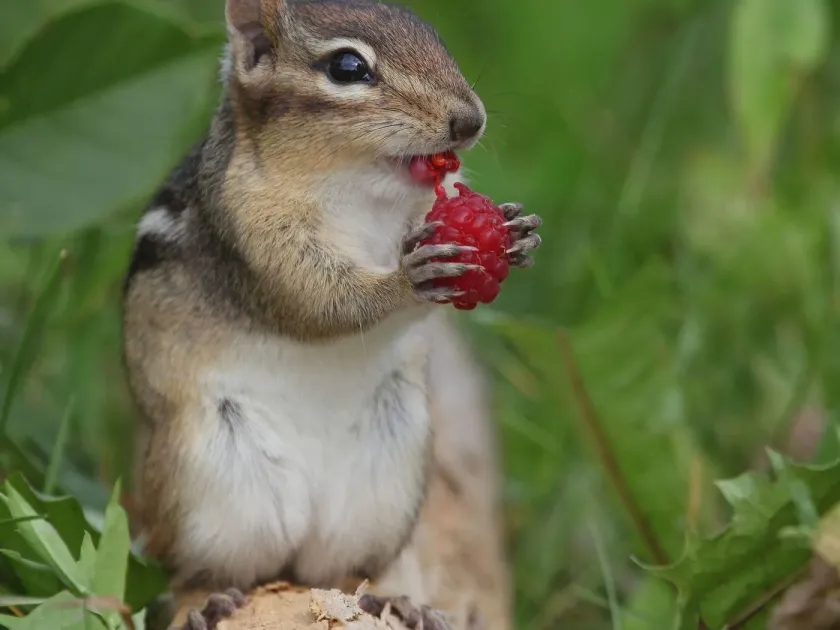
The Siberian chipmunk (Latin: Tamias sibiricus) is a small rodent belonging to the Sciuridae family. It is easily recognizable by its distinct physical features.
The body length ranges from 12 to 17 centimeters, accompanied by a long, bushy tail. The most prominent marking is the five dark, longitudinal stripes that run down its back.
These rodents are diurnal, meaning they are primarily active during the day. They possess excellent climbing abilities but are also proficient at digging complex burrow systems.
They prefer to inhabit the forest floor and edges, where they build nests for raising young and storing significant amounts of food for the winter season.
Their adaptive nature allows them to thrive in human-altered landscapes, often bringing them into close contact with agricultural fields and suburban home gardens.
What it damages
Siberian chipmunks are opportunistic feeders, causing damage to various crops, including cereals, legumes, and a wide array of soft fruits and vegetables.
They are particularly destructive during the planting season, as they dig up and consume seeds from the soil, often forcing farmers to replant entire areas.
In home gardens, they frequently target ripening strawberries, raspberries, and currants, leaving behind partially eaten berries and significantly reducing yields.
They can also damage fruit trees by gnawing on young bark and tender buds, which stunts growth and may lead to the eventual death of younger saplings.
- Cereals: wheat, oats, corn kernels.
- Vegetables: peas, beans, pumpkin and cucumber seeds.
- Fruits: strawberries, raspberries, apples, plums.
When it appears
Their activity cycle begins in early spring, right after they emerge from hibernation. At this stage, they are focused on finding energy-rich food sources.
Late spring and early summer involve high levels of foraging for sprouting seeds and seedlings, making this a critical period for protecting newly planted vegetable beds.
Mid-to-late summer coincides with the peak fruiting season, during which the chipmunks focus their destructive efforts on gardens, berry bushes, and orchards.
Autumn marks their most intensive period of hoarding behavior, as they actively collect seeds and grains to store deep within their underground tunnels.
By late autumn, as temperatures drop, these rodents retreat into their burrows to enter a state of hibernation, effectively ending their activity for the year.
Signs of infestation
The presence of chipmunks is often signaled by small, clean-cut entrance holes into the ground, usually found near rocks, logs, or dense vegetation.
Gardeners may notice thin, shallow trenches along seed rows where the rodents have dug up planted seeds, leaving behind empty hulls or husks.
On berry crops, fruit damage appears as bite marks from small incisors, with partially consumed fruit remaining attached to the stems or left on the ground.
Gnaw marks on the stems or lower branches of saplings, combined with scattered shells or pits around the base of trees, are classic indicators of a nesting pair.
Audible signs, such as a sharp, repetitive 'chip' or 'tsik' sound, are clear indicators that a chipmunk is nearby and aware of intruders in its territory.
Control measures
Installing hardware cloth or fine-mesh wire fences around vegetable patches is one of the most effective mechanical methods to prevent physical access.
Ultrasonic rodent repellers can be used to create an environment that is unpleasant for chipmunks, causing them to move their foraging activities elsewhere.
Live traps can be utilized to capture the animals safely. Once caught, they should be released at least a few kilometers away to discourage their return.
Managing the surrounding landscape is crucial; clearing away brush piles, tall weeds, and debris removes the hiding spots they rely on for safety.
If the population is high, consult with local agricultural extension offices to explore integrated pest management strategies that protect both your harvest and the environment.
Taxonomy
- Latin name
- Tamias sibiricus
- Order
- Rodents
- Family
- Sciuridae
- EPPO code
- EUTASI
Discussion
No discussions yet — be the first.