
Hoverfly
Syrphus
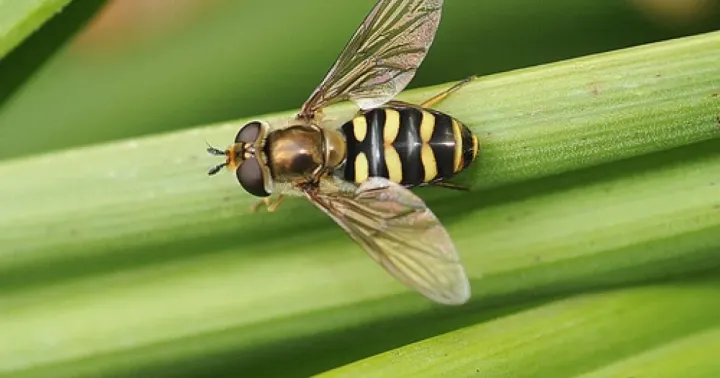
Description
How to identify
Hoverflies, scientifically known as Syrphidae (including the genus Syrphus), are often called flower flies. They are frequently mistaken for wasps or bees because of their bright yellow and black striped bodies, but they have only one pair of wings and are completely harmless to humans.
Adult hoverflies are essential pollinators. They are highly mobile and possess the remarkable ability to hover in mid-air, which gives them their common English name. They are commonly found visiting flowers to feed on nectar and pollen.
The larvae of many hoverfly species are voracious predators. They have a slug-like, legless appearance and are often found in shades of green or brown, allowing them to blend perfectly with plant foliage.
The life cycle consists of the egg, larval, pupal, and adult stages. Females are highly strategic, laying their eggs directly within or near aphid colonies, ensuring their larvae have an immediate food source upon hatching.
In agronomy, hoverflies are strictly considered beneficial insects. Their predatory larvae play a crucial role in natural biological pest control, effectively managing aphid populations without the need for chemical intervention.
What it damages
Hoverflies do not cause damage to plants. They do not consume plant tissues, suck sap, or stunt the growth of agricultural or ornamental crops. Any classification of them as pests is entirely incorrect.
In fact, they are highly valuable. A single hoverfly larva can consume hundreds of aphids during its development, making them one of the most effective natural enemies of aphid infestations.
Beyond the larval stage, adult hoverflies contribute to higher crop yields through their role as efficient pollinators. They are known to be active and foraging even in cooler weather conditions compared to other pollinators.
Their presence is a hallmark of a healthy, balanced garden. An abundance of hoverflies usually indicates that the local ecosystem is thriving and that pesticide use is being kept at a minimum.
Agro-professionals encourage the presence of hoverflies as a sustainable way to manage pests. They are a core component of integrated pest management (IPM) strategies, providing cost-free and environmentally friendly protection.
When it appears
Hoverflies are active from early spring through late autumn. The first adults emerge with the onset of the earliest spring blooms, which provide the essential nectar they require for energy and reproduction.
The peak activity of the larvae coincides with the spring flush of young plant growth, which is when aphid colonies are typically most active and problematic for gardeners and farmers.
In temperate climates, hoverflies can produce several generations within a single growing season. This continuous breeding cycle allows them to keep aphid numbers suppressed throughout the entire season.
Hoverflies typically overwinter as pupae or adults in protected environments, such as leaf litter, mulch, or crevices in tree bark. As soon as temperatures stabilize in spring, they resume their life cycle.
To support a consistent hoverfly population, it is essential to maintain a continuous supply of nectar-rich flowers in the garden. This provides food for the adults throughout the entire spring and summer period.
Signs of infestation
You can identify hoverflies by their unique flight pattern: they move rapidly between flowers and then pause mid-air, hovering perfectly still before darting away. This stationary hovering is their most distinctive trait.
If you examine leaves infested with aphids, look for small, slug-like larvae crawling among them. They often hold their prey up while feeding, making them easily distinguishable from other insect larvae.
A rapidly declining aphid population without any human intervention is a classic sign of hoverfly larval activity. You may also notice empty, dried-out aphid husks left behind on the stems or leaves.
Tiny, elongated, white eggs may be visible on the underside of leaves or near aphid clusters. These are the eggs of the hoverfly, waiting to hatch and begin their work as predators.
The presence of many fly-like insects with hover-flight behavior on your garden plants is an excellent indicator that your garden's biological control system is active and functioning effectively.
Control measures
No control measures are needed for hoverflies, as they are essential allies in the garden. Instead, efforts should focus on habitat conservation and increasing their populations to improve pest management.
To attract more hoverflies, include nectar-rich plants in your garden design, such as dill, fennel, parsley, coriander, sweet alyssum, and various daisies. These provide perfect food sources for the adults.
Avoid using broad-spectrum insecticides, as these chemicals do not distinguish between pests and beneficial insects. Killing hoverflies will often lead to a rapid resurgence of aphid populations due to the loss of natural control.
Leave small patches of undisturbed grass and some leaf litter in your garden during the winter months. This provides safe overwintering sites for the larvae and pupae to survive until the next season.
Adopting an integrated pest management approach, which relies on natural predators like hoverflies, will lead to a healthier and more productive garden or farm with less reliance on chemical products.
Taxonomy
- Latin name
- Syrphus
- Order
- Diptera (flies)
- Family
- Syrphidae
- EPPO code
- SYRPSP
Discussion
No discussions yet — be the first.