
Synuchus vivalis
Synuchus vivalis
Description
How to identify
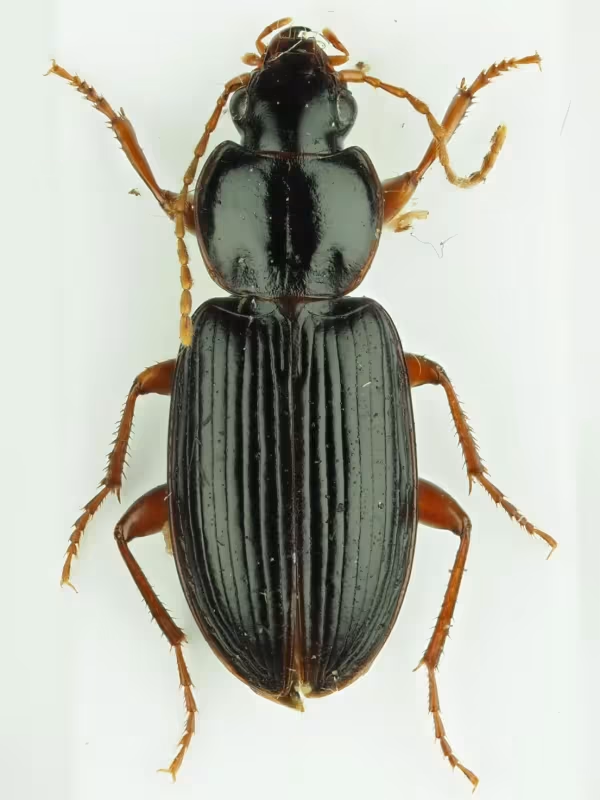
Synuchus vivalis belongs to the Carabidae family, commonly known as ground beetles, within the Coleoptera order. Adult beetles typically measure between 6 and 8 mm in length.
Their coloration is generally dark, ranging from pitch-brown to almost black, often with a subtle metallic luster. The wing covers (elytra) are smooth with distinct longitudinal grooves.
The larvae of this species possess a typical campodeiform structure: an elongated, slightly flattened body equipped with three pairs of well-developed thoracic legs.
The larval head is well-defined and features powerful mouthparts designed for active searching and consuming prey or organic matter.
While primarily entomophagous, this species may exhibit phytophagous behavior when natural food sources are scarce, potentially damaging agricultural crops.
What it damages
Significant damage is primarily observed in cereal crops, including winter and spring wheat, rye, and barley.
During the milk and dough stages of grain development, beetles can damage the ears, consuming the contents of the kernels, which leads to shriveled grains and reduced yields.
In addition to cereals, this pest can be found in fields of various vegetable crops and technical plants, where it seeks shelter in the root zones.
The economic impact increases significantly during years with weather conditions favorable for mass reproduction and in systems where crop rotation is neglected.
Beyond direct grain damage, these beetles can act as mechanical vectors for fungal pathogens, contaminating damaged plant tissues with spores.
When it appears
The species primarily overwinters as adult beetles within the topsoil, under plant residues, or in soil crevices within the field.
Active emergence of adults after hibernation begins in the spring as soon as soil temperatures reach approximately 8–10 degrees Celsius.
Peak activity occurs during the heading and grain-filling stages, making the beetles most visible within the agrocenosis at this time.
Pupation takes place in the soil within specially constructed chambers, followed by the emergence of a new generation of adults that feed actively until autumn cooling.
The life cycle is closely tied to soil moisture; prolonged summer rains contribute to population growth and higher activity levels.
Signs of infestation
The primary sign of infestation is the presence of eaten or damaged grains in the ears, easily observable during field inspections.
Visual inspection of the soil surface during evening or morning hours may reveal active adult specimens roaming the field.
Specific scoring marks on damaged plant parts and the absence of pericarp tissues are indicators of ground beetle activity.
Infested sections of the field often appear thin or stunted, with visible delays in crop growth and overall plant development.
During mass outbreaks, a noticeable reduction in grain weight during test threshing serves as a confirmation of heavy pest pressure.
Control measures
The main management strategy is the implementation of crop rotation, which prevents the build-up of beetle populations associated with monocultures.
Quality autumn plowing with soil inversion effectively destroys a significant portion of the overwintering population and limits further reproduction.
Eliminating weeds around the fields removes essential refugia and alternative food sources for the beetles during the off-season.
When the economic threshold is exceeded, the application of insecticides from the pyrethroid or organophosphate groups is recommended.
- Harvesting crops at the optimal time to minimize losses caused by grain consumption.
- Using high-quality seed material to improve the overall resilience and immunity of the crop.
Taxonomy
- Latin name
- Synuchus vivalis
- Order
- Coleoptera (beetles)
- Family
- Carabidae
- EPPO code
- SYUSVI
Discussion
No discussions yet — be the first.