
Conglobate ladybird
Synharmonia conglobata
Description
How to identify
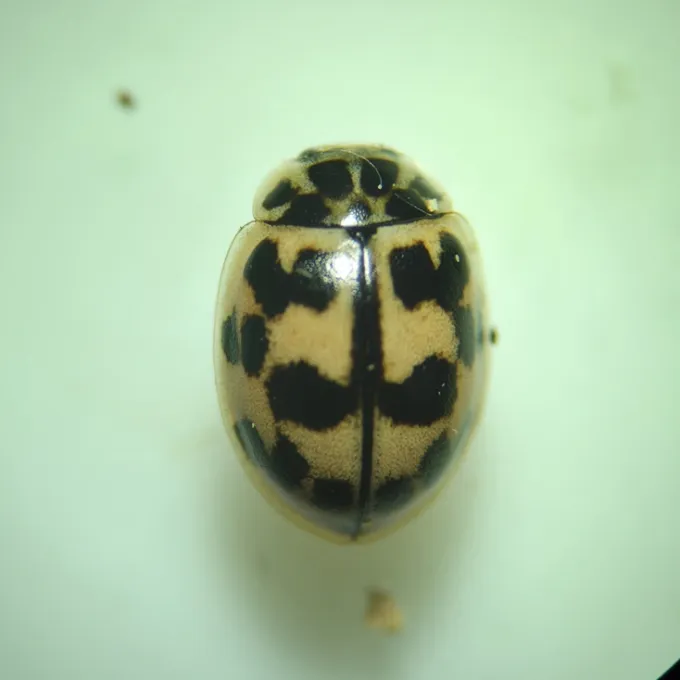
The Conglobate ladybird (Synharmonia conglobata) belongs to the Coccinellidae family within the Coleoptera order. Adult specimens have a round, convex body, typically measuring between 3.5 and 5 mm in length.
The coloration of the elytra ranges from yellowish-brown to bright red. A key characteristic is the presence of 14 black spots that frequently fuse, creating complex, intricate patterns across the shell.
The head and pronotum are light-colored with dark markings, which are essential for precise species identification. The antennae are short and consist of 11 segments, typical for this subfamily.
The larvae are of the campodeiform type, characterized by their high mobility and active hunting behavior. They are usually dark, appearing nearly black, with distinctive yellow or orange spots on their body segments.
The pupa attaches itself to leaves or tree bark. It features camouflage coloring, which allows it to remain concealed from predators during the transformation period.
What it damages
Notably, unlike many ladybird species, this type can occasionally exhibit phytophagy, damaging ornamental and fruit trees. While they primarily feed on aphids, in cases of food scarcity, they may feed on young plant shoots and foliage.
The primary concern is the damage to buds and tender young leaves, leading to the deformation of the plant's vegetative mass. In nurseries, this can significantly reduce the aesthetic and commercial value of seedlings.
The damage peaks during the summer months when the population is at its highest. Voracious larvae can chew the leaf epidermis, which creates entry points for various fungal infections.
Commonly affected plants include various coniferous and deciduous trees, such as pines, spruces, linden trees, and poplars, where large aggregations of this pest are frequently observed.
Indirect damage occurs when the surface of leaves becomes contaminated with excrement, promoting the growth of sooty mold, which severely inhibits the plant's ability to photosynthesize.
When it appears
Activity begins in early spring, immediately after the snow melts, as individuals emerge from their overwintering sites. They immediately begin searching for available food sources on budding trees.
The peak of the life cycle occurs in June and July, during which rapid reproduction and egg-laying are observed. During this time, the pest is most visible on the underside of leaves.
By late August, activity declines, and the adults begin searching for hibernation spots. They prefer to overwinter in leaf litter, tree bark crevices, or gaps in man-made structures.
Temperature significantly impacts the rate of development. A hotter summer can lead to an increase in the number of reproductive cycles, causing sudden spikes in population density.
It is recommended to monitor the population during mid-summer when the largest clusters of larvae and adults are typically found on young succulent shoots.
Signs of infestation
The first sign of infestation is the appearance of characteristic "windows" or hole-like damage on the leaf blades. The leaves often appear chewed along the edges and in the center.
When inspecting the underside of a leaf, one can find egg clusters, appearing as dense groups of yellow-orange cylindrical eggs arranged vertically.
The presence of larvae of varying ages on a single plant is a clear indicator of an active colonization process. They are frequently found clustered along the leaf veins.
The presence of sticky residue on leaves, not associated with aphid activity, may also indicate the presence of this pest, as it can damage plant tissues during feeding.
In severe cases, general plant wilting, premature yellowing, and leaf drop are observed, which can be critical for the survival of young seedlings in tree nurseries.
Control measures
For pest management, it is recommended to employ biological control methods, such as encouraging the presence of natural predators like lacewings or predatory bugs.
Manual collection is effective for small garden plots. Regular inspection and the removal of damaged shoots help significantly limit the population size.
In cases of heavy infestation, the application of systemic insecticides is justified. Pyrethroid-based products have shown high efficacy in controlling both adults and larvae.
Agrotechnical measures include maintaining high-quality growing conditions: timely watering and fertilization significantly increase the tree's resilience against pest damage.
- Regular removal of autumn leaf litter to eliminate overwintering sites.
- Use of sticky traps to prevent larval movement.
- Application of biological products based on insect-pathogenic fungi.
Taxonomy
- Latin name
- Synharmonia conglobata
- Order
- Coleoptera (beetles)
- Family
- Coccinellidae
- EPPO code
- SYNHCO
Discussion
No discussions yet — be the first.