
Common darter
Sympetrum striolatum
Description
How to identify
The common darter (Sympetrum striolatum) is a member of the dragonfly family Libellulidae, widely distributed across temperate regions.
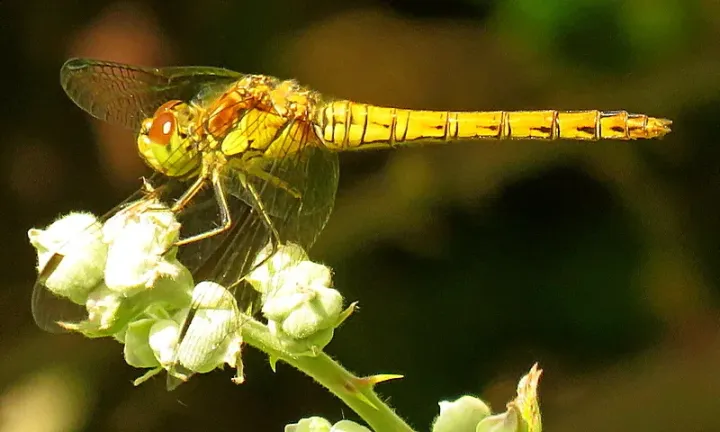
Adults are medium-sized with a typical brownish-yellow coloration, which may deepen to a rich reddish hue in mature males.
They are characterized by strong flight capabilities and specialized compound eyes that provide excellent vision for aerial hunting.
The wings are transparent with a complex vein structure, making them highly efficient predators in open landscapes.
The nymphs, or naiads, are aquatic predators with specialized jaws designed to capture small invertebrates living in water.
What it damages
The common darter is strictly an insectivorous predator and is not considered a pest of agricultural crops.
It does not consume plant tissues, stems, leaves, or roots, and therefore poses no direct threat to garden or farm productivity.
There is no economic damage associated with this species; it does not infect plants with diseases or leave destructive bite marks.
Instead, these insects act as efficient natural biological control agents by consuming various small flying insects such as midges.
Agronomists classify this species as a beneficial entomophage that contributes to the ecological stability of the farm environment.
When it appears
The life cycle involves an aquatic larval stage that lasts for several months within ponds, ditches, or slow-moving water.
Adults emerge from the water from mid-summer onwards, typically appearing in gardens and fields from July to late autumn.
During the warm months, they are highly active, often patrolling sunny areas of the farm to hunt for prey.
Egg-laying occurs in late autumn, when females deposit eggs into or near water bodies to prepare for the next generation.
The species survives the winter in the egg stage or as young nymphs buried in the substrate of a water body.
Signs of infestation
The presence of common darters is easily detected by observing adults flying over gardens or fields during bright, sunny days.
They often settle on dry plant stems or garden fences, providing a clear visual indication of their activity in the area.
There are no specific signs of infestation such as necrosis, leaf curling, or boreholes, as they do not feed on plant matter.
You may see them hovering near irrigation ditches or water storage containers, which are typical sites for their activity.
Finding these dragonflies suggests a healthy local environment with a functioning food chain and available water sources.
Control measures
There is no need for control measures, as the common darter is a beneficial insect that does not harm agricultural output.
The use of pesticides against dragonflies is strongly discouraged as it destroys natural predators that suppress pest populations.
Maintaining a balanced environment is the best approach, ensuring that these predators can thrive and help manage pest levels.
No agricultural intervention is required; focus should instead be placed on supporting native biodiversity in the landscape.
In cases where their numbers need to be managed, simply ensuring that artificial water sources are maintained will naturally regulate their local presence.
Taxonomy
- Latin name
- Sympetrum striolatum
- Family
- Libellulidae
- EPPO code
- SYMEST
Discussion
No discussions yet — be the first.