
Four-spotted chaser
Libellula quadrimaculata
Description
How to identify
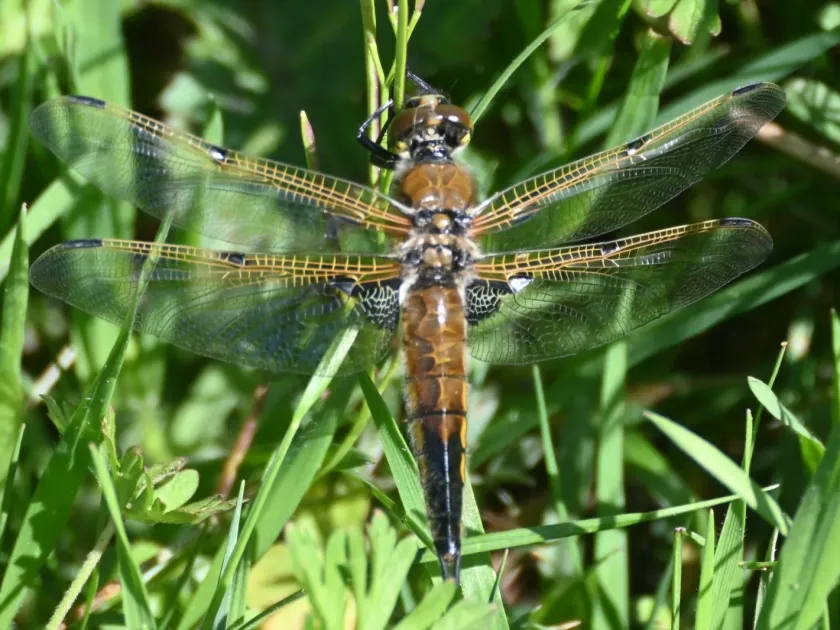
The Four-spotted chaser (Libellula quadrimaculata) is a large dragonfly species belonging to the order Odonata. Its common name is derived from the distinct dark spots found near the middle of the leading edge of each wing.
Adult dragonflies reach a body length of about 45 millimeters with a wingspan of up to 80 millimeters. Their bodies typically exhibit brownish, yellowish, or golden-brown coloration with darker markings along the abdomen.
The aquatic larvae, or nymphs, have a stocky and robust build. They are well-camouflaged, usually appearing in muddy brown tones, which helps them blend into the substrate of ponds and wetlands.
The compound eyes of the adult dragonfly are exceptionally large and provide a 360-degree field of vision, making them highly efficient aerial hunters capable of tracking fast-moving prey.
This species is widely distributed across temperate regions of the Northern Hemisphere, favoring standing or slow-moving water bodies surrounded by abundant aquatic vegetation.
What it damages
The Four-spotted chaser is not a plant pest. It does not feed on leaves, stems, roots, or fruits of agricultural crops. It is an exclusively carnivorous insect during both its larval and adult life stages.
Adult dragonflies are beneficial entomophagous predators that hunt various flying insects in mid-air. Their diet often includes mosquitoes, gnats, and other small flying pests that can cause damage to gardens and fields.
In their larval stage, they inhabit water bodies where they act as top predators, feeding on other insect larvae, small tadpoles, and invertebrates, thereby maintaining the balance of aquatic ecosystems.
The minor damage potentially caused by females ovipositing (laying eggs) into plant stems is negligible and never results in economic loss or crop decline for any agricultural system.
Therefore, farmers should consider the presence of these dragonflies as a positive indicator of biological pest control and overall environmental health on their property.
When it appears
The flight season for adult Four-spotted chasers typically spans from late May through August, with peak activity occurring during warm, sunny summer months when prey availability is highest.
The life cycle of this species is complex and relatively long compared to other insects, lasting between one and three years depending on local climate conditions and water temperature.
Larvae hibernate in the benthic layer of ponds, burying themselves in silt or hiding within aquatic vegetation to survive the winter months, remaining active at lower metabolic rates.
Emergence, the process where the larva leaves the water to transform into an adult dragonfly, is a critical phase usually observed in early summer as temperatures rise.
After reaching maturity, adults mate and females deposit their eggs in aquatic environments, ensuring the continuation of the species for the following season.
Control measures
No control measures are necessary for the Four-spotted chaser. In fact, deliberate attempts to eliminate these insects would be counterproductive, as they are effective natural allies against agricultural pests.
Agricultural managers are encouraged to avoid the use of broad-spectrum insecticides near water bodies to protect the dragonfly population, which contributes to the natural suppression of gnat and mosquito populations.
Maintaining a healthy habitat, including buffer strips around farm ponds and preserving natural water sources, will encourage these beneficial insects to stay and hunt on your land.
Integrated Pest Management (IPM) strategies emphasize the conservation of such predators rather than their removal, as they provide free and constant pest management services.
- Beneficial predator of mosquitoes and flies.
- Acts as a bio-indicator for healthy water.
- Helps reduce reliance on chemical pesticides.
Taxonomy
- Latin name
- Libellula quadrimaculata
- Family
- Libellulidae
- EPPO code
- LIBLQU
Discussion
No discussions yet — be the first.