
Sympetrum dragonfly
Sympetrum
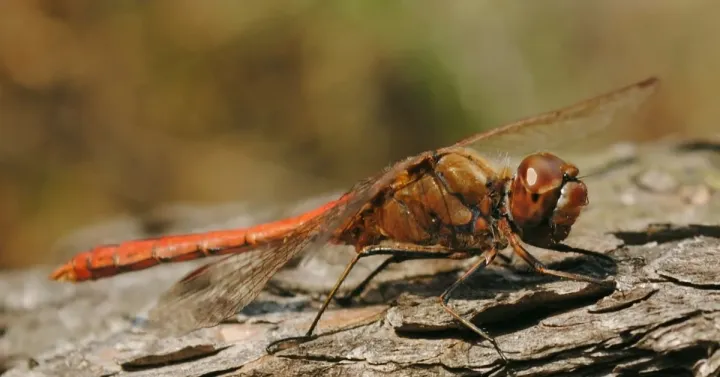
Description
How to identify
Dragonflies of the genus Sympetrum, commonly known as darters, belong to the order Odonata and the family Libellulidae. Adult insects are characterized by vibrant coloration, typically shades of red or brownish-yellow.
The body is of medium size with a characteristic constriction in the abdomen. They possess well-developed net-veined wings and large compound eyes that provide excellent vision for hunting.
The larvae, known as naiads, are aquatic organisms. They reside in still or slow-moving water bodies, possessing a robust body shape adapted for the benthic environment.
These insects are active predators throughout their entire life cycle. They specialize in catching other small insects, using their specialized anatomical features for agile aerial hunting.
Systematically, this genus is widespread across the globe. From an agronomic perspective, it is crucial to distinguish between phytophagous pests and beneficial predators like these dragonflies.
What it damages
From an agronomic point of view, Sympetrum dragonflies are not agricultural pests. They do not possess mouthparts capable of damaging plant tissues.
These insects do not feed on leaves, stems, flowers, or roots of any crops. They do not cause plant diseases, nor are they vectors for viruses that affect agricultural yields.
The misconception of their harmfulness often arises from the high density of individuals flying over fields. In reality, they are attracted by the presence of other insects that may indeed be crop pests.
They cause absolutely no economic damage to agriculture. Their presence in fields is entirely safe for crops and is, in fact, highly beneficial.
In no scientific manual on plant protection are Sympetrum dragonflies listed as objects requiring control or mitigation.
When it appears
The flight of adult dragonflies is observed from early summer through late autumn. This period coincides with the active growing season of many agricultural crops.
The life cycle includes egg, larval, and adult stages. Larval development occurs in an aquatic environment, where they can reside for one or two years.
After metamorphosis, the adults leave the water bodies and disperse into surrounding areas. This explains their appearance in agricultural lands during mid-summer.
The reproduction of dragonflies is closely tied to the presence of water sources, so their abundance in a specific area depends on proximity to ponds or canals.
Dragonfly activity also depends on air temperature: on hot days they become less mobile, while during warm twilights they hunt with particular intensity.
Signs of infestation
The primary signal of dragonfly presence is the visual detection of adult individuals in the field. They frequently land on the tops of plant stems to rest or hunt.
The presence of dragonflies is not accompanied by signs of tissue consumption, punctures, or necrosis, which are characteristic of actual pests.
Monitoring for dragonfly presence does not require special traps. A visual inspection of the area during field walks is sufficient.
High concentrations of dragonflies in a certain spot may indicate a high density of small flying insects, which they prey upon, potentially serving as a sign to check for other pest species.
One should distinguish dragonflies from phytophagous insects that actually cause crop damage, as dragonflies are strictly predators.
Control measures
Control measures against Sympetrum dragonflies are not required. The use of pesticides for their destruction is ineffective and harmful to the agro-ecosystem.
Dragonflies perform an important function as natural regulators of pest insect populations, including mosquitoes and various small crop-damaging insects.
To maintain ecological balance, it is important to keep adjacent water bodies clean and avoid contaminating them with chemicals.
Agronomists should encourage the presence of these insects in fields, as they contribute to reducing pest populations without the need for chemical treatment.
- Avoiding the use of broad-spectrum insecticides.
- Preserving riparian zones for dragonfly reproduction.
- Maintaining biodiversity along field margins.
Taxonomy
- Latin name
- Sympetrum
- Family
- Libellulidae
- EPPO code
- SYMESP
Discussion
No discussions yet — be the first.