
Common winter damselfly
Sympecma fusca
Description
How to identify
The Common winter damselfly, scientifically known as Sympecma fusca, belongs to the Lestidae family within the Odonata order.
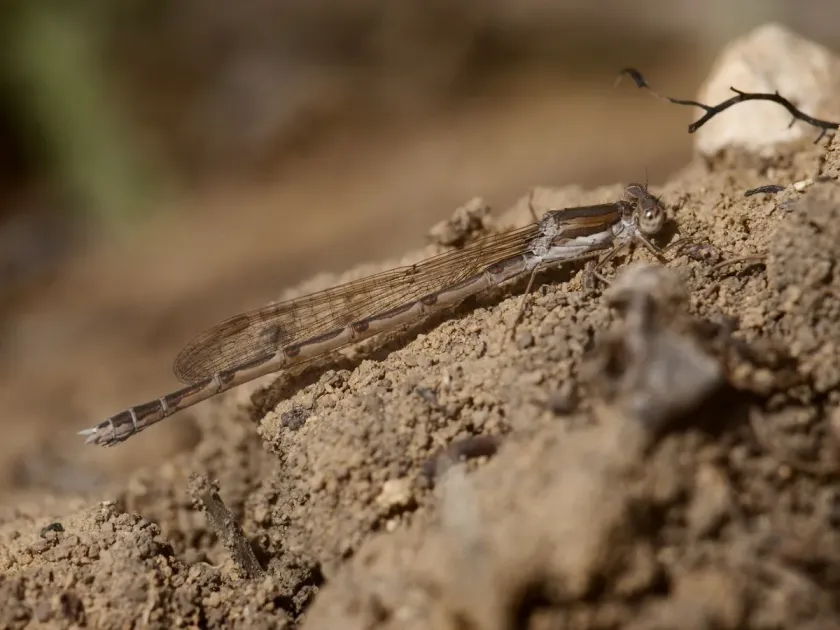
It is a slender insect, typically brownish in color, which serves as excellent camouflage against dried grass and stems.
One of its most distinctive features is the pterostigma on its wings, which is set back from the wing edge.
Unlike most other damselflies, when at rest, it holds its wings folded along its abdomen, making it easier to distinguish in the field.
The nymphs are aquatic, elongated, and possess three leaf-like gills at the end of their abdomen, typical for the Lestidae group.
What it damages
The Common winter damselfly is not a plant pest; it does not feed on crops, foliage, or roots of agricultural plants.
Instead, it acts as a predatory insect throughout its entire life cycle, consuming a variety of smaller insects.
Adults capture midges, mosquitoes, and other small flying insects, contributing to natural pest control in agricultural areas.
Nymphs live in ponds and slow-moving waters, feeding on other small aquatic invertebrates, including mosquito larvae.
There is no economic damage associated with this species; in fact, it is considered a beneficial organism in agro-ecosystems.
When it appears
This species is unique among European dragonflies because it overwinters as an adult, often hidden in dense, dry vegetation.
They become active very early in the spring, once temperatures rise, to start their mating and egg-laying process.
The development of the next generation occurs throughout the summer in suitable water bodies.
By late summer and early autumn, the new generation of adults emerges and can be seen in fields near water.
The cycle is deeply synchronized with the vegetation stages of aquatic plants found near fields.
Signs of infestation
The presence of these damselflies can be observed by spotting them resting on dry plant stalks along field edges.
They are frequently found near irrigation channels or natural ponds where they hunt for prey.
In autumn, they are often found on dried stubble, as they seek hibernation sites before the cold weather sets in.
There are no signs of infestation on crops, such as leaf biting or discoloration, associated with their activity.
Their presence is a good indicator of water quality and a balanced local ecological environment.
Control measures
Control measures are not required for this species, as it is a beneficial insect that aids in biological control.
The use of broad-spectrum pesticides should be avoided near water bodies to protect these natural pest predators.
Maintaining riparian buffers and natural vegetation around fields helps support stable populations of damselflies.
Farmers are encouraged to recognize these insects as allies rather than pests in their integrated pest management programs.
Sustainable agricultural practices that preserve local biodiversity naturally enhance the presence of such beneficial predators.
Taxonomy
- Latin name
- Sympecma fusca
- Family
- Lestidae
- EPPO code
- SYMCFU
Discussion
No discussions yet — be the first.