
Migrant emerald
Lestes barbarus
Description
How to identify
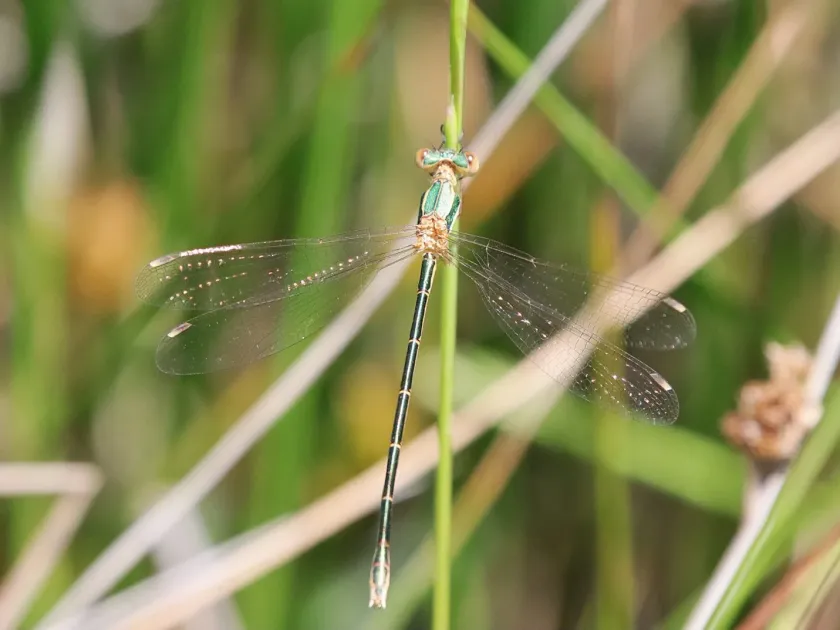
The Migrant emerald (Lestes barbarus) is a species of damselfly belonging to the family Lestidae (order Odonata). Adults are relatively slender, reaching a body length of up to 48 mm with a wingspan of approximately 50–60 mm.
The coloration is predominantly metallic green, often with a bronze sheen, which provides excellent camouflage among tall grasses and crop stems. A key identifying feature is the pterostigma on the wings, which transitions from light in juveniles to a characteristic pinkish-brown in mature adults.
When resting, this species typically holds its wings in a semi-open position. This behavior is a diagnostic trait that distinguishes the Migrant emerald from many other damselfly species that keep their wings closed or fully spread while at rest.
They possess a mobile head with large, widely spaced compound eyes, providing a wide field of vision for hunting small insect prey. Their legs are equipped with small spines designed to firmly grasp prey during flight or while resting on vegetation.
The life cycle involves an aquatic larval stage followed by a terrestrial adult stage. Adults are strong fliers and can travel significant distances from their breeding grounds to explore surrounding fields and grasslands.
What it damages
Although damselflies are primarily beneficial predators, Lestes barbarus can occasionally cause minor damage to crops during its reproductive phase. Damage occurs when females insert their ovipositors into the tissues of plant stems to lay eggs.
These punctures can cause localized mechanical injury to young shoots. In delicate crops, such injuries may interfere with nutrient and water transport, potentially leading to stunted growth or localized necrosis around the puncture site.
Damage is typically observed on crops located near water bodies, such as irrigation canals, ponds, or damp meadows. Cereals and forage crops in these areas are most susceptible to egg-laying activity.
The economic impact is generally low, as the damage is rarely severe enough to cause significant yield loss. In most cases, the species is considered a minor pest or even a beneficial component of the ecosystem due to its predatory nature.
Management is only required if population densities become unusually high, as the species plays a valuable role in regulating populations of other, more harmful insect pests in the agricultural environment.
When it appears
The flight period for adult Migrant emeralds typically occurs in mid-to-late summer, with peak activity observed during July and August. During this time, they are most frequently encountered on and around agricultural fields.
The species overwinters primarily in the egg stage, with eggs embedded within the stems of aquatic or near-water vegetation. Larvae hatch in the spring and develop through several instars in water before emerging as adults.
Adult lifespan is limited to a few weeks, which is sufficient for mating and dispersal. The timing of emergence is highly dependent on regional temperatures and the stability of water levels in their breeding habitats.
High humidity and warm conditions favor their activity. During periods of extreme heat or dryness, these insects tend to seek shelter in dense vegetation, becoming significantly less mobile and harder to observe.
Monitoring for the presence of the species involves observing fields during the early morning or late afternoon when damselflies are most active and likely to be found perched on crop stems or peripheral vegetation.
Signs of infestation
The most prominent sign of a Migrant emerald presence is the visual detection of resting adults on the tops of crop stalks or weeds, specifically noting their characteristic semi-open wing posture.
Signs of egg-laying are subtle, manifesting as tiny, superficial punctures on plant stems. In some cases, slight chlorosis or wilting of the affected stem tissue can be observed upon close inspection.
In adjacent water bodies, the presence of larvae can be confirmed through sweep-netting in the aquatic vegetation. Larvae are easily identified by their slender, elongated body shape and the large mask-like labium.
An indirect sign of the species' activity is an increase in predatory behavior. Observing the damselflies catching small insects is a strong indicator of their established presence and their role as a localized natural enemy of other pests.
Monitoring the population density is essential to determine if further management is necessary. Regular field scouting, particularly in humid or low-lying areas, helps in early detection of population surges.
Control measures
Specific control measures for the Migrant emerald are rarely necessary. Management strategies primarily focus on habitat modification to discourage breeding in areas too close to sensitive crops.
Maintaining clean drainage canals and removing excessive emergent vegetation significantly reduces the amount of suitable substrate available for egg-laying and larval development.
Effective water management, including the prevention of stagnant, temporary water pools in or around fields during the summer breeding season, helps to naturally limit the population density of this species.
Chemical control is generally discouraged because it can disrupt the beneficial predatory populations in the agroecosystem. Instead, integrated pest management (IPM) practices should be followed to maintain ecological balance.
General cultural practices, such as effective weed control around field margins, reduce the availability of resting sites for adults, thereby making the area less attractive for colonization by Lestes barbarus.
Taxonomy
- Latin name
- Lestes barbarus
- Family
- Lestidae
- EPPO code
- LESTBA
Discussion
No discussions yet — be the first.