
Emerald Damselfly
Lestes sponsa
Description
How to identify
The Emerald Damselfly (Lestes sponsa) is a prominent member of the Lestidae family, within the order Odonata, widely distributed across temperate regions.
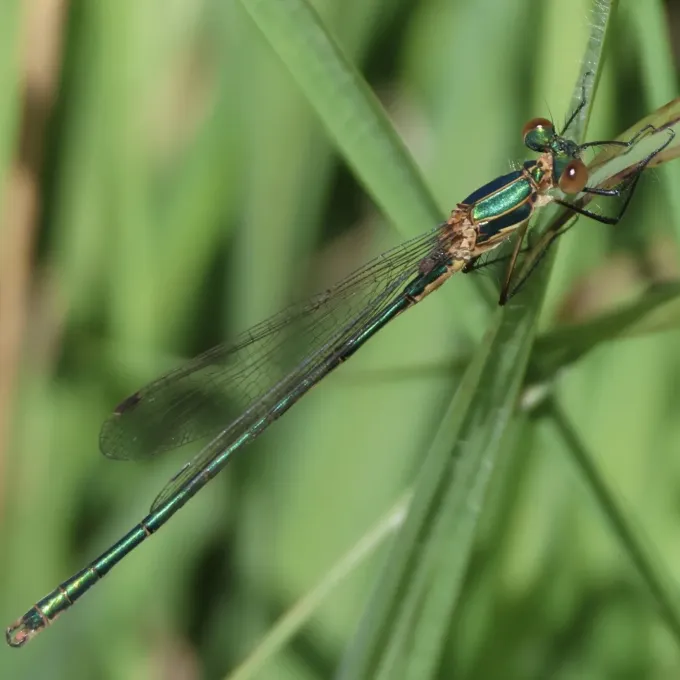
Adult insects exhibit a striking metallic green coloration, with bodies reaching approximately 35 to 45 mm in length.
A distinctive behavioral trait is their habit of holding their wings partially open while at rest, differentiating them from other damselfly species.
They possess a broad head with large, widely separated eyes, providing an excellent visual range for hunting small insect prey in flight.
Nymphs are aquatic creatures with elongated bodies, adapted for a secretive existence among submerged stems and floating aquatic vegetation.
What it damages
It is crucial to note that the Emerald Damselfly is not a crop pest; rather, it serves as a highly beneficial predator in agricultural settings.
These damselflies feed on various small insects, including aphids, midges, and flies, effectively contributing to natural pest population regulation.
The species does not damage plant tissues, foliage, or fruit, nor does it carry any pathogens that could infect cultivated agricultural crops.
Their presence on a farm is a positive ecological indicator, suggesting a balanced environment and sustainable land management practices.
Farmers benefit from their presence as they provide natural biological control against common minor crop pests throughout the growing season.
When it appears
Adult Emerald Damselflies are active during the summer months, typically emerging from mid-June and remaining present through early September.
The lifecycle is strictly tied to water bodies, as the female lays eggs directly into the tissues of aquatic plants near the waterline.
The species survives the winter in the egg stage, which is a key adaptation for cold climates, ensuring offspring emerge during favorable conditions.
Larvae develop underwater throughout the spring and undergo metamorphosis to reach the adult stage just in time for the peak summer insect activity.
The flight period coincides with the most active phases of other flying insects, which serve as the primary food source for the damselfly.
Signs of infestation
There are no "infestation signs" for this species, as it is a beneficial insect that does not create negative impacts on crop health or yield.
Observation of adults near irrigation ditches or moist field edges indicates a healthy biodiversity level within the agricultural landscape.
No damage patterns or physiological changes in crops will be observed that could be attributed to the activity of Lestes sponsa.
Egg-laying sites on aquatic plants are a natural biological event and require no intervention or removal by farm personnel.
- Monitor the presence of natural predators near water sources.
- Maintain buffer zones around fields to support beneficial fauna.
- Avoid misidentifying this predatory damselfly as a crop pest.
Control measures
Control measures are not required for the Emerald Damselfly, as it is an essential predator that assists in the protection of agricultural crops.
To support these populations, farmers should aim to preserve natural aquatic habitats and minimize the use of non-selective broad-spectrum pesticides.
Integrated Pest Management (IPM) strategies emphasize the conservation of such beneficial species to help reduce the reliance on chemical inputs.
Farm management should focus on maintaining ecological diversity, which naturally keeps pest populations below the economic injury level.
There are no specialized extermination protocols for this species, as it contributes to the long-term health and stability of the ecosystem.
Taxonomy
- Latin name
- Lestes sponsa
- Family
- Lestidae
- EPPO code
- LESTSN
Discussion
No discussions yet — be the first.