
Willow emerald damselfly
Lestes viridis
Description
How to identify
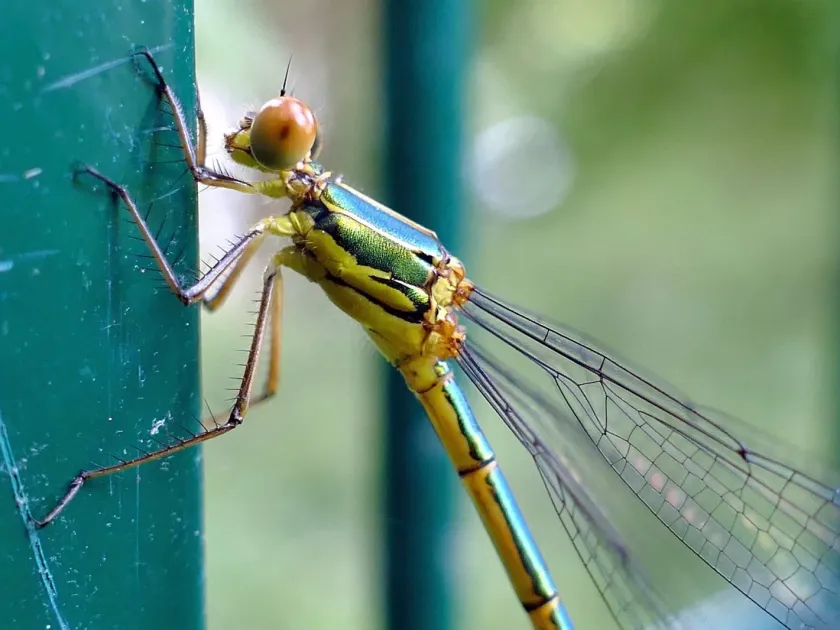
The Willow emerald damselfly (Lestes viridis) belongs to the order Odonata and the family Lestidae. Adults are easily identified by their striking metallic green body color with a slight bronze sheen.
The average body length of an adult is about 40–50 mm, with a wingspan ranging from 60 to 70 mm. The wings are clear and feature a distinctive light-colored pterostigma.
Unlike many other damselflies, this species is well-known for its habit of laying eggs into the woody stems of trees and shrubs hanging over water bodies.
The life cycle involves an egg stage, a pro-nymph, a larval stage living in water, and the final adult stage. Adults are active during warm months, usually in shaded areas near water.
Proper identification requires looking for typical oviposition scars on young twigs, which the female creates using its sharp ovipositor.
What it damages
Damage is primarily caused during the reproductive phase, as females pierce the bark of young twigs to lay their eggs, which can stress the plant tissue.
Commonly affected host plants include willow, alder, birch, and various fruit-bearing trees located near pond edges or in riparian zones.
The mechanical injury to the bark can lead to localized tissue swelling, scarring, and restricted nutrient transport in the affected shoots.
These puncture sites often become entry points for secondary pathogens, such as fungi or bacteria, which can exacerbate the damage to the woody plant.
While adult damselflies are beneficial predators that consume various insect pests, their specific breeding habits make them problematic in nurseries and young plantations.
When it appears
Adult Willow emerald damselflies are typically active from mid-summer through early autumn, which is their peak period for mating and egg-laying.
The species overwinter in the egg stage, which remains safely embedded within the bark of the host plant until the following spring.
Larvae emerge in the spring and drop into the water to continue their development, eventually undergoing metamorphosis into their final winged form.
For agricultural management, it is critical to monitor tree growth and twig health in the late summer months when females are actively seeking egg-laying sites.
Understanding this seasonality is key to implementing prevention strategies before the eggs are successfully embedded in the plant tissues.
Signs of infestation
Early signs of infestation are recognizable as rows of small, precise punctures on the bark of young twigs and branches.
Over time, these puncture sites appear as raised ridges or small, dark scars on the surface, indicating the presence of eggs underneath.
Affected twigs may show signs of wilting, curvature at the tips, or stunted development due to the interference with sap flow caused by the damage.
In cases of heavy infestation, the wounds can develop into elongated lesions or bark ruptures, making the shoot structure weaker.
Visual inspection of suspicious bark swellings often reveals the presence of elongated, whitish eggs buried just beneath the epidermal layer.
Control measures
The most effective control measure is manual removal and destruction of heavily damaged shoots containing egg-clutches during winter or early spring.
Landscape management should prioritize avoiding the planting of susceptible tree species in immediate proximity to open water bodies where damselfly populations aggregate.
Keeping the riparian zone clear of dense, low-hanging woody vegetation can significantly reduce the number of suitable sites for egg deposition.
Chemical control is generally discouraged because adult damselflies play a significant role in natural pest suppression, so non-chemical methods are preferred.
Encouraging biodiversity in the garden by supporting birds and other natural insectivores can help keep adult populations in balance naturally.
Taxonomy
- Latin name
- Lestes viridis
- Family
- Lestidae
- EPPO code
- LESTVI
Discussion
No discussions yet — be the first.