
Emerald Damselfly
Lestes dryas
Description
How to identify
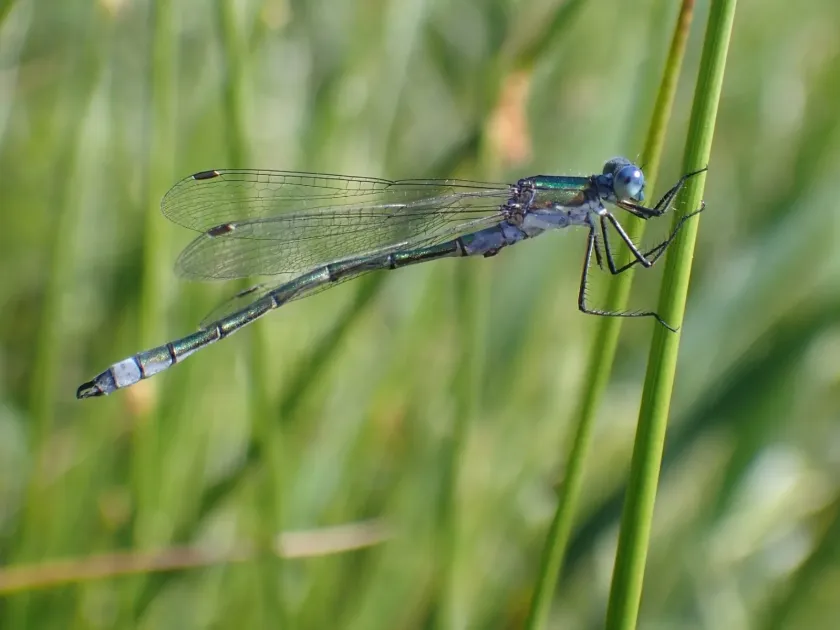
The Emerald Damselfly (Lestes dryas) belongs to the Lestidae family within the Odonata order. Adults are characterized by a slender body with a metallic green-bronze sheen and the habit of resting with wings held partially open.
Males and females show distinct abdominal structures, allowing for precise identification. The head is large with prominent compound eyes, and the transparent wings feature dark pterostigmata near the tips.
Nymphs develop in aquatic environments, possessing elongated bodies and specialized gill appendages for respiration. They act as active predators, feeding on various small organisms in standing water.
Adults prefer vegetated areas near water bodies where they remain vigilant for prey. Their total body length generally ranges between 35 to 40 millimeters with a wingspan of about 50 millimeters.
The coloration of adults shifts from vibrant green to almost black with metallic reflections, providing effective camouflage among aquatic plants and surrounding vegetation.
What it damages
Lestes dryas is not classified as a primary agricultural pest, but it can cause incidental damage to crops during the oviposition process.
Females deposit eggs by piercing the stems of aquatic and semi-aquatic plants, including certain grasses growing in waterlogged areas, using an endophytic laying method.
Heavy egg-laying activity in young plant stems may cause structural damage to vascular tissues, which can impede growth and weaken the plant's structural integrity.
These puncture wounds serve as entry points for phytopathogenic fungi and bacteria, potentially facilitating the development of secondary plant diseases.
In intensive irrigation zones, high concentrations of these insects near field edges can lead to localized quality issues due to stem tissue damage from oviposition.
When it appears
The life cycle of the emerald damselfly is closely linked to warmer months, providing optimal conditions for breeding and larval development.
Adults emerge in late spring or early summer, with timing dependent on regional temperature profiles and the warming of aquatic habitats.
Peak flight and mating activity occur during June and July, when insects actively spread across feeding grounds and suitable egg-laying sites.
As autumn approaches, activity declines, ending with the deposition of eggs that overwinter within plant tissues in wet or submerged environments.
Larval development proceeds rapidly, allowing for multiple molts until the nymphs reach maturity and transform into adults the following season.
Signs of infestation
The primary indicators of Lestes dryas presence are characteristic slits or puncture marks on the stems of plants along water margins or damp areas.
Closer inspection of vegetation may reveal longitudinal or oblique wounds, sometimes containing eggs or evidence of recent larval emergence.
Observers may notice massed flights of damselflies over water edges and adjacent field margins during the early morning or evening hours.
Localized yellowing or wilting of plant tips can occur where stem vascular systems have been damaged by heavy egg-laying activity.
The presence of predatory nymphs within irrigation ditches or seasonal ponds serves as a sign of high population density in the immediate vicinity.
Control measures
Control strategies for the emerald damselfly focus on maintaining water levels and managing vegetation around agricultural sites.
Regular maintenance of irrigation canals and drainage systems, including the removal of excess aquatic vegetation, reduces suitable egg-laying substrates.
Chemical control is generally discouraged as these insects function as beneficial predators, suppressing populations of smaller pests like mosquitoes and flies.
- Implement proper crop rotation and drainage management.
- Clear aquatic plant debris post-season.
- Manage water levels in fields and irrigation ditches.
- Promote biological control through natural predator habitats.
- Monitor field edges to prevent secondary infection risks.
If population reduction is necessary in specialized settings, focus on eco-friendly management techniques that promote natural population limits.
Taxonomy
- Latin name
- Lestes dryas
- Family
- Lestidae
- EPPO code
- LESTDR
Discussion
No discussions yet — be the first.