
Winter damselfly
Sympecma
Description
How to identify
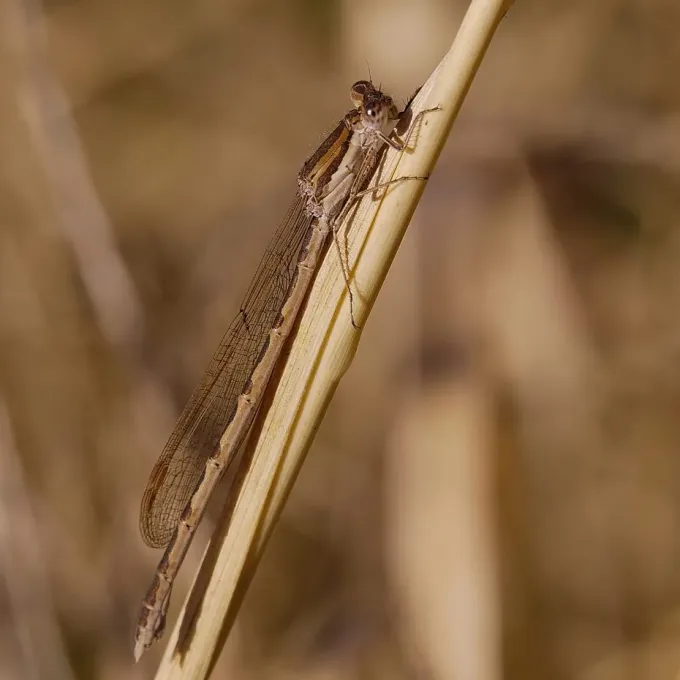
The winter damselfly (Sympecma) belongs to the order Odonata and the family Lestidae. It is a slender insect with a wingspan of approximately 40–50 mm, characterized by its brown-bronze coloration that provides excellent camouflage in dry grass and vegetation.
A unique feature of the genus Sympecma is the ability to hibernate as an adult (imago), which distinguishes it from most other damselfly species in Europe. When at rest, they hold their wings folded along the abdomen.
The larvae (naiads) inhabit stagnant or slow-moving water bodies. They feature an elongated body and a retractable mask for capturing prey, typically completing their development in about one year.
Adults are active during warmer months, favoring sunny field margins, forest edges, and the vicinity of water bodies. They are strong fliers and cover significant distances while hunting.
It is important to emphasize that this insect is not an agricultural pest. Instead, it serves as a beneficial predator that helps regulate insect populations in agroecosystems.
What it damages
The winter damselfly does not damage crops. Neither adults nor larvae feed on plant tissues; they are specialized predators that possess mandibles designed for hunting other invertebrates.
Adult damselflies prey on small flying insects, including midges, mosquitoes, and various other insects, many of which can be minor pests in agricultural settings.
The larvae thrive in aquatic environments, feeding on small crustaceans, mosquito larvae, and other aquatic invertebrates, thus posing no threat to the roots or stems of hydrophytic crops.
Agronomic observations consistently categorize the genus Sympecma as a non-pest species, contributing to the biodiversity that supports healthy crop production.
Therefore, no damage assessment is required for this species, and its presence should be encouraged as part of natural pest management strategies.
When it appears
The life cycle is marked by the hibernation of the adult form. Adults enter diapause in late summer or autumn, finding shelter in dry grasses, leaf litter, or other debris far from water.
They emerge in early spring, often as early as April, making them one of the first damselflies seen after winter. This early emergence allows them to begin mating and reproduction early in the season.
The mating and egg-laying processes take place during the spring. Females deposit their eggs into the tissues of aquatic or semi-aquatic plants within or near water.
Larval development occurs throughout the spring and summer months in the aquatic environment. Development concludes by late summer, resulting in the emergence of a new generation.
These new adults remain active until autumn before entering their winter hibernation, thus completing the annual cycle.
Signs of infestation
The presence of the winter damselfly is identified by sighting adult individuals resting on stems of vegetation with their wings folded along their bodies.
Because they do not consume plant material, there are no symptoms of leaf damage, stem lesions, or physiological decline in crops associated with this species.
A high density of these damselflies in or near a field indicates a stable ecosystem with available prey, which is often a sign of reduced broad-spectrum pesticide usage.
Unlike true pests, they do not aggregate in harmful numbers or show destructive feeding patterns, making their impact entirely neutral or beneficial to the farmer.
Identification is based on their distinct color and posture, which are visual indicators for monitoring the presence of beneficial insects in the field.
Control measures
No control measures are necessary for the winter damselfly, as it is a beneficial predator that provides ecosystem services rather than causing economic harm.
Avoiding the use of broad-spectrum insecticides is crucial to protecting this species, as chemical treatments can disrupt natural predator-prey dynamics in the field.
Maintaining strips of natural vegetation and hedgerows along field borders and water channels provides vital overwintering sites for the adults and habitat for reproduction.
Integrated Pest Management (IPM) practices should prioritize the conservation of such species to promote natural biological control of genuine insect pests.
Supporting biodiversity by minimizing environmental disturbances is the most effective approach to ensuring the continued presence of these beneficial damselflies.
Taxonomy
- Latin name
- Sympecma
- Family
- Lestidae
- EPPO code
- SYMCSP
Discussion
No discussions yet — be the first.