

Pest · Coleoptera (beetles) · affects Fodder beet, Winter wheat, Winter barley
Especially harmful
Beet flea beetle
Chaetocnema concinna
Description
How to identify
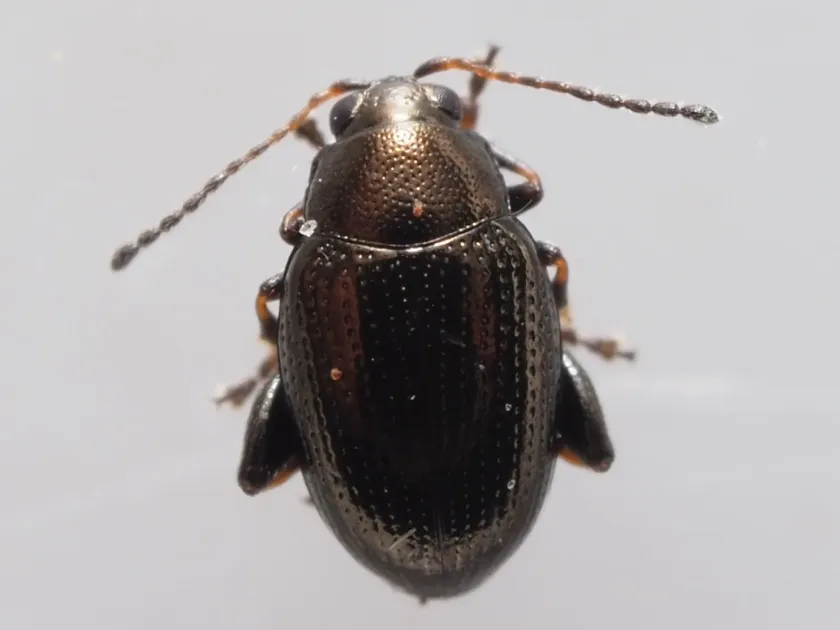
The beet flea beetle (Chaetocnema concinna) is a member of the leaf beetle family. These small insects, measuring about 2 mm, are known for their metallic bronze or green coloration.
The most distinctive morphological feature is the enlarged hind femora, which provide the beetle with significant jumping ability. Adult beetles are primarily responsible for the foliage damage, while larvae feed underground.
What it damages
This pest affects a wide range of crops. It is particularly notorious for damaging sugar and fodder beets, as well as oilseed rape, cabbage, soybeans, and sunflowers.
Additional hosts include winter barley, common hop, and the foliage of apple trees, showing the beetle's versatility in choosing various agricultural and horticultural environments.
When it appears
Beetle adults overwinter in soil debris or field margins and emerge during the first warm days of spring. Their peak activity typically coincides with the emergence of seedlings.
The damage is most severe during early spring when seedlings are in their cotyledon or early true leaf stages, as these plants have limited ability to compensate for significant foliage loss.
Signs of infestation
The primary symptom of infestation is the presence of numerous small, circular pits or holes on the leaves, which often results in a shot-hole appearance.
Extensive feeding can lead to complete destruction of the photosynthetic leaf area. In cases of high pressure, seedlings may die entirely, necessitating replanting of the crop.
Control measures
Effective management includes crop rotation and the elimination of weed reservoirs, such as plants from the Amaranthaceae family, to reduce initial populations.
For chemical control, insecticidal seed treatments are often used. If foliage damage exceeds thresholds, foliar application of pyrethroids or organophosphates is recommended to protect the crop.
In brief
14
Damages crops
Content graph
Damages crops · 14
Content graph
Connections · Beet flea beetle
Most often together:
Marketplace
Products · 108


Biology
Taxonomy
- Latin name
- Chaetocnema concinna
- Order
- Coleoptera (beetles)
- Family
- Chrysomelidae
- EPPO code
- CHAECO
Community
Discussion
No discussions yet — be the first.