
Banded pig
Sus vittatus
Description
How to identify
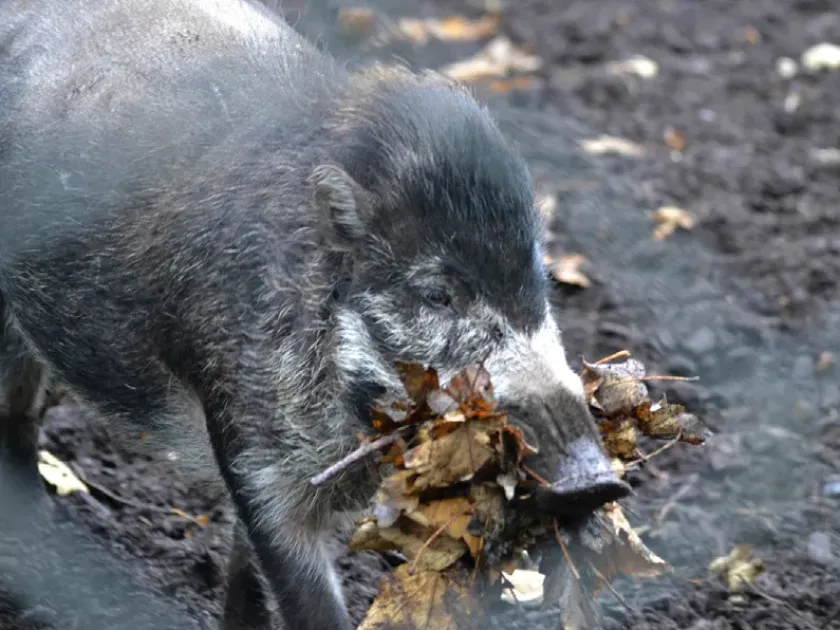
The banded pig (Sus vittatus) is a species of the artiodactyl order, belonging to the Suidae family. It is a wild relative of the domestic pig found in Southeast Asia.
The species is identified by a distinct light-colored stripe running along its snout, which distinguishes it from other wild suids in the region.
These animals possess a sturdy frame and strong tusks, adapted for foraging in various terrains, including dense forests and human-altered landscapes.
Their biology is characterized by high adaptability and opportunistic feeding habits, which enable them to exploit agricultural fields as a primary food source.
Primarily nocturnal or crepuscular, these animals avoid human contact during the day, making them difficult to spot without specialized monitoring.
What it damages
The banded pig poses a major threat to agricultural productivity, specifically targeting grain crops, oilseeds, tuber plantations, and vegetable farms.
By rooting up the soil, these pigs cause extensive damage to plant root systems and tubers, often leading to the complete loss of a seasonal crop.
Furthermore, they cause physical damage to farm infrastructure, including irrigation pipes, fencing, and pathways, which requires costly repairs.
Damage is usually most severe during the maturation phase of crops, as the abundance of nutrients makes the field an ideal feeding ground for a herd.
Their gregarious behavior means that a herd can decimate a large plantation within a single night, leaving behind severely degraded soil.
When it appears
The highest level of pest activity coincides with the crop maturation cycle, particularly when fields are laden with ripening fruits and starch-rich roots.
During dry seasons, when natural food sources in the forest diminish, banded pigs increase their incursions into agricultural zones out of necessity.
The species reproductive cycle can be fast, leading to rapid population growth when resources in the surrounding environment are abundant.
Harvesting time is a critical period when leftover debris and scattered grains continue to attract the pigs to the fields.
Activity remains high throughout the year in tropical climates, but peak damage is often noted during the primary planting and growth seasons.
Signs of infestation
The most prominent indicator of their presence is the characteristic rooting pattern, where the pigs churn up the soil with their snouts in search of roots.
Well-worn trails are often visible, leading from forest cover directly into the crop fields, indicating regular traffic routes used by the herd.
The presence of feces, discarded plant parts, and tracks in muddy areas confirms the recent presence of a herd in the vicinity of the fields.
Broken stalks, trampled rows, and uprooted vegetables are clear signs of foraging activity rather than random movement.
Damaged fencing or tunnels under barriers provide definitive evidence that the pigs have found a way to bypass protective measures.
Control measures
Physical exclusion through the use of sturdy, high-quality perimeter fencing remains the most effective long-term deterrent for these pests.
Electric fencing systems are highly recommended for large-scale operations, as they provide a non-lethal shock that keeps herds out of the field.
Audio-visual repellents, such as strobe lights or motion-activated sound devices, can be used to disrupt their nocturnal foraging habits.
Good farm management practices, such as removing dense vegetation and brush near fields, can reduce the number of hiding spots available to them.
- Regular use of trail cameras for population density monitoring.
- Creation of buffer zones between forest edges and cultivated land.
- Engagement with local wildlife authorities for management strategies.
Taxonomy
- Latin name
- Sus vittatus
- Family
- Suidae
- EPPO code
- SUXXVI
Discussion
No discussions yet — be the first.