
Javan warty pig
Sus verrucosus
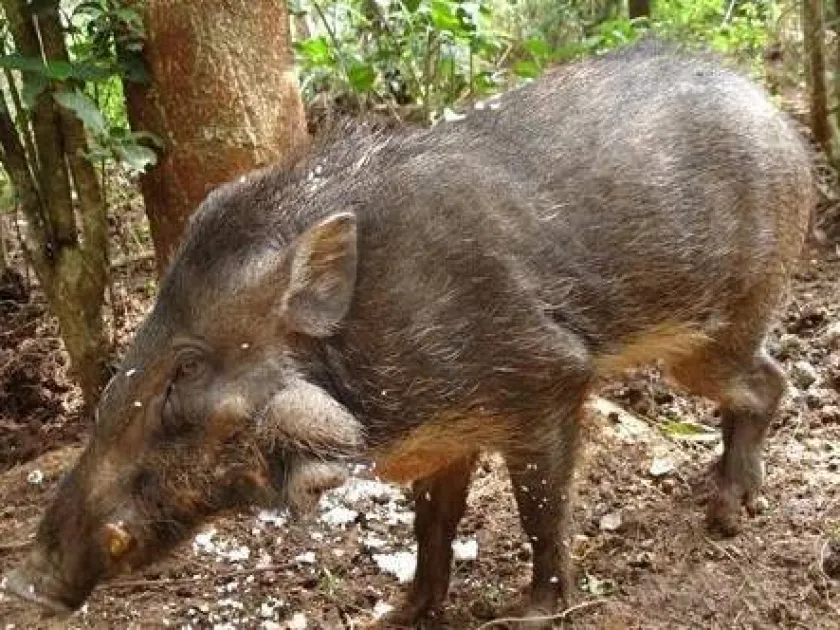
Description
How to identify
The Javan warty pig (Sus verrucosus) is a mammal belonging to the Suidae family and Artiodactyla order. Adults can weigh up to 80 kg and are distinguished by prominent warty growths on their faces, which give them their specific name.
These animals are largely nocturnal, making them difficult to spot during daylight hours. They have coarse, sparse, dark-grey to reddish-brown fur, providing excellent camouflage in the dense undergrowth of their forest habitats.
The species is endemic to Java and nearby islands. Its biological cycle involves deep integration with forest ecosystems, but the encroachment of agricultural land into these areas leads to frequent conflicts with local farmers.
Populations are generally considered threatened in the wild, which complicates control efforts. Farmers must balance the need to protect their crops with the legal protections afforded to this unique species in Indonesia.
They are highly adaptable creatures capable of surviving on various food sources, which allows them to transition easily from forest foraging to raiding commercial agricultural plantations.
What it damages
The primary damage caused by the Javan warty pig includes the consumption of maize, rice, and root crops. They are especially destructive during the stage when crops are maturing and provide high nutritional value.
Beyond feeding, these pigs dig extensively into the soil with their snouts. This behavior disrupts the soil structure, ruins irrigation furrows, and damages the root systems of long-term crops, often killing the plants entirely.
The damage is often localized but can be devastating. A single group of pigs can destroy a large segment of a plantation in one night, leaving a chaotic mess of trampled stalks and upturned earth.
Fields located near the forest edge are most susceptible. The proximity to their natural shelter allows the pigs to make quick forays into the fields and retreat to safety before dawn.
Crops heavily impacted by the species include:
- maize (young seedlings and mature cobs);
- rice (during the ripening stage);
- cassava and other tubers;
- sugarcane.
When it appears
Activity levels tend to peak during the wet season. Increased moisture in the soil makes it much easier for the pigs to dig, while the lush vegetation provides better concealment and abundant forage options.
The harvest cycle of local crops is a significant factor. When crops such as corn or rice reach maturity, the scents attract pigs from the forest, prompting increased raids on farmland.
During drier months, pigs may retreat deeper into the forest where moisture is retained, leading to a temporary decrease in crop-raiding incidents near human settlements.
Young pigs, once they become mobile, start accompanying adults on raids. This increases the total amount of forage needed by the group, leading to more frequent or larger-scale incursions.
Climate variations or deforestation in their natural habitat can force the species to depend more heavily on agricultural crops, changing their seasonal patterns of field invasion.
Signs of infestation
Evidence of their presence includes deep hoof prints and distinct furrows in the ground, showing clear signs of rooting activity. Unlike other livestock, these pigs leave behind irregular patterns of disturbed soil.
Trampled crop stalks, particularly in cornfields, are a major tell. When the pigs feed, they often push over entire plants, leaving remnants of half-eaten cobs and torn leaves scattered across the ground.
Scat and traces of coarse hair caught on wire fences or nearby brush are reliable identifiers of their presence in the area.
Nocturnal noise is a primary indicator. Farmers often hear the sound of the pigs rooting, snorting, and moving through the vegetation, which is usually the signal for them to take protective action.
Large patches of overturned earth in fields that have not been recently plowed by farmers serve as a clear sign that a group of pigs has been foraging in the area.
Control measures
Physical exclusion is the most effective control method. Sturdy, well-maintained fences—especially those partially buried in the ground—are necessary to prevent pigs from gaining access to crops.
Motion-activated sound and light deterrents can be employed, though they require regular maintenance and variation to prevent the intelligent animals from getting habituated to the stimuli.
Repellents using strong-smelling natural oils applied to the perimeter can act as an olfactory deterrent. These are particularly useful for smaller vegetable gardens or plots near the forest edge.
Maintaining clear zones or buffer strips between the forest and the fields reduces the pigs' cover, making them hesitant to enter open spaces where they are visible.
Collaborative patrols and night guarding remain common practices, especially when lethal methods are restricted by conservation laws, helping to protect livelihoods while respecting local wildlife.
Taxonomy
- Latin name
- Sus verrucosus
- Family
- Suidae
- EPPO code
- SUXXVE
Discussion
No discussions yet — be the first.