
Wild boar
Sus scrofa
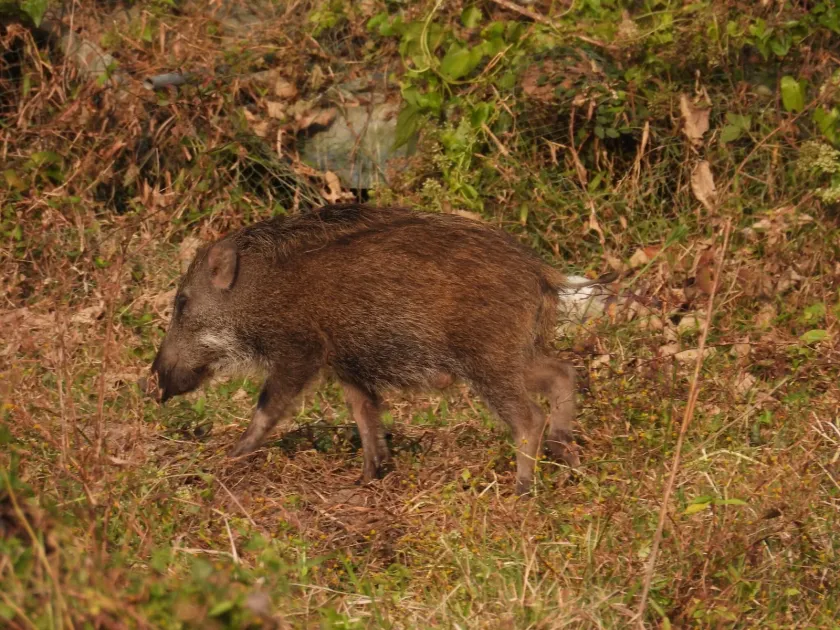
Description
How to identify
The wild boar (Sus scrofa) is a large, highly adaptable ungulate belonging to the Suidae family. These animals are characterized by a robust body, a powerful snout for rooting, and, in males, well-developed tusks.
Wild boars are typically nocturnal or crepuscular, meaning they are active primarily during the night or twilight hours, which makes them difficult to observe directly on farmlands.
They possess an exceptional sense of smell, allowing them to detect roots, tubers, and seeds buried deep in the soil, which leads to extensive ground disturbance.
These animals are highly social, living in groups called sounders. This group behavior allows them to forage collectively and cause significant destruction to crops in a very short amount of time.
Due to their high intelligence and mobility, wild boars can easily adapt to changing environmental conditions, moving between dense forests and agricultural fields to optimize their food intake.
What it damages
Wild boars are omnivorous, but they pose a severe threat to agricultural crops such as corn, wheat, barley, sunflowers, and potatoes. They consume significant quantities of these plants.
Beyond direct feeding, boars cause massive damage through trampling. Their heavy weight and tendency to move in groups compact the soil and flatten crops, making them unharvestable.
During the milk stage of grain development, boars are particularly attracted to corn, often destroying entire fields within a few nights by breaking stalks to reach the ears.
Root crops are highly susceptible, as boars completely excavate the soil to reach tubers, which effectively ruins the field and disrupts the soil structure for future seasons.
In addition to physical damage, wild boars can carry pathogens and parasites, posing a risk of disease transmission to livestock on mixed-use farms.
When it appears
Boar activity on agricultural land peaks during the maturation of crops, specifically from mid-summer through late autumn when grains and vegetables are most nutritious.
In the spring, boars often forage for seeds and roots, frequently destroying freshly planted fields and emerging seedlings of winter cereals.
Summer provides boars with both food and shelter within tall crops like corn, allowing them to remain hidden while feeding throughout the day and night.
Autumn represents a critical period as boars increase their intake of carbohydrates to build fat reserves for winter, leading to the most intense damage to harvesting fields.
During winter months, when natural food sources in the forest are scarce, boars may congregate near agricultural storage areas or search for remaining crop debris.
Signs of infestation
The most unmistakable sign of wild boar presence is the extensive rooting of soil, which resembles a freshly plowed field with overturned dirt and uprooted vegetation.
- Widespread flattening and breaking of crop stalks along the field edges and throughout the interior.
- Distinctive hoof prints that are generally larger and more rounded than those of other ungulates.
- Rubbing marks on trees, fence posts, or rocks near the field, often accompanied by coarse bristles.
- Large, tubular-shaped droppings containing undigested plant matter, grain, or seeds.
Control measures
The most reliable method for protecting crops is the installation of permanent fencing or electric fencing, which acts as a physical and psychological barrier to the animals.
Acoustic and visual deterrents, such as motion-activated lights or devices mimicking predator sounds, can be used to scare boars, though they require frequent rotation to remain effective.
Chemical repellents applied around the perimeter of the field can help reduce the attraction of the site, provided they are re-applied regularly, especially after rain.
Effective farm management involves maintaining clean borders between fields and forests, removing potential daytime resting covers for the sounders.
Collaborating with local wildlife management agencies or hunting clubs is essential for controlling the boar population density and mitigating long-term agricultural losses.
Taxonomy
- Latin name
- Sus scrofa
- Family
- Suidae
- EPPO code
- SUXXSC
Discussion
No discussions yet — be the first.