
Celebes warty pig
Sus celebensis
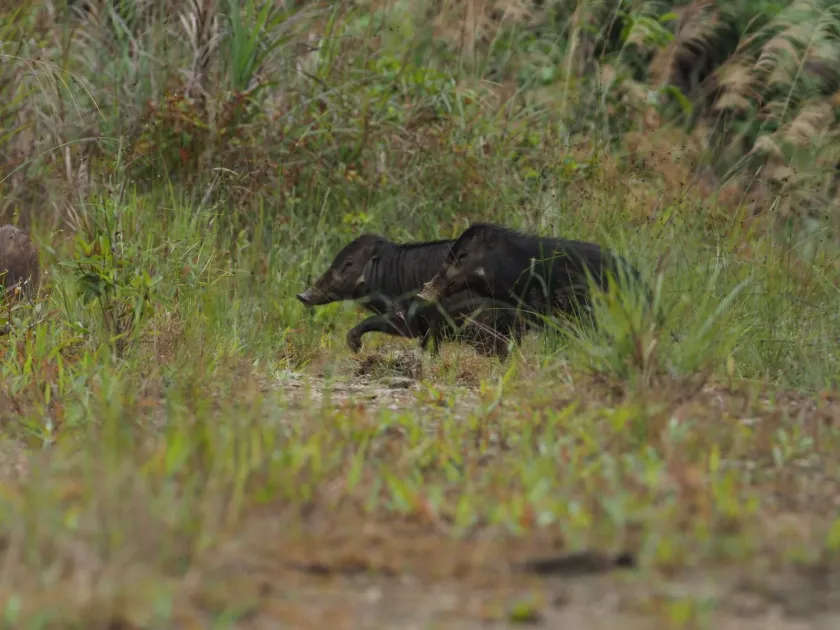
Description
How to identify
The Celebes warty pig (Sus celebensis) is a species within the Suidae family that acts as a significant agricultural pest in Indonesia. As a large ungulate, it poses a direct threat to various agricultural systems through its feeding behavior and movement patterns.
Physically, the adult pig is characterized by a dark coat and coarse bristles. Males are particularly identifiable by their prominent tusks and the facial warts that give the species its name, which distinguishes them from other local wildlife.
These animals are predominantly nocturnal, making them difficult to observe during daylight hours. Their ability to thrive in both dense forests and agricultural frontiers allows them to exploit human-cultivated crops with high efficiency.
Reproductive biology is a key factor in their status as a pest, as they can breed throughout the year. This constant recruitment makes population management challenging, as the animals can quickly recolonize areas after removal efforts.
As a large herbivore, the species causes damage not just through consumption, but through extensive soil disturbance and habitat alteration, which significantly impacts the productivity of agricultural plots.
What it damages
The primary crops affected by the Celebes warty pig include maize, root vegetables, and various cereal grains. The pigs are highly opportunistic and can consume large portions of a harvest in a single night.
Mechanical damage is widespread, as the pigs trample crops while navigating through fields. This leads to reduced stand density and negatively affects the overall yield potential of the agricultural site.
Soil disturbance is a major issue, as pigs dig up the ground to access roots, tubers, and invertebrates. This activity destroys the root systems of standing crops, leading to plant wilting and secondary pathogen infection.
Agricultural infrastructure is also vulnerable, with fences, irrigation hoses, and temporary shelters often being destroyed by herds. This adds significant maintenance costs for farmers trying to protect their livelihoods.
The movement of herds facilitates the spread of weed seeds across the landscape, complicating subsequent weed management and increasing the reliance on herbicides in affected fields.
Signs of infestation
The most prominent sign of a Celebes warty pig infestation is the deep plowing pattern observed in the soil. These pigs use their snouts to root through the earth, leaving behind large, characteristic craters.
Distinctive hoof prints are often visible near the field edges and along trails leading into the forest. These prints are larger than those of most other local fauna, providing a clear indication of the intruder.
Damaged crops display clear evidence of feeding and trampling. For example, maize stalks are often pushed over or completely uprooted, and ears are consumed or scattered, which is a signature behavior of these animals.
Friction marks on fences, mud on trees, and hair caught on perimeter barriers indicate a high-traffic area. These signs allow farmers to determine the routes the pigs use to enter their land.
Auditory evidence, such as grunting and squealing during the night, combined with a noticeable musky scent around the perimeter, serves as a reliable indicator of active pig presence.
Control measures
The most effective physical protection method involves the installation of robust, buried fencing. Ensuring the fence extends below the soil surface prevents the pigs from burrowing underneath.
Electric fencing, commonly known as electric netting, is a highly recommended solution for protecting large field areas. The shock teaches the pigs to avoid the perimeter, providing a long-term deterrent.
Acoustic and visual repellents, such as motion-activated lights or sound emitters, can be used as a supplementary measure. However, these are most successful when moved or changed frequently to prevent the animals from habituating to them.
Agronomic management involves keeping fields clear of attractive harvest leftovers, as these serve as a magnet for hungry herds. Rapid harvesting upon crop maturity is essential to minimize the window of opportunity for the pigs.
- Regular patrolling of field perimeters.
- Collaborative community efforts to monitor populations.
- Integration of multiple repellent technologies.
Taxonomy
- Latin name
- Sus celebensis
- Family
- Suidae
- EPPO code
- SUXXCE
Discussion
No discussions yet — be the first.