
Indian boar
Sus cristatus
Description
How to identify
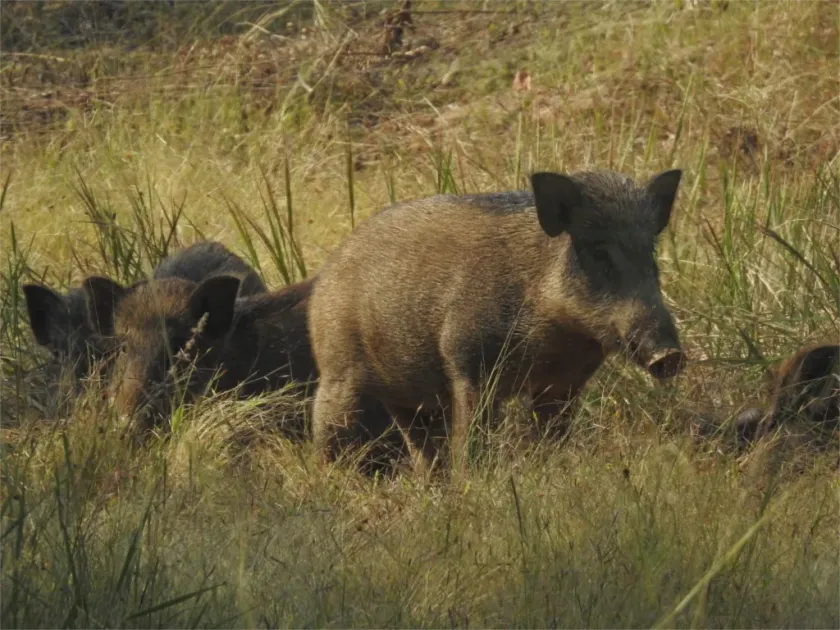
The Indian boar (Sus cristatus) is a subspecies of the wild boar characterized by a taller, leaner body structure and a prominent mane of coarse black hair along its spine.
Adult boars have a robust musculoskeletal system, allowing them to exert significant force with their snouts when foraging through hard-packed agricultural soil.
These animals are largely crepuscular or nocturnal, operating in social groups that can range from small family units to larger aggregations of mature individuals.
Known for their acute sense of smell and hearing, they are highly elusive, often remaining hidden in surrounding dense vegetation during daylight hours.
Belonging to the family Suidae, they are highly adaptable foragers, which makes them a constant threat to rural agriculture and food security.
What it damages
The most severe damage occurs through rooting, where the boars excavate the soil to reach tubers, seeds, and root systems, effectively destroying entire rows of crops.
They are notorious for decimating rice paddies, maize fields, wheat, and sugarcane plantations, often preferring crops at the milky or dough stage of grain development.
In addition to direct consumption, they cause massive trampling damage, as herd movement creates wide paths of destroyed crops that render machinery harvest impossible.
Their presence often leads to the destruction of essential farm infrastructure, including irrigation pipes, drainage ditches, and perimeter fencing.
Large-scale rooting disrupts the soil structure, leading to increased erosion and preventing the natural growth of replanted vegetation in the damaged areas.
When it appears
Indian boars are particularly active during the ripening season of cereals and tuber crops, as these provide high-calorie sustenance required for herd health.
While they can breed year-round, increased activity is often observed during monsoon transitions when foraging conditions in the wild change significantly.
During the dry season, the pressure on agricultural fields increases as boars gravitate toward irrigated farmlands to meet their daily water and food requirements.
Nocturnal activity peaks during periods of stable weather, whereas extreme rain may cause them to seek deeper shelter within adjacent forest boundaries.
Seasonal migration patterns are dictated by the maturation cycle of local crops, drawing boars away from natural habitats and directly into productive farm landscapes.
Signs of infestation
Extensive areas of upturned soil resembling a poorly tilled field are the most obvious signs of an Indian boar infestation in an agricultural setting.
Deep hoof prints with distinct dewclaw marks are typically found along the edges of the damaged fields or near entry points in perimeter barriers.
Rubbing marks and coarse hair deposits on trees, fence posts, or irrigation equipment provide clear evidence of a boar's presence in the immediate vicinity.
The presence of scat and a distinct, musky odor are reliable indicators that a group of boars has been active in the area during the previous night.
- Tilled and uneven soil surface across the field.
- Broken stalks and uprooted young plants.
- Well-worn trails connecting forest cover to the crops.
- Physical damage to perimeter fencing and gates.
Control measures
Electric fencing, specifically designed for large wildlife, remains the most effective deterrent for preventing boars from entering agricultural plots.
Automated motion-sensor devices that combine bright strobe lights and loud audio alarms can provide effective temporary deterrence for encroaching groups.
Physical barriers such as chain-link fencing must be reinforced at the base and buried at least 40 cm deep to prevent the animals from burrowing underneath.
Integrated pest management strategies should include clearing brush and thickets around the field edges to reduce available cover for the approaching animals.
Continuous monitoring and rapid repair of any breached perimeter sections are essential to ensure the long-term protection of sensitive cash crops.
Taxonomy
- Latin name
- Sus cristatus
- Family
- Suidae
- EPPO code
- SUXXCR
Discussion
No discussions yet — be the first.