
Wild boar
Sus
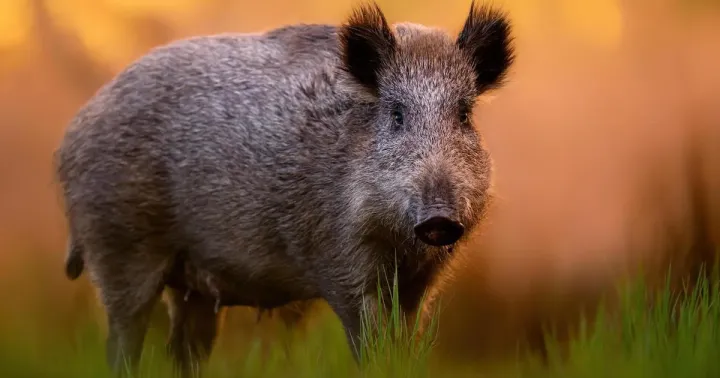
Description
How to identify
The wild boar (Sus scrofa) is a large mammal belonging to the Suidae family within the Artiodactyla order. These animals are robust, with a wedge-shaped head and sharp tusks.
Their coat color ranges from dark brown to black, which serves as camouflage in the dense vegetation where they seek refuge during the daylight hours.
Wild boars possess a highly developed sense of smell and hearing, making them extremely cautious animals that often avoid human contact while exploiting agricultural resources.
They are highly social creatures that live in groups, which increases the scale of damage they can inflict on agricultural fields within a single night.
Due to their high adaptability, wild boars thrive in various habitats, including forests adjacent to farmlands, where they find ideal conditions for breeding and feeding.
What it damages
Wild boars are notorious for causing massive damage to cereal crops, especially maize, wheat, and barley. They trample crops and consume them in large quantities.
Damage to maize fields is particularly severe during the milky stage of the ears. Boars destroy stems and ears, often leaving the field unsuitable for mechanical harvesting.
Root crops like potatoes and sugar beets are frequently uprooted. Boars dig deep holes in the soil, which compromises the structure and fertility of the land.
In vineyards and orchards, boars can cause significant harm by stripping tree bark and damaging the root systems of young plants, which can lead to tree death.
Beyond direct consumption, the overall destruction of the field surface by digging and trampling leads to significant yield losses and increased production costs.
When it appears
The activity of wild boars in agricultural fields is most intense during the summer and autumn, which correlates with the ripening period of the main crops.
As crops begin to mature, boars shift their feeding patterns toward agricultural fields to consume high-calorie grain and produce before winter starts.
Spring can also be a season of concern when boars search for fresh sprouts and underground roots, often causing damage to early-stage winter crop vegetation.
During the winter, if natural food sources become scarce, boars may approach farm storage facilities, potentially raiding silos or stockpiles of hay and silage.
Weather conditions significantly impact their behavior; dry summers force boars to move into irrigated fields in search of both food and moisture.
Signs of infestation
The most obvious signs of wild boar presence are the deeply tilled areas of soil, where the ground looks as if it has been recently plowed by the animals.
Well-trodden paths (game trails) leading from the forest into the fields are common markers. These paths are usually wide and contain numerous hoof prints.
Damaged crop edges, broken stems, and partially consumed ears of corn scattered across the field are clear indicators of a recent foraging activity.
Evidence of wallowing areas—muddy pits near water sources or field margins—often shows tracks, hair, and specific smells associated with the wild boar group.
Occasional sightings or hearing their distinct vocalizations—grunts and squeals—near field boundaries at night are common indicators of their presence.
Control measures
Electric fencing is considered the most effective deterrent. High-voltage pulses provide a non-lethal shock that keeps boars away from protected crop areas.
Acoustic and visual repellents, such as motion-activated lights or sound cannons, can be used to disrupt their feeding routine and scare them away from the fields.
The application of chemical or biological repellents around the perimeter can mask the scent of crops and create an unpleasant environment for the animals.
Good agricultural practices, such as maintaining clear buffer zones around fields, can minimize the attractiveness of the area to wandering wild boar populations.
- Installing robust electric fences around fields.
- Using motion-activated LED lights or alarms.
- Clearing debris and tall grass from field edges.
- Coordinating with local wildlife control agencies.
Taxonomy
- Latin name
- Sus
- Family
- Suidae
- EPPO code
- SUXXSP
Discussion
No discussions yet — be the first.