
Stygia australis
Stygia australis
Description
How to identify
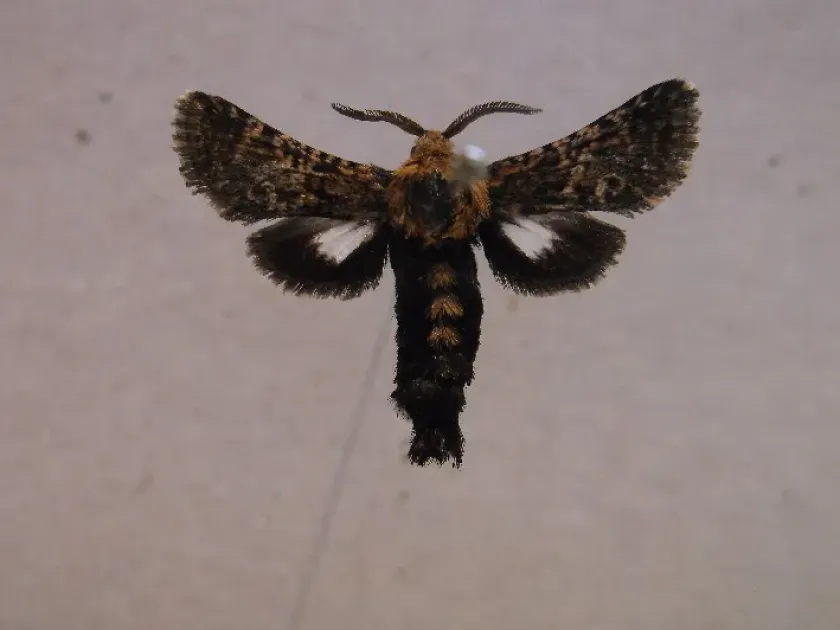
Stygia australis belongs to the order Lepidoptera, family Cossidae. It is a small moth that exhibits secretive behavior during its adult stage.
The adult specimen has a specific appearance typical of the goat moth family, with a fairly dense body and grayish-brown wings, allowing it to camouflage itself against plant debris.
The larvae of this species are characterized by powerful mouthparts adapted for feeding inside dense plant tissues, making them inaccessible to many contact insecticides.
The insect undergoes complete metamorphosis, including egg, larva (caterpillar), pupa, and adult stages, with the larval stage being the most destructive to agricultural crops.
This pest prefers arid zones, where its life cycle is best adapted to the climatic conditions of regions with hot and dry summers.
What it damages
The primary food source for the larvae are cereal crops, particularly wheat, as well as some types of wild grasses that serve as reservoirs for the species.
The larvae are capable of damaging the underground parts of plants and the root zone of the stem, which disrupts normal metabolism and nutrient intake of the crop.
Damage to the root system causes stunted growth in plants, premature wilting, and a reduction in the overall yield of the fields.
In cases of severe infestation, massive mortality of young seedlings is observed, which significantly thins the stand density of the crop in the field.
The economic damage lies not only in the direct loss of biomass but also in the degradation of grain quality harvested from the affected plots.
When it appears
The flight of the moths usually occurs during the spring and summer periods when stable, warm weather conditions facilitate reproduction.
Egg-laying happens near host plants, after which the newly hatched larvae quickly penetrate the soil towards the root collar or enter the stem directly.
The pest overwinters in the larval stage either in the soil or inside the damaged plant, where they maintain viability even at low temperatures.
The activation of larval feeding in the spring coincides with the beginning of active growth in cereal crops, making plants most vulnerable during the tillering phase.
Pupation occurs in the soil or within tunnels made inside plant residues, usually towards the end of the spring season.
Signs of infestation
The first sign of the pest's presence is the appearance of wilting patches in crops, which may externally resemble moisture deficiency or fungal diseases.
Upon inspecting the root system of affected plants, one can discover characteristic tunnels or cavities gnawed by larvae in the lower part of the stem.
Near the damaged plants, larval excrement and fragments of gnawed tissue are often observed, which is clear evidence of the pest's active life cycle.
In fields with a high density of the pest, uneven crop development, the appearance of bald spots, and noticeable yellowing of leaves in affected areas can be seen.
A thorough examination of the soil around the roots allows for the detection of larvae of different ages, which are found in immediate proximity to their food source.
Control measures
The basis of control is adherence to proper crop rotation, which prevents continuous cultivation of cereal crops in the same field.
An important agrotechnical practice is deep autumn plowing, which helps destroy overwintering larvae and pupae by bringing them to the soil surface.
It is recommended to conduct timely weed control, as weeds often serve as intermediate hosts for the development of the pest population.
The use of chemical plant protection products is justified during periods of mass larval hatching, when they are most vulnerable to contact-stomach insecticides.
- Use of certified seed treatments.
- Monitoring the pest using pheromone traps.
- Timely fertilization of crops to enhance their regenerative capacity.
Taxonomy
- Latin name
- Stygia australis
- Order
- Lepidoptera (butterflies)
- Family
- Cossidae
- EPPO code
- STGIAU
Discussion
No discussions yet — be the first.