
Stethorus
Stethorus punctillum
Description
How to identify
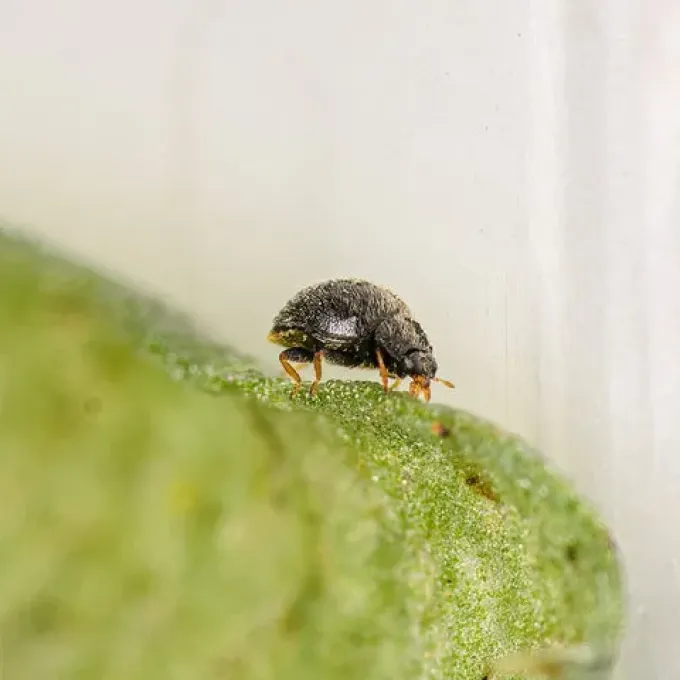
Stethorus punctillum is a tiny beetle belonging to the Coccinellidae family, commonly known as a specialist predator of spider mites.
The adult beetle is very small, typically ranging from 1.3 to 1.5 mm in length, and is characterized by a shiny, black body that is easily overlooked by the naked eye.
Larvae are dark in color and possess numerous small hairs on their backs, which provides them with a distinct appearance as they actively roam across leaves.
These predators are highly mobile and possess strong flight capabilities, allowing them to effectively locate and colonize spider mite hotspots in diverse habitats.
The female beetle deposits tiny eggs within or near the colonies of mites, ensuring that the hatched larvae have immediate access to their preferred food source.
What it damages
It is crucial to clarify that Stethorus punctillum is a beneficial insect, not a plant pest. It plays a vital role in natural pest control systems.
Both the larvae and adults feed voraciously on all life stages of spider mites (Tetranychidae), including eggs, nymphs, and adults, providing significant suppression of pest populations.
A single beetle can consume dozens of spider mites daily, making it one of the most efficient natural enemies available for controlling mite infestations in crops.
Due to its high consumption rate, this predator is highly sought after for use in greenhouse and field vegetable production to maintain biological balance.
Presence of Stethorus punctillum on a plant is a sign of a healthy ecosystem and acts as a natural biological filter against spider mite damage.
When it appears
Adults emerge from hibernation in the spring when temperatures begin to rise, seeking out early mite infestations to establish their first generation.
The life cycle is temperature-dependent and can be completed in as little as two to three weeks during the warm summer months, allowing for rapid population growth.
The peak activity of Stethorus punctillum usually aligns with the peak of spider mite outbreaks, typically occurring during hot and dry weather conditions.
As the season progresses, multiple generations are produced, ensuring that the predator remains active throughout the main period of crop growth.
At the end of the season, the beetles seek shelter in leaf litter or tree bark to survive the winter, waiting for the return of favorable temperatures.
Control measures
Protecting Stethorus punctillum involves reducing or eliminating the use of broad-spectrum pesticides that could harm this beneficial predator.
Integrated Pest Management (IPM) strategies should prioritize selective products that target pests while sparing the ladybird beetles.
In greenhouses, horticulturalists may augment local populations by releasing lab-reared beetles if spider mite numbers begin to exceed the economic threshold.
Creating landscape diversity near crops provides necessary refuge and overwintering sites for the beetles, which enhances their survival rate.
- Avoid preventative chemical sprays.
- Use selective acaricides when chemical intervention is necessary.
- Monitor mite levels and wait for the predator to arrive naturally before intervening.
Taxonomy
- Latin name
- Stethorus punctillum
- Order
- Coleoptera (beetles)
- Family
- Coccinellidae
- EPPO code
- SCYMPU
Discussion
No discussions yet — be the first.