
Stethorus japonica
Stethorus japonica
Description
How to identify
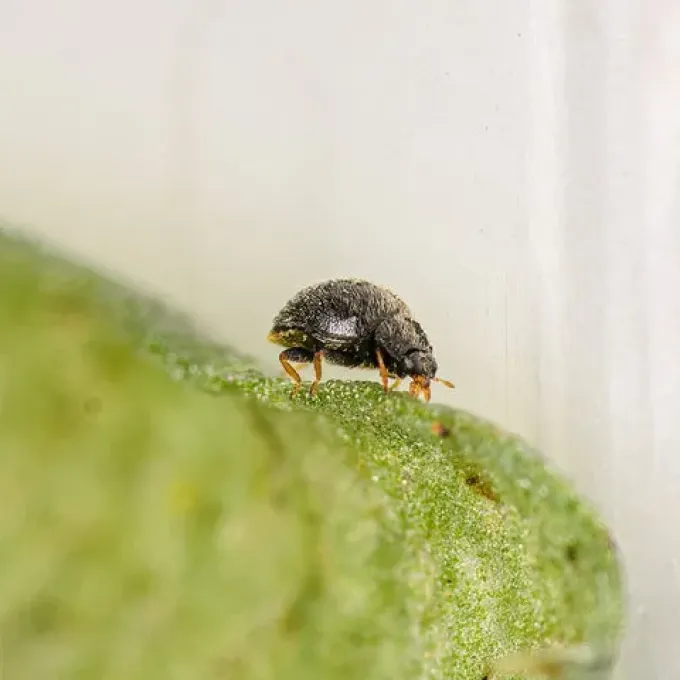
Stethorus japonica is a specialized predatory beetle belonging to the Coccinellidae family. These beetles are tiny, typically measuring about 1.5 mm in length, which often makes them difficult to spot without close inspection of infested leaves.
The adults have a shiny, black body, sometimes with a slight brownish tint. Their bodies are covered with sparse, fine hairs that give them a slightly matte appearance under specific lighting conditions.
The larvae are greyish or dark brown and are covered in numerous bristles, giving them a slightly spiked appearance. This camouflage allows them to blend in effectively with spider mite colonies.
Their life cycle includes egg, four larval instars, pupa, and adult stages. The pupae are typically found on the undersides of leaves, often near the very mite colonies the beetle will eventually feed upon.
As an obligate acariphage, this species has evolved specifically to hunt mites. Unlike many generalist predators, its entire lifecycle is tightly synchronized with the availability of spider mite populations.
What it damages
It is crucial to clarify that Stethorus japonica is not a plant pest; rather, it is a highly beneficial predator. It acts as an essential biological control agent against various species of spider mites (Tetranychidae).
By consuming large numbers of mites, these beetles help prevent severe damage to crops, such as leaf yellowing, desiccation, and premature drop, which significantly impact plant health and total yield.
Both adults and larvae are voracious predators. A single individual can consume dozens of spider mites daily, making them incredibly efficient at suppressing localized outbreaks before they become unmanageable.
In greenhouses and orchards, their presence is often the difference between a minor mite infestation and a catastrophic crop loss. They are highly valued in sustainable and organic farming systems.
Their efficiency is boosted by their searching behavior, as they are capable of detecting and migrating to new mite colonies as soon as they emerge, providing proactive protection for the host plants.
When it appears
The activity of Stethorus japonica begins in the spring, triggered by rising temperatures and the awakening of spider mite populations from their overwintering sites.
They are most active during the peak of summer. During this time, the warmer conditions lead to faster reproduction rates for the beetles, which helps them keep pace with the rapidly multiplying spider mite populations.
Since the development time from egg to adult is relatively short, multiple generations of Stethorus japonica can occur within a single growing season, providing continuous pressure on pest populations.
As temperatures drop and day length decreases in the autumn, the beetles seek sheltered locations for hibernation, typically in bark crevices or thick ground litter, where they remain until the following spring.
Weather factors like heavy rainfall or extreme temperature fluctuations can temporarily disrupt their activity, slowing down their predatory rate and overall population growth throughout the season.
Control measures
To support populations of Stethorus japonica, it is essential to avoid the use of broad-spectrum insecticides. Such chemicals are lethal to these beneficial beetles and can trigger secondary outbreaks of mites.
Implementing an Integrated Pest Management (IPM) program is the best way to utilize this predator. Priority should be given to selective pesticides that do not harm coccinellids and other beneficial arthropods.
Providing refuges in the form of natural vegetation or unmanaged areas near crop fields can significantly aid in maintaining a resident population of these beetles, ensuring they are present when mites first appear.
In intensive production systems, if mite populations exceed economic thresholds, growers can release commercially reared Stethorus japonica to rapidly reduce the pest density without relying on chemical intervention.
- Monitor mite populations regularly.
- Avoid prophylactic spraying of broad-spectrum insecticides.
- Promote biodiversity around crop areas.
- Use selective, predator-safe pesticides only when necessary.
Taxonomy
- Latin name
- Stethorus japonica
- Order
- Coleoptera (beetles)
- Family
- Coccinellidae
- EPPO code
- STHRJA
Discussion
No discussions yet — be the first.