
Stenonema interpunctatum
Stenonema interpunctatum
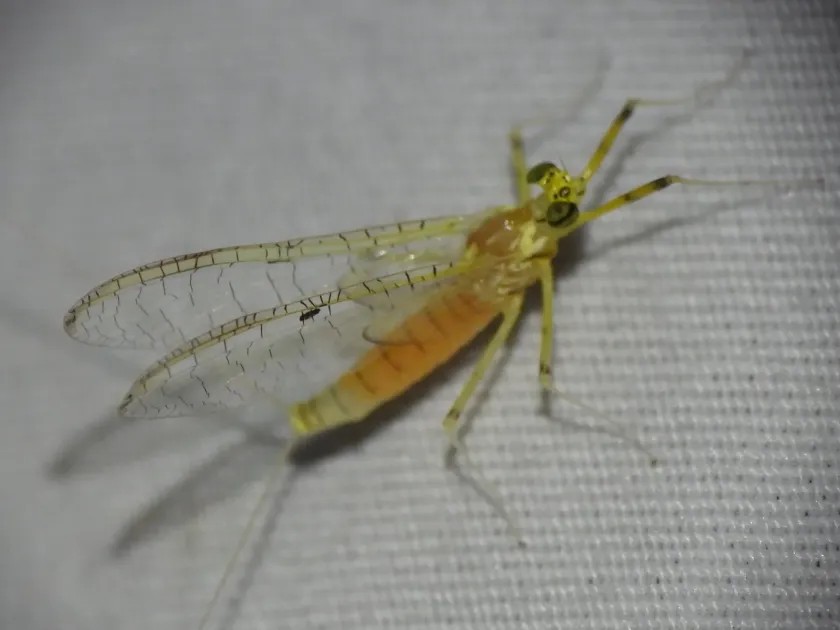
Description
How to identify
Stenonema interpunctatum belongs to the order Ephemeroptera (mayflies) and the family Heptageniidae. This insect undergoes incomplete metamorphosis, with its nymphal stages primarily developing in freshwater bodies.
Adult mayflies are characterized by two pairs of transparent wings, with the forewings being significantly larger than the hindwings. A distinct feature is the presence of long, thread-like caudal filaments (cerci) extending far beyond the body length.
The body color of the imago ranges from pale yellow to light brown. The adult body is delicate and slender, with clearly visible abdominal segments often displaying distinctive dark markings.
Nymphs have flattened bodies adapted for clinging to rocks and vegetation in flowing water. They possess powerful mouthparts and well-developed gill plates located along the sides of the abdomen.
It is important to note that while this species often serves as an indicator of water purity, it can become a nuisance in agricultural settings when untreated surface water is used for irrigation.
What it damages
Direct damage to agricultural crops by Stenonema interpunctatum is minimal, as adult insects are short-lived and feed very little. The primary concern is the presence of nymphs in irrigation and hydroponic systems.
Mass infestations can lead to the clogging of drip irrigation nozzles and filtration components, causing water flow restrictions that negatively affect vegetable and technical crop production.
Mechanical damage to young seedlings may occur if plants are grown hydroponically using unfiltered surface water where high populations of nymphs are present.
Indirect damage occurs when nymphs or their exuviae act as vectors or carriers of pathogens, which can contaminate the irrigation supply from polluted natural water sources.
Damage to the root system in greenhouses becomes a critical issue if the filtration system is insufficient to prevent the entry of these organisms into the nutrient solution.
When it appears
The peak activity of adult Stenonema interpunctatum occurs in late spring and throughout the summer months. Mass emergence usually happens synchronously, typically during evening hours.
Nymphs develop over an extended period, often covering most of the year, with a peak in metamorphosis occurring during warmer seasons when water temperatures are optimal for growth.
In agronomic practice, monitoring for the presence of these insects is crucial during the main growing season, when irrigation requirements are at their highest.
During the autumn, nymphal metabolism slows down, yet they remain viable in the bottom sediments of irrigation canals and storage reservoirs.
Development rates are highly dependent on the water thermal regime; therefore, in drier years, emergence peaks may shift to earlier calendar dates.
Signs of infestation
The most common sign of infestation is the discovery of nymphal exuviae (cast-off skins) on system filters and inside nutrient solution tanks.
A noticeable decrease in pressure within drip irrigation lines often serves as an indicator of mechanical clogging caused by nymphs or their debris.
The presence of large numbers of adult mayflies near greenhouses during twilight hours is a strong signal that nearby water sources support high nymph populations.
Specific marks or lesions on delicate plant tissues in hydroponic setups can sometimes indirectly indicate the presence of nymphs in the delivery lines.
Visual inspection of primary water filters typically reveals the presence of flattened, grayish-brown nymphs trapped within the mesh screens.
Control measures
To prevent nymphs from entering irrigation systems, fine-mesh filters should be installed at all water intake points from surface water sources.
An effective control strategy involves the chlorination or ozonation of irrigation water in storage reservoirs to eliminate nymphal stages before water reaches the fields.
Agronomic management includes regular cleaning of irrigation canals to remove algae and bottom silt, which provide essential habitats for nymphal development.
- Utilization of ultraviolet water sterilization systems.
- Routine mechanical cleaning of all filtration elements.
- Encouraging natural predators within reservoir environments.
The use of chemical insecticides in open water bodies is strictly regulated by environmental laws, therefore, priority is given to physical and mechanical protection methods.
Taxonomy
- Latin name
- Stenonema interpunctatum
- Family
- Heptageniidae
- EPPO code
- STNNIN
Discussion
No discussions yet — be the first.