
Heptagenia hebe
Heptagenia hebe
Description
How to identify
Heptagenia hebe belongs to the order Ephemeroptera, family Heptageniidae. This insect undergoes hemimetabolous development, with larvae living exclusively in aquatic environments.
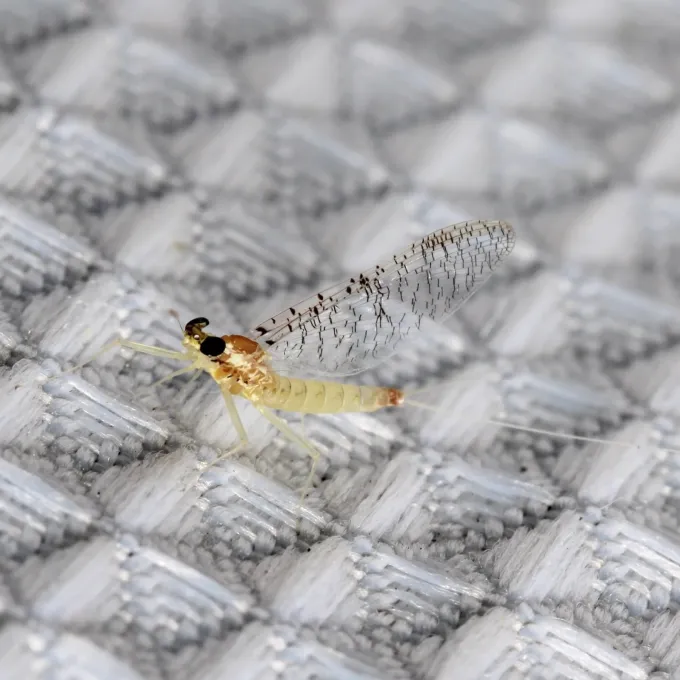
Adult specimens possess two pairs of transparent wings, with the forewings significantly larger than the hindwings. A distinct feature of this species is its long caudal filaments, which are usually longer than the insect's body.
The larvae exhibit a flattened body shape, which enables them to hold onto rocks and other substrates even in fast-flowing water. The head and thorax are widened, and the legs are well-adapted for clinging to surfaces.
Their coloration ranges from light yellow to dark brown, providing excellent camouflage against bottom sediments and aquatic vegetation, making them hard to detect.
This species serves as a biological indicator of water quality, preferring areas with high oxygen levels and clean water, avoiding heavily polluted environments.
What it damages
Heptagenia hebe is not a primary agricultural pest as it does not feed on crops. Its significance is primarily associated with the maintenance of irrigation and water supply systems.
In irrigation channels, larvae may accumulate in concrete conduits or pipes. These clusters can obstruct the flow of water and decrease the overall efficiency of irrigation infrastructure.
The biological activity of these insects within large irrigation networks can lead to the accumulation of organic waste, potentially affecting the chemistry of the irrigation water.
While they do not damage plants, their mass proliferation can necessitate manual or mechanical cleaning to prevent the clogging of filters and pumping equipment.
Therefore, the damage caused by this species is technical and operational, impacting the infrastructure used in agricultural water management.
When it appears
The life cycle of this species in temperate climates generally spans about a year, depending heavily on the temperature of the water body and the availability of algae for feeding.
The peak of adult emergence typically occurs in late spring and early summer, when mating flights take place near the water's surface.
Larvae develop actively throughout the warm season, reaching their maximum population densities in mid-summer when optimal temperatures support rapid growth.
Winter is spent in the larval stage directly within the water body, where they remain active at low temperatures, dwelling among stable bottom substrates.
Due to the short lifespan of the adult stage, their presence is often overlooked by agronomists until mass emergence occurs, which is when technical issues are usually identified.
Signs of infestation
The presence of this species can be determined by visually inspecting stones along the shoreline or the walls of irrigation channels for the flattened, clinging larvae.
Adults often gather near light sources in the evenings during the mating season, which serves as a clear indication of a significant nearby population.
A reliable sign of their presence is the discovery of discarded exuviae (larval skins) on stones or vegetation near the water line, left behind after the transition to the adult stage.
If pumping equipment suffers from unexplained mechanical clogging, an inspection of the hydrotechnical system for larval colonization is highly recommended.
Specialized hydrobiological sampling of water samples allows for precise identification of the species based on the morphological characteristics of the larvae.
Control measures
Effective control measures in an agricultural setting focus on the routine maintenance of irrigation channels and the cleaning of hydrotechnical facilities.
To prevent excessive colonization, it is recommended to regulate water flow velocities, as stagnant or slow-moving water is more attractive to the larvae of this species.
The use of insecticides in irrigation networks is strongly discouraged, as it can compromise the quality of the irrigation water and harm the broader agro-ecosystem.
- Regular removal of silt and sediments from main irrigation canals.
- Installation of fine-mesh filters at the intakes of pumping stations.
- Maintenance of water quality to prevent excessive algal growth that attracts larvae.
Biological control can be enhanced by supporting local fish populations, which are natural predators of mayfly larvae and can significantly keep their numbers in check.
Taxonomy
- Latin name
- Heptagenia hebe
- Family
- Heptageniidae
- EPPO code
- HEPTHE
Discussion
No discussions yet — be the first.