
Stenolophus rotundatus
Stenolophus rotundatus
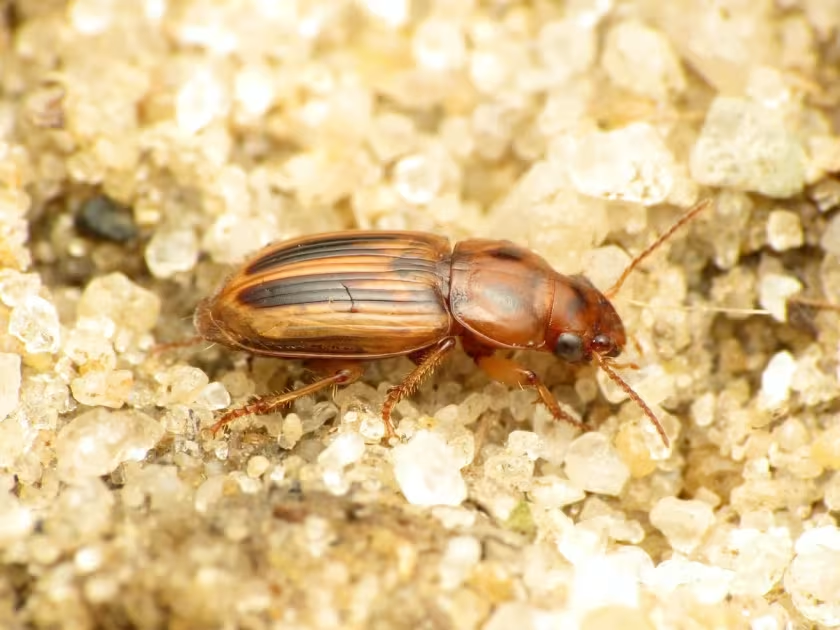
Description
How to identify
Stenolophus rotundatus belongs to the ground beetle family (Carabidae) within the order Coleoptera. It is a small beetle characterized by its distinct oval-rounded body shape.
The coloration of the beetle typically ranges from dark brown to black, often featuring a metallic luster on the elytra. The head and pronotum may appear slightly lighter in color, aiding in field identification.
Adults possess well-developed wings, enabling them to migrate actively over long distances in search of suitable environments for feeding and reproduction.
The life cycle involves complete metamorphosis, including egg, larva, pupa, and adult stages. They typically overwinter as adults in the topsoil or under crop residues.
The biology of this species is closely associated with moist field areas, with higher concentrations often found in low-lying spots or near irrigation channels.
What it damages
Primary crops susceptible to damage by Stenolophus rotundatus include cereal grains (wheat, barley, rye) and maize during the early growth stages.
While many ground beetles are predatory, Stenolophus rotundatus can exhibit phytophagous behavior, feeding on sown seeds and young seedlings directly in the soil.
The greatest damage occurs during years with high soil moisture, when beetles congregate in winter crop fields immediately after sowing.
Seed damage leads to uneven seedling emergence, which negatively impacts crop density and overall yield potential.
Beyond direct damage, the presence of large populations in fields warrants agronomic monitoring as they may migrate from weed populations to crop plants.
When it appears
The emergence of Stenolophus rotundatus adults in fields is typically recorded in early spring when soil temperatures reach levels favorable for their activity.
Peak beetle activity is observed during the germination period of cereal crops, when young shoots provide an accessible food source.
Activity levels may decrease during the summer but can recover under favorable moisture conditions if weed cover provides sufficient shelter.
In autumn, adults prepare for overwintering, migrating into deeper soil layers or seeking refuge under surface debris.
Population monitoring should be conducted during sowing and germination phases, which is critical for assessing the risk of crop damage.
Signs of infestation
The main indicator of infestation is the appearance of thin or missing stands where seedlings failed to emerge due to seed destruction or stem damage.
Excavation within damaged areas often reveals the presence of beetles, confirming their involvement in the soil profile.
Young shoots may exhibit characteristic mechanical damage, such as eaten tissues at the base of the stem or around the seed kernel.
The presence of dense weed growth along field margins serves as a reservoir for beetles, which is a secondary indicator of potential infestation risks.
Visual inspection using soil traps allows agronomists to diagnose the threat early and implement necessary mitigation strategies.
Control measures
Effective soil preparation before sowing is the primary method of control, as it disrupts overwintering sites and reduces the pest population.
Crop rotation plays a significant role in preventing the build-up of Stenolophus populations in fields continuously sown with cereals.
Using insecticidal seed treatments is highly effective in protecting germinating seeds and young seedlings from beetle feeding during early stages.
Maintaining clean fields by removing weeds and crop residues reduces the attractiveness of the land for beetle colonization during autumn and spring.
- Adhering to optimal sowing dates to ensure rapid emergence.
- Applying authorized insecticides when economic thresholds are reached.
- Conducting regular field monitoring using soil traps.
- Utilizing autumn tillage to create unfavorable overwintering conditions.
Taxonomy
- Latin name
- Stenolophus rotundatus
- Order
- Coleoptera (beetles)
- Family
- Carabidae
- EPPO code
- STNLRO
Discussion
No discussions yet — be the first.