
Strawberry sap beetle
Stelidota geminata
Description
How to identify
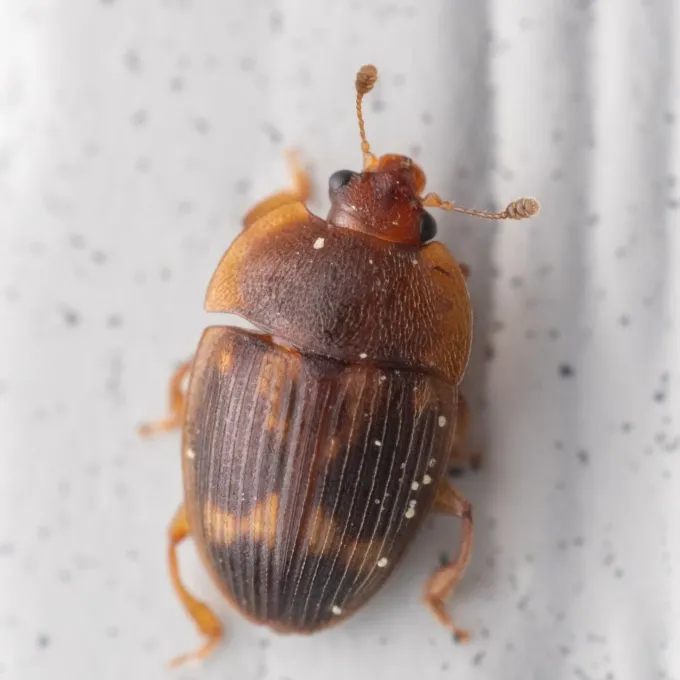
The strawberry sap beetle, known scientifically as Stelidota geminata, is a small insect belonging to the Nitidulidae family. Adult beetles typically measure about 3 millimeters in length and possess an oval, slightly flattened body shape.
Their coloration ranges from dark brown to black, often featuring a mottled or spotted pattern on the wing covers (elytra). The body is covered in fine, short hairs, which give the insect a dull or matte appearance rather than a shiny one.
The larvae are creamy-white or light yellow and grow up to 5 millimeters in length. They have a distinct, dark-colored head capsule and well-developed legs, allowing them to crawl efficiently as they forage for sustenance.
These beetles are notoriously secretive, preferring shaded and humid environments. They are commonly found under heavy mulch, decomposing plant debris, or hidden inside the crevices of ripening fruit.
Adult beetles are most active during the night or on overcast days, which makes them difficult to spot during routine garden maintenance unless specific trapping methods are employed.
What it damages
Strawberries are the primary target for this pest. The beetles are most destructive when the fruit begins to ripen and soften, especially if the berries are in direct contact with the soil surface.
While strawberries are the preferred host, these beetles are opportunistic feeders and can attack other fleshy fruits such as raspberries, blackberries, peaches, and even fallen tomatoes left on the ground.
Both the adult beetles and their larvae cause significant damage. They burrow deep into the flesh of the fruit, often concentrating their feeding around the seeds or near existing bruises on the berry skin.
The feeding sites serve as entry points for various fungal pathogens. Once a beetle has damaged a berry, it quickly succumbs to secondary fruit rot, rendering the produce unmarketable and inedible.
Under heavy infestation pressure, these beetles can destroy up to 30–50% of the harvest, posing a severe economic threat to both commercial strawberry growers and home gardeners.
When it appears
The life cycle of the strawberry sap beetle is highly dependent on environmental temperature. Overwintering adults emerge in early spring as soon as soil temperatures reach favorable levels for activity.
The peak reproductive period occurs throughout late spring and early summer. Females lay their eggs in decaying organic matter or moist soil, which provides the necessary humidity for larval development.
Depending on the climate, multiple generations can emerge during a single growing season, leading to an exponential increase in population size by the mid-summer harvest peak.
As temperatures begin to drop in the autumn, adult beetles migrate toward overwintering sites. They typically seek refuge deep within the soil, under dense leaf litter, or in protected structures near the garden.
High levels of rainfall and warm temperatures significantly accelerate the beetle’s development cycle, often resulting in more severe outbreaks during wetter growing seasons.
Signs of infestation
The most reliable sign of a sap beetle infestation is the appearance of small, circular holes on the surface of the fruit. These holes are usually accompanied by localized softening of the surrounding tissue.
If you inspect damaged berries, you may find larvae or adult beetles inside the fruit cavities. They often hide beneath the calyx (the green leafy cap), making it necessary to inspect the berries carefully from all angles.
A sudden onset of rapid fruit rot on seemingly healthy berries is a strong indicator of hidden sap beetle activity, as the internal damage is often invisible from the outside initially.
The presence of fine, black frass (excrement) within the feeding cavities is a clear diagnostic feature that helps distinguish sap beetle damage from that of slugs or birds.
Utilizing light traps or scent-based attractants in the field can help reveal the presence of adult beetles, allowing growers to monitor the population density and time their management actions accordingly.
Control measures
Effective management relies on a combination of cultural practices. The most important strategy is to maintain a rigorous harvesting schedule, as overripe or damaged fruit is highly attractive to these beetles.
Sanitation is critical; growers should remove all fallen leaves, decomposing mulch, and damaged berries from the planting area to eliminate potential food sources and breeding grounds.
Using plastic mulch or landscape fabric helps prevent fruit from touching the soil, significantly reducing the beetle's access to the developing berries.
Trapping is a highly effective control measure. Placing containers filled with a fermentation bait—such as a mixture of red wine, vinegar, and sugar—can successfully lure and capture a large number of adult beetles.
- Practice crop rotation to disrupt the beetle's life cycle.
- Ensure proper plant spacing to improve airflow and reduce humidity.
- Avoid over-irrigation during the fruit ripening stage.
- Consider biological controls, such as entomopathogenic fungi like Beauveria bassiana.
Taxonomy
- Latin name
- Stelidota geminata
- Order
- Coleoptera (beetles)
- Family
- Nitidulidae
- EPPO code
- STELGE
Discussion
No discussions yet — be the first.