
Spongostylum etruscum
Spongostylum etruscum
Description
How to identify
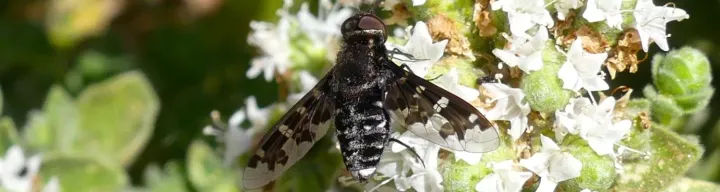
Spongostylum etruscum is a species of bee fly belonging to the family Bombyliidae in the order Diptera. These insects are easily recognized by their dense, hair-like covering, giving them a bee-like appearance that acts as a form of Batesian mimicry.
The adults are robust with distinct wing patterns featuring dark spots. They possess a long proboscis, which they use to feed on floral nectar while hovering in mid-air with impressive precision.
Physiologically, they are highly specialized fliers, capable of stationary flight and rapid evasive maneuvers. This agility is vital for their survival and reproductive success in open landscapes.
The larval stage is parasitic, adapted specifically to invade the underground nests of solitary bees. The larvae possess specialized mouthparts for consuming the host's offspring.
These flies are primarily found in warm, sunny habitats where their host populations are most active, making them a common sight in Mediterranean and continental climates.
What it damages
The economic impact of Spongostylum etruscum is largely indirect but significant for agriculture. As larval parasitoids, they target solitary bees, which are essential pollinators for various crops.
By consuming the larvae of these beneficial insects, the bee fly reduces the overall number of available pollinators in a given area, potentially leading to suboptimal crop fertilization.
This reduction in pollination efficiency often results in decreased fruit set, lower quality yields, and stunted crop development in orchards and berry farms.
The damage is not inflicted on the plant tissue directly, but rather on the biological workforce (pollinators) required for the plant's reproductive cycle.
In regions where solitary bee management is used to improve crop production, the presence of these parasitoids is viewed as a disruption to the pollination management strategy.
When it appears
Adult Spongostylum etruscum are active during the late spring and summer months when weather conditions are warm and conducive to high-speed flight.
Their emergence is synchronized with the phenology of their host bees, ensuring that the female flies can locate active nesting sites during the egg-laying period.
The flight period usually spans several weeks, with the highest concentration of individuals occurring during the peak blooming season of local vegetation.
After the mating phase, females actively patrol areas with suitable soil types where solitary bees construct their burrows, seeking optimal points for oviposition.
The life cycle concludes with a pupal stage that typically spans the winter months, ensuring that the next generation emerges precisely when the host species becomes active again.
Signs of infestation
The presence of this species can be detected by observing their characteristic hovering behavior near bare soil patches where solitary bees congregate.
High numbers of these flies around a bee nesting site often indicate a high infestation rate, which warrants monitoring of the pollinator population's health.
Reduced crop yield and poor fruit set on pollinator-dependent crops can serve as a secondary sign that the population of beneficial bees might be under pressure.
Field observation of the flies repeatedly landing or darting near ground entrances is a primary indicator of their reproductive activity in that specific area.
Inspection of nesting tunnels by researchers may reveal the remnants of larvae, confirming the presence of the parasitoid within the bee community.
Control measures
Chemical control is generally avoided because the target species and its hosts occupy the same ecological niche, making pesticides highly detrimental to beneficial bees.
Integrated Pest Management (IPM) strategies emphasize habitat maintenance and the protection of solitary bee nesting grounds from human-induced disturbance.
By ensuring a diverse array of nectar-rich plants, farmers can boost the resilience of pollinator populations, helping them withstand parasitoid pressure.
Minimal soil disturbance near identified nesting zones is highly recommended to protect the safety of the developing bee larvae from premature exposure.
Focusing on biological equilibrium and avoiding unnecessary insecticide use is the most effective approach to managing these insects within an agricultural context.
Taxonomy
- Latin name
- Spongostylum etruscum
- Order
- Diptera (flies)
- Family
- Bombyliidae
- EPPO code
- SPGSET
Discussion
No discussions yet — be the first.