
Ground squirrel
Spermophilus
Description
How to identify
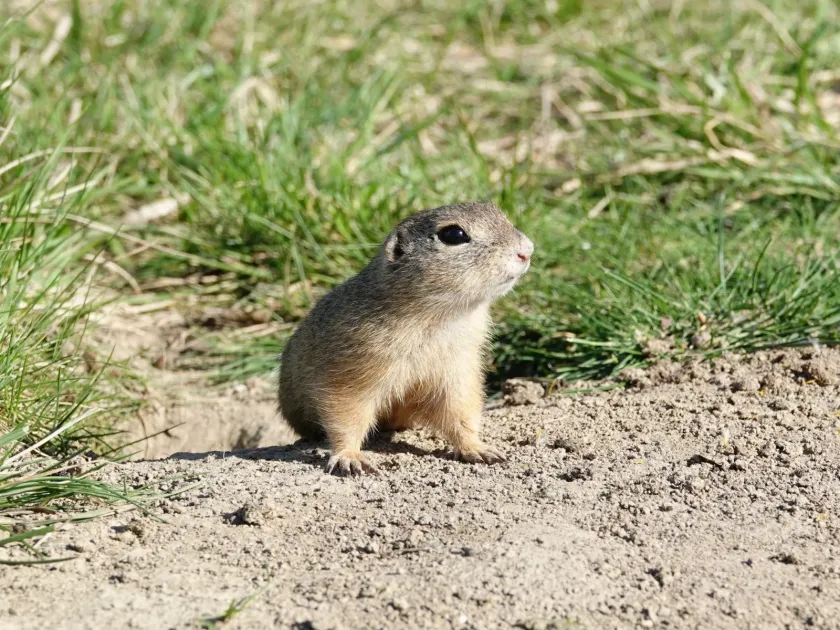
Ground squirrels (genus Spermophilus) are members of the Sciuridae family. They are stout rodents with short, strong limbs, short ears, and a bushy or sparsely haired tail, adapted for life in underground burrows.
They possess large cheek pouches used for transporting food and building material. Their coat color typically ranges from yellowish to grayish-brown, which provides excellent camouflage in grassland and meadow environments.
These animals are highly social, living in complex burrow systems that include nesting chambers, hibernation rooms, and food storage areas. They are known for their alert behavior, often standing upright on their hind legs to scan the area.
Communication within a colony is sophisticated; they use loud alarm calls to signal danger. Their keen eyesight and hearing allow them to react quickly to predators or human disturbance.
The reproduction cycle is seasonal, with females giving birth once a year to a litter. Their ability to hibernate allows them to survive extreme weather conditions, making them resilient pests.
What it damages
Ground squirrels are significant agricultural pests that feed on a wide variety of crops. They destroy newly planted seeds, young sprouts, and mature grains, causing thinning of crops.
Beyond direct feeding, the burrowing activity causes extensive damage to fields. The excavated soil covers and kills surrounding vegetation, while the network of tunnels compromises soil stability.
Agricultural machinery is often damaged by driving over hidden or collapsed tunnel entrances. Furthermore, the tunnels can cause erosion and disrupt irrigation channels in affected areas.
Heavy infestations can lead to substantial yield losses, sometimes requiring farmers to reseed entire plots of land after major damage occurs in early spring.
They are particularly problematic in pastures and cereal fields, where their habit of consuming green biomass leads to significant losses of forage and grain productivity.
When it appears
The activity of ground squirrels is strictly regulated by hibernation. They spend the majority of the year, including winter and often summer drought periods, in deep sleep within their burrows.
Emergence occurs in early spring, precisely when crops are in the most vulnerable stage of germination and early development. This leads to intense feeding behavior.
The most active period for farmers to monitor for these pests is from late winter through early summer. This is when the squirrels are breeding and provisioning their young.
As vegetation dries out in mid-summer, many species enter a period of estivation (summer sleep). Their activity on the surface decreases significantly during this time.
Management efforts are most effective when timed with their emergence in spring, as they are hungry and actively seeking food sources before the peak growing season.
Signs of infestation
The most obvious signs of a ground squirrel infestation are the entrances to their burrows, which are often accompanied by piles of loose, fresh soil called mounds.
Observation of clear, well-worn paths or trails radiating from the burrow entrances into the crop indicates active foraging areas.
Evidence of clipped or missing vegetation near the holes is a strong indicator of feeding activity. Young plants may appear cleanly cut at the base.
Audible alarm calls, which sound like high-pitched whistles, serve as a clear sign of a colony's presence as they alert each other to your presence.
Direct sightings of the animals standing in the characteristic "picket-pin" posture near the burrow entrance are the definitive way to confirm an active colony.
Control measures
Managing ground squirrel populations requires a multi-faceted approach to reduce their numbers effectively and minimize damage to crops.
- Deep tillage and plowing are effective at collapsing burrow systems, which destroys nests and forces the squirrels to move or die.
- Baiting with registered rodenticides is a common method for population reduction, usually placed inside the burrows to minimize non-target exposure.
- Fumigation using gas cartridges or tablets can be highly effective for treating deep, active burrows during the spring season.
- Promoting natural predators, such as hawks, eagles, and owls, by providing nesting sites can help keep populations under control naturally.
- Regular monitoring of field edges allows for early detection and localized control, preventing the spread of the colony into the center of the field.
Taxonomy
- Latin name
- Spermophilus
- Order
- Rodents
- Family
- Sciuridae
- EPPO code
- SPRMSP
Discussion
No discussions yet — be the first.