

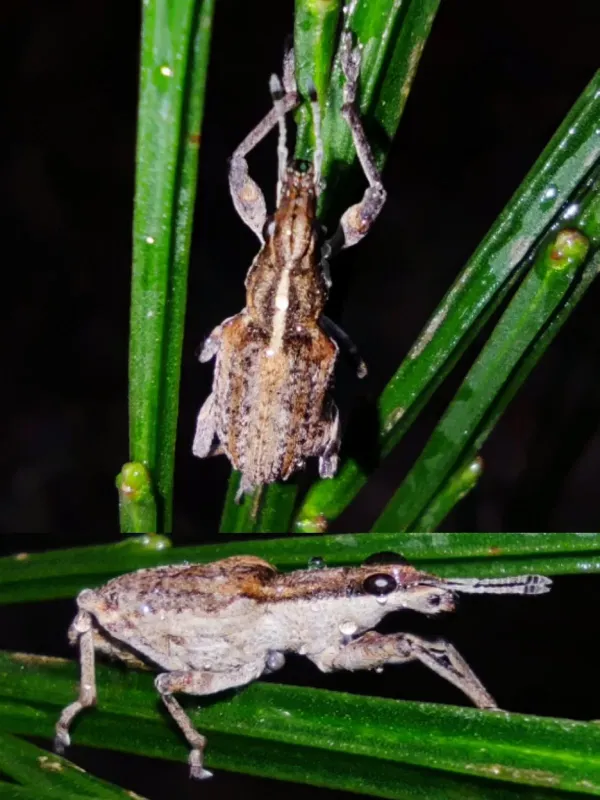
Description
How to identify
The lupin leaf weevil (Latin: Sitona gressorius) is a member of the Curculionidae family, known for its impact on legume crops. Adult weevils typically measure 6–8 millimeters in length.
The insect’s body is covered with dense scales, providing a greyish or brownish appearance. A short, wide snout is a characteristic feature of the Sitona genus, making them identifiable to trained agronomists.
Larvae are legless, white to yellowish in color, and feature a distinct brown head capsule. They spend their entire developmental cycle in the soil, feeding on the underground parts of the plant.
The life cycle undergoes complete metamorphosis, including egg, larval, pupal, and adult stages. Adult weevils are highly mobile and exhibit a death-feigning behavior when disturbed.
They prefer sunny, warm conditions to move across fields and feed. Their ability to hibernate in soil makes them a persistent pest in regions where legumes are cultivated continuously.
What it damages
The primary host for this pest is the lupin, although it can feed on various other Fabaceae family members. Both adult weevils and their larvae cause significant agricultural damage.
Adults feed on the foliage, creating characteristic semi-circular notches along the leaf edges. This "notching" reduces the plant's photosynthetic capacity, which can stunt growth in the early stages.
Larvae cause more severe damage by feeding on the root system and specifically targeting nitrogen-fixing nodules. This disruption limits the plant's ability to fix nitrogen and absorb essential nutrients.
Heavy infestations can lead to seedling mortality, especially under drought conditions where the damaged root system cannot support the plant's water requirements.
Overall yield losses occur due to both the loss of green leaf area and the decline in nitrogen accumulation, which is critical for healthy legume development.
When it appears
Adults overwinter in the upper soil layers or under plant debris from previous harvests. They emerge in the spring as temperatures rise, ready to migrate to newly emerged legume crops.
The peak activity of adults occurs during late spring and early summer. During this time, they feed on leaves and lay eggs in the soil near the plant stems.
The larval stage progresses through the summer months, feeding on roots until pupation occurs in the soil. The timing of this cycle is highly dependent on local weather conditions.
The new generation of adults typically emerges in the late summer, feeding briefly before seeking suitable sites to enter their overwintering stage as autumn temperatures drop.
The prevalence of the pest is often correlated with the previous year's crop history and the humidity of the soil, which affects larval survival rates significantly.
Signs of infestation
The most recognizable sign of infestation is the notched, serrated appearance of leaf edges on young seedlings caused by adult feeding activity.
Stunted growth or wilting of plants on sunny days is a secondary sign that root damage by larvae may be occurring. Uprooting the plant often reveals chewed roots and damaged nodules.
The presence of adult weevils on the soil surface or stems during morning inspections is a direct indicator of a pest population building up in the field.
Yellowing of the foliage, if not caused by nutrient deficiency, can sometimes be linked to the compromised root system resulting from larval feeding.
- Characteristic notched edges on leaves.
- Damage to root nodules and fine roots.
- Thinning of plant stands due to seedling loss.
- Direct observation of weevils on the plants.
Control measures
Crop rotation is the most effective preventative measure. Avoiding the planting of legumes on the same field for at least 3-4 years breaks the pest's life cycle.
Deep autumn tillage helps destroy overwintering sites, significantly reducing the adult population that emerges in the following spring.
Seed treatment with systemic insecticides can provide a critical window of protection for emerging seedlings, preventing initial damage by adult weevils.
Foliar insecticide applications should be timed carefully based on economic threshold counts. Spraying is most effective during the active hours of the weevils, typically in the evening.
Good agricultural practices, such as proper fertilization and sowing at optimal times, encourage rapid plant growth, which helps the crop tolerate and recover from light infestations.
Content graph
Connections · Lupin leaf weevil
Most often together:
Marketplace
Products · 5


Biology
Taxonomy
- Latin name
- Sitona gressorius
- Order
- Coleoptera (beetles)
- Family
- Curculionidae
- EPPO code
- SITNGE
Community
Discussion
No discussions yet — be the first.