
Northern birch mouse
Sicista betulina
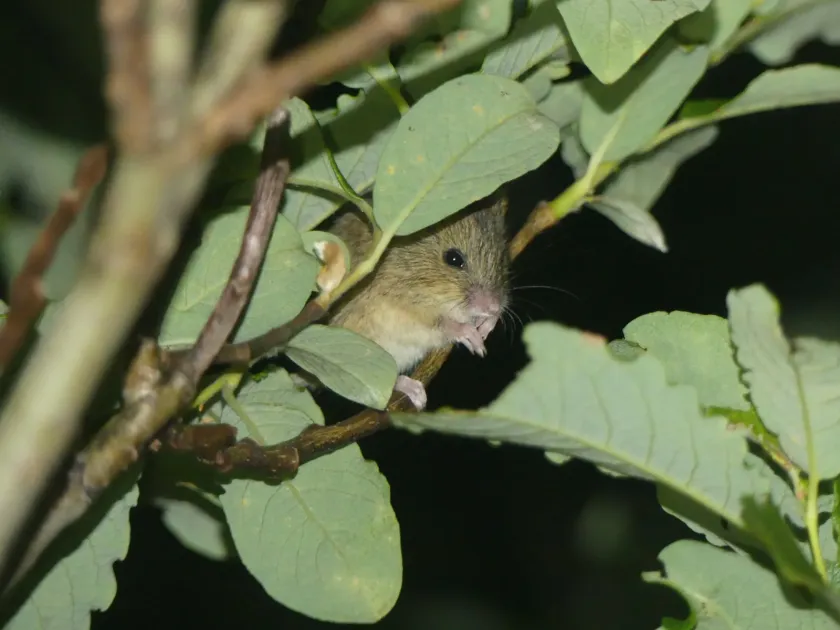
Description
How to identify
The Northern birch mouse (Sicista betulina) is a small rodent belonging to the Sminthidae family. It is easily identified by a distinct dark stripe running along its back and an exceptionally long, prehensile tail used for balance.
This nocturnal animal is uniquely adapted for climbing, often seen moving through tall grass, shrubs, and low branches rather than just staying on the ground.
It prefers humid forest edges, meadows, and riverbank vegetation. Unlike many other rodents, it undergoes deep hibernation during the winter months, typically in underground burrows or hollows.
They have a relatively low reproductive rate, producing only one litter per year, which generally prevents explosive population growth. However, in certain environments, their density can increase sufficiently to cause local agricultural concern.
Accurate identification is crucial for farmers, as distinguishing this species from the more common and destructive field vole helps in tailoring specific non-invasive control strategies.
What it damages
The Northern birch mouse primarily feeds on the seeds of cereal crops, including wheat, rye, and oats, causing losses during both the developmental and ripening stages.
Beyond cereals, they can also impact sunflower crops, legumes, and various vegetables planted near forests or shrubby margins, where they can easily access the plants.
The damage is caused by the mice consuming the grains directly from the ears. While individual mice cause minor damage, high-density populations can strip significant portions of crop borders.
In orchards, they occasionally feed on the bark of young fruit trees during winter or early spring, potentially stunting growth or killing the saplings if the damage is severe.
Their impact is usually concentrated at the edges of fields bordering woody vegetation, as they prefer to stay close to their natural cover rather than venturing deep into open agricultural areas.
When it appears
Activity commences in early spring when the mice emerge from hibernation and begin searching for young shoots and seeds to restore their body mass.
The period of maximum activity and potential crop damage occurs in late summer, specifically from July to August, as cereal grains begin to mature and provide high-energy food sources.
During the autumn, they spend much of their time foraging to accumulate the necessary fat reserves for successful overwintering, increasing the risk to late-harvested crops.
By late autumn, they retreat into hibernation, making them inactive during the cold winter months and eliminating any further threat to crops until the following spring.
Monitoring efforts are most effective during the peak harvest season, when the presence of the mice and their characteristic feeding patterns become visible along the field margins.
Signs of infestation
A key sign of their presence is the clean extraction of seeds from the grain ears, often without destroying the ear itself. They leave the husk while consuming the grain kernel.
Droppings are cylindrical and dark, typically found along their established pathways through thick vegetation or flattened crop stems near the field edges.
Evidence of feeding on the upper parts of plants, such as stalks and leaves, is a strong indicator of the birch mouse, given its climbing capability compared to ground-dwelling rodents.
Localized thinning of the crop stand near woodland or hedgerows serves as an early warning sign that a population has moved into the area to feed on the maturing crop.
Unlike voles, they do not leave extensive networks of surface runways or large excavated soil piles, as they often utilize existing natural cavities or loose soil cover.
Control measures
The most effective management strategy is cultural control: maintaining clean field margins by removing dense brush and tall weeds that provide essential cover and nesting sites.
Deep plowing of field edges after harvest effectively disrupts their hibernation sites and reduces the overwintering survival rate of the population.
Encouraging natural predators, such as owls and hawks, through the installation of perches or nest boxes can provide continuous, sustainable biological control against these rodents.
If population numbers exceed economic thresholds, targeted use of rodenticides in bait stations can be considered, ensuring minimal risk to non-target species and wildlife.
- Removal of tall weeds near fences and woods.
- Strategic crop rotation away from field borders.
- Harvesting crops as early as possible to limit food exposure.
Taxonomy
- Latin name
- Sicista betulina
- Order
- Rodents
- Family
- Dipodidae
- EPPO code
- SICIBE
Discussion
No discussions yet — be the first.