
Lesser Egyptian jerboa
Jaculus jaculus
Description
How to identify
The Lesser Egyptian jerboa is a small desert rodent belonging to the Dipodidae family, characterized by its specialized adaptation to arid environments and sandy terrains.
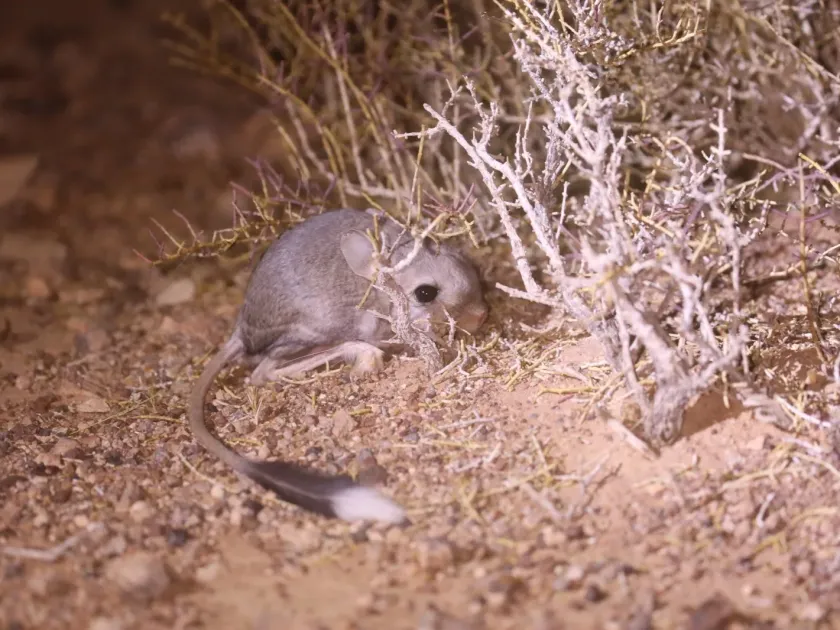
The most distinctive feature of this animal is its significantly elongated hind limbs, which are adapted for rapid bipedal leaping, an essential trait for escaping predators in open deserts.
The fur color is typically sandy or buff-yellow, which acts as natural camouflage against the desert substrate, helping the animal remain inconspicuous during its nocturnal movements.
It possesses a long tail with a distinct black and white tuft at the tip, which is used for balance and communication during high-speed leaps across the sand.
Its eyes and ears are relatively large in proportion to its head, providing excellent sight and hearing, which are vital for survival in the nocturnal environment where it searches for food.
What it damages
This rodent is considered a minor but persistent pest in desert-fringe agriculture, where it occasionally invades irrigated farmland to feed on cultivated plant parts.
The primary damage occurs when jerboas consume seeds, tender seedlings, and succulent roots of vegetables and grain crops, often resulting in significant plant loss.
Their habit of digging complex burrow systems can lead to structural damage in the soil and the destruction of root systems for young crops, hindering their growth and development.
During periods of drought, when wild vegetation is scarce, jerboas may gather in high densities near fields, exacerbating the impact on local agricultural outputs.
They can also cause secondary damage to irrigation infrastructure by digging near water channels or buried supply lines in arid agricultural zones.
When it appears
The activity of the Lesser Egyptian jerboa is highly influenced by seasonal weather patterns, with peaks in movement corresponding to agricultural cycles in desert areas.
During the spring season, as crops begin to germinate, the rodents often become more active, seeking the soft, water-rich tissues of seedlings to supplement their diet.
Summer activity is predominantly nocturnal due to the intense daytime heat, with jerboas emerging at sunset to forage in the cooler parts of the day and night.
In winter, they may reduce their foraging activity or enter a state of torpor if temperatures drop significantly, although this is less common in the warmest regions of their range.
Population spikes are frequently correlated with mild, moist winters, which improve the survival rate of offspring and lead to increased pressure on neighboring fields.
Signs of infestation
Identifying a jerboa presence usually involves spotting their distinct burrow entrances, which are often found near the edges of fields or in uncultivated wasteland.
The presence of unique, long-distance tracks on sandy soil, characterized by deep marks from the hind feet and a trailing tail mark, is a key sign of their activity.
Visually, farmers can identify damage by observing localized clusters of destroyed seedlings, where the plants have been clipped or partially excavated from the ground.
During the night, these animals can be spotted in fields when artificial lights reflect off their large, reflective eyes, allowing for easy identification in the dark.
Piles of plant debris and freshly moved sand near hole openings serve as strong indicators of active burrow maintenance and recent foraging behavior.
Control measures
Effective management of this pest involves a combination of mechanical disruption of habitats and strategic land-clearing practices to protect crops.
Deep plowing of field borders and wasteland adjacent to croplands effectively collapses burrow networks and forces the rodents to relocate away from agricultural zones.
Maintaining a weed-free buffer zone around cultivated areas reduces the availability of natural shelters, making the environment less hospitable for the jerboas.
In cases of severe infestation, specialized baiting programs may be used, though these must be carefully managed to avoid negative impacts on the local ecosystem.
- Monitor field perimeters regularly for new burrow excavations.
- Implement perimeter fencing in areas of high population density.
- Promote biodiversity to encourage natural predators like birds of prey.
Taxonomy
- Latin name
- Jaculus jaculus
- Order
- Rodents
- Family
- Dipodidae
- EPPO code
- JACUJA
Discussion
No discussions yet — be the first.