
Sexava nubila
Sexava nubila
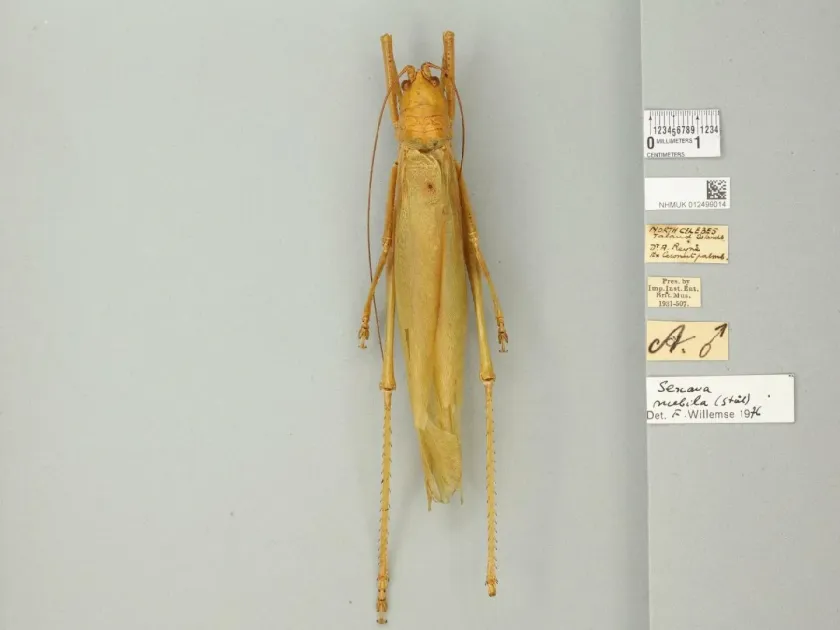
Description
How to identify
Sexava nubila is a large insect belonging to the order Orthoptera and the family Tettigoniidae (katydids). This species is primarily distributed across Melanesia and Southeast Asia.
Adult insects are characterized by a massive body structure, reaching lengths of 7–10 cm. Their coloration is typically green or brownish, allowing them to blend seamlessly into tree foliage.
Adults possess well-developed wings, enabling high mobility within the canopy or between adjacent trees.
Females are equipped with a powerful, saber-shaped ovipositor, which they use to deposit eggs into the soil or plant tissue, a hallmark trait of this family.
Sexava nubila is primarily nocturnal, hiding within dense foliage during the day, which makes visual detection difficult during the early stages of infestation.
What it damages
This pest poses a significant threat to coconut palm, oil palm, and various other tropical fruit tree plantations, affecting large industrial areas.
The primary damage is caused by both nymphs and adults, which feed aggressively on leaf blades. During outbreaks, they are capable of completely skeletonizing the leaves of an entire tree.
Leaf damage leads to a reduction in the photosynthetic capacity of the palms, which directly impacts fruit formation and overall crop quality.
In cases of severe infestation, the dropping of young fruits and premature death of terminal buds can occur, potentially leading to the loss of young seedlings in nurseries.
Economic losses result from reduced yields of copra and nuts, as well as the substantial costs associated with repeated insecticide applications required to salvage the plantations.
When it appears
The insect's life cycle is highly dependent on regional climatic conditions, with activity peaks generally occurring during the wet season, which favors reproduction.
Adult females lay eggs in the soil beneath the canopy or in the fibrous parts of the trunks, where embryonic development may last for several months.
Nymphs undergo several developmental stages, gradually increasing in size and expanding their feeding range from lower leaves to the upper parts of the palm crown.
The total duration of the life cycle can reach approximately six months, allowing the species to produce multiple generations per year under favorable temperature regimes.
The highest population density is often found in neglected or poorly maintained plantations where natural biological control is absent.
Signs of infestation
The first sign of infestation is the presence of characteristic irregular chewing marks on the edges of palm leaves, which eventually develop into large, ragged holes.
Inspecting trees often reveals accumulations of insect frass (excrement) on the leaf surfaces located below active feeding sites.
Nighttime surveys using lanterns make it easier to detect active specimens resting on petioles or leaf blades.
Yellowing and progressive drying of the canopy, starting from the lower levels, indicate an advanced stage of infestation that requires urgent intervention.
The specific stridulation (chirping) of males during the evening and night is a clear indicator of a resident population, even if individual insects remain hard to spot.
Control measures
Biological control includes the use of entomopathogenic fungi, which can effectively reduce population numbers in natural settings without causing environmental harm.
The application of contact and systemic insecticides is the primary management strategy for large industrial plantations experiencing high pest pressure.
Regular maintenance of plantation floors, including clearing weeds and debris, is crucial for disrupting the oviposition process and creating unfavorable conditions for nymph development.
Pheromone traps are used to monitor population dynamics and provide data-driven decisions on when to initiate chemical control measures.
- Canopy spraying with systemic insecticides.
- Encouraging the presence of natural egg parasitoids.
- Agrotechnical isolation of heavily infested plots.
Taxonomy
- Latin name
- Sexava nubila
- Order
- Orthoptera (locusts)
- Family
- Tettigoniidae
- EPPO code
- SEXANU
Discussion
No discussions yet — be the first.