
Sericoda quadripunctata
Sericoda quadripunctata
Description
How to identify
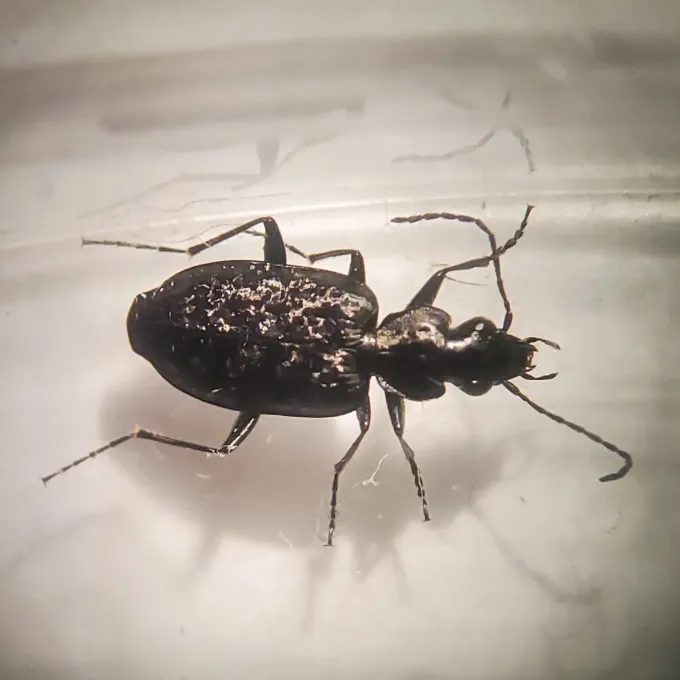
Sericoda quadripunctata belongs to the ground beetle family (Carabidae) of the order Coleoptera. This insect has a flattened body shape, typically measuring between 6 and 8 millimeters in length.
The coloration of the beetle ranges from dark brown to charcoal black. A defining characteristic of the species is the presence of four distinct, symmetrical indented spots on the elytra (wing covers).
The surface of the elytra is smooth with faint longitudinal grooves. The legs and antennae of the beetle are well-adapted for rapid movement across soil surfaces and woody debris.
Larvae have a typical carabid appearance, featuring an elongated body, well-developed thoracic legs, and cerci at the end of the abdomen. They lead a secretive lifestyle, often remaining hidden.
Adult beetles are capable of flight, which allows them to migrate actively to new areas in search of food sources or favorable overwintering conditions.
What it damages
While many ground beetles are considered beneficial entomophages, Sericoda quadripunctata can occasionally exhibit omnivorous behavior, damaging young shoots and roots of various crops.
The primary damage occurs in the early spring, when a lack of natural prey forces the beetles to feed on the tender tissues of agricultural plants, particularly cereal seedlings.
The larvae of the beetle, residing in the soil, may feed on the root systems of vegetable crops, causing wilting, leaf yellowing, and a significant reduction in overall yield.
During massive outbreaks, the pest can destroy a significant portion of crops at early growth stages, which negatively impacts plant density and uniformity in the field.
Additional damage is caused by the transmission of pathogenic microorganisms on the beetle's body, which may trigger secondary infections in the weakened plants.
When it appears
The life cycle of Sericoda quadripunctata is closely linked to soil temperature and moisture levels in the ground-level microclimate.
The first wave of adult activity is typically observed in early spring, immediately after the snow melts and the top layer of soil warms up sufficiently to support metabolic processes.
The mating and egg-laying period generally occurs in May and early June, when environmental conditions for larval development become highly favorable.
During the summer months, the pest becomes less active, often seeking refuge in shaded areas or beneath plant debris to prevent dehydration.
Overwintering of adult beetles occurs deep in the soil or under dense forest litter, which protects them from extreme cold during the winter season.
Signs of infestation
The first signs of infestation include specific damage to leaf edges, which appear as ragged edges or irregular holes eaten into the foliage.
Inspecting the root collar of seedlings may reveal signs of gnawing, which leads to sudden wilting or lodging of the plants, particularly during the morning hours.
The observation of beetles hiding under soil clumps during the day or moving actively on the surface at night confirms the colonization of the site by this species.
A key indicator is the rapid expansion of wilting patches within the crop, which typically emerge in areas with higher soil moisture levels.
The presence of large amounts of frass (excrement) on leaves and damaged stems also serves as clear evidence of high pest activity in the field.
Control measures
Effective control measures include cultural practices such as deep autumn plowing, which disrupts overwintering sites and reduces the population density.
Crop rotation is essential for minimizing the accumulation of the pest, as changing host crops deprives them of a stable food source throughout the season.
The use of systemic or contact insecticides is justified only when the economic injury threshold is exceeded during the early stages of plant development.
Trapping techniques, such as burying containers with baits in the soil, allow for population monitoring and timely intervention before damage becomes severe.
Regular sanitation of fields by removing plant debris and weeds significantly reduces the attractiveness of the site for breeding and temporary shelter.
Taxonomy
- Latin name
- Sericoda quadripunctata
- Order
- Coleoptera (beetles)
- Family
- Carabidae
- EPPO code
- SEDAQU
Discussion
No discussions yet — be the first.