
American Scymnus
Scymnus americanus
Description
How to identify
The American Scymnus (Scymnus americanus) belongs to the lady beetle family (Coccinellidae) within the order Coleoptera. While most members of this family are beneficial entomophages, this specific species is sometimes categorized as a pest due to its impact on plant tissues.
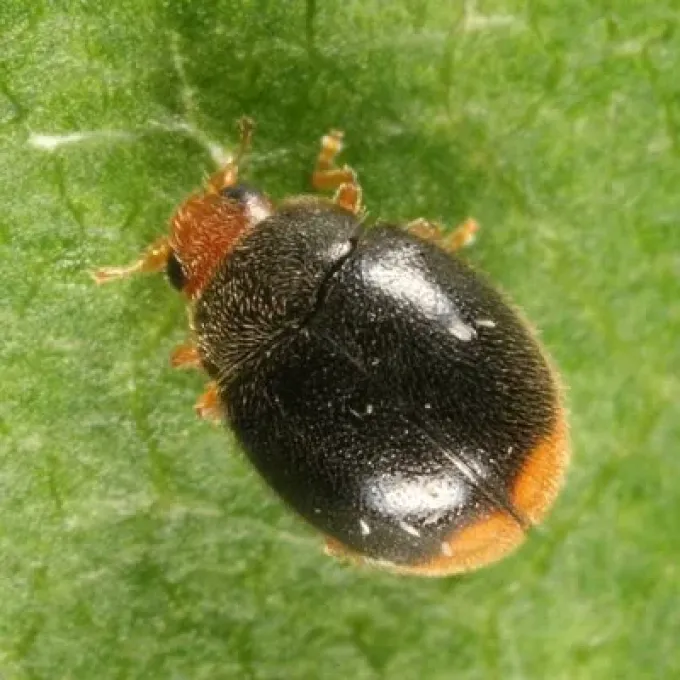
Adult beetles are small, usually ranging from 2 to 3 millimeters in length, with a rounded or oval body shape. Their coloration typically varies from dark brown to black, often featuring a subtle metallic sheen, and the body surface is covered in short, fine hairs.
The larvae of Scymnus americanus have a distinct appearance typical for coccinellids: an elongated body equipped with various outgrowths and bristles. As they develop through several instars, they grow in size and undergo changes in their integument pigmentation.
The insect's life cycle is closely tied to regional climatic conditions. Development progresses through egg, larval, pupal, and adult stages. In most temperate regions, the pest overwinters as an adult beetle in leaf litter or the top layer of soil.
Identifying this species in the field can be challenging due to its small size and agility. Agronomists often employ techniques like sweep netting or setting up traps in areas where infestations are suspected to monitor and identify the population accurately.
What it damages
The damage caused by the American Scymnus involves feeding on the vegetative and generative parts of various agricultural crops. By consuming succulent plant tissues, the insect disrupts the normal metabolic processes within the affected plant organs.
This pest poses a significant threat to fruit and berry crops, where it damages young leaves, buds, and fruit sets. Such damage often leads to the deformation of leaf blades, reduced photosynthetic activity, and overall stunted growth of the plant.
In cases of heavy infestation, the quality of fruit is significantly compromised, characterized by the appearance of necrotic spots and indentations. Furthermore, these damaged areas create entry points for secondary fungal and bacterial infections.
Crops most susceptible to Scymnus infestation include apples, pears, and various berry shrubs. In intensive orchard environments, the pest can spread rapidly, colonizing neighboring plants within rows or blocks.
The economic impact of the species varies based on regional climate and the general health of the agroecosystem. Timely monitoring is essential to mitigate substantial yield losses and prevent the spread of the pest to adjacent plantings.
When it appears
The period of peak activity for the American Scymnus generally occurs during the spring and summer, starting when average daily temperatures consistently exceed 15 degrees Celsius.
The first generation of the pest typically emerges during the period of bud burst and active sap flow in fruit trees, which is a critical stage for implementing early protective measures.
Throughout the season, the pest can complete several generations, with population peaks often coinciding with periods of prolonged dry and hot weather. While activity may wane in the latter half of summer, the population often persists until autumn.
As autumn approaches, adults prepare for diapause by migrating to overwintering sites, such as fallen leaves, bark crevices, or soil shelters. The temperature fluctuations during the fall significantly influence the survival rate of the overwintering population.
Overwintering ends early in the spring as the soil warms, prompting adults to resume feeding and oviposition. Understanding these temporal patterns is vital for scheduling agricultural operations aimed at pest management.
Signs of infestation
Key indicators of an American Scymnus presence include mechanical damage to leaf surfaces, such as small holes, chewed edges, or distinct "windows" on young foliage.
When inspecting the undersides of leaves, one can often find egg clusters, which appear as small yellowish or orange groups arranged along the leaf veins. In areas where larvae are feeding, excrement and damaged tissue debris are often present.
The deformation of shoot tips and stunted growth of central leaders serve as indirect signs of high pest population density. Damaged areas often darken and wither, which becomes clearly visible upon closer inspection of the tree canopy.
Severe infestations frequently result in premature leaf drop and the shedding of fruit sets, which weakens the plant significantly before winter. Unusual spotting on fruits may also be a consequence of adult beetle feeding.
The presence of large numbers of beetles in the canopy, detectable by shaking branches or visual inspection, is a clear sign that immediate intervention and protective measures are required.
Control measures
The control strategy for the American Scymnus relies on an integrated approach combining agrotechnical, biological, and chemical methods. An essential foundation is the practice of crop rotation and the removal of weeds that act as pest reservoirs.
Agrotechnical interventions include deep autumn cultivation of orchard soil beneath tree canopies to destroy overwintering sites. Additionally, timely pruning and the proper disposal of infested branches are highly effective practices.
Biological control involves utilizing natural predators, such as predatory mites, entomopathogenic fungi, and parasitic insects. Fostering biodiversity in the orchard environment promotes natural regulation of pest populations.
If the economic threshold of damage is exceeded, the application of systemic or contact insecticides is recommended. The choice of chemical agent must adhere to regulatory guidelines and take into account safety intervals prior to harvest.
- Deployment of pheromone traps for population monitoring.
- Regular application of mineral fertilizers to strengthen crop immunity.
- Use of bio-insecticides based on Bacillus thuringiensis during early larval development stages.
- Strict adherence to quarantine measures when importing nursery planting material.
Taxonomy
- Latin name
- Scymnus americanus
- Order
- Coleoptera (beetles)
- Family
- Coccinellidae
- EPPO code
- SCYMAM
Discussion
No discussions yet — be the first.