
Scybalicus
Scybalicus
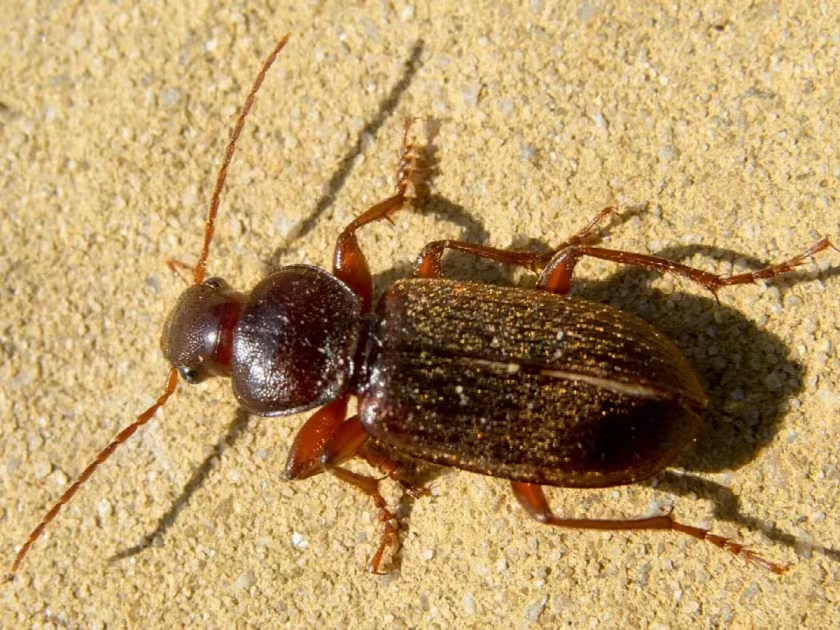
Description
How to identify
Scybalicus belongs to the family Carabidae (ground beetles) within the order Coleoptera. Most species of this genus are nocturnal and exhibit secretive behavior.
Morphologically, these beetles possess a robust body, often dark or brownish, which serves as camouflage within the soil surface layers.
Research on this pest is challenging as they spend the majority of their lifecycle deep within the soil or under surface debris.
Their mouthparts are adapted to consume both organic debris and tender sprouts of agricultural crops, making them potential pests.
Precise identification often requires expert entomological keys due to the morphological similarity with other related ground beetle species.
What it damages
This pest can cause significant damage to a wide range of agricultural crops, including cereals and various row crops during their early stages.
The primary threat is posed during the germination phase, as the beetles gnaw on seedlings and cotyledons, causing stand thinning.
High population densities can lead to substantial yield losses due to direct destruction of young, vulnerable plant tissue.
Root system damage slows down plant development and often leads to wilting and death of affected plants during critical growth phases.
The economic impact varies significantly based on regional climatic factors and the crop rotation history of the field.
When it appears
Activity begins in early spring once soil temperatures reach the threshold required for the beetles to emerge from diapause.
Maximum damage usually occurs during the emergence of seedlings, a time when crops are least resistant to mechanical injuries.
Summer activity may decline, though it often persists if soil moisture levels remain high enough for the beetles to remain active.
In autumn, beetles prepare for overwintering, migrating into deeper soil layers or seeking refuge under accumulated crop residues.
The lifecycle stages are adapted to ensure survival through adverse seasonal conditions, allowing the species to persist in agricultural environments.
Signs of infestation
Visible signs of infestation often include uneven crop emergence or patches of bare soil where seedlings have been destroyed.
Close inspection of the seedling base often reveals characteristic gnawing marks or completely severed plant tissue.
Beetles can be located by conducting soil sampling or using bait traps, typically during the early morning hours.
The presence of small burrow channels in the topsoil is a strong indicator of recent beetle activity in the field.
Overall crop vigor reduction and delayed growth are indirect indicators that should prompt a more thorough pest investigation.
Control measures
Crop rotation is the primary strategy, preventing the buildup of population levels in fields prone to infestation.
Deep autumn tillage is highly effective in disrupting the overwintering sites of the beetles, significantly reducing their population density.
Treating seeds with systemic insecticides provides a necessary layer of protection for seedlings during the early, most vulnerable developmental phases.
Weed management is essential, as overgrown fields provide ideal conditions for the survival and multiplication of this pest.
- Proper soil cultivation practices
- Systemic seed treatment
- Routine population monitoring
- Optimal sowing timing
Taxonomy
- Latin name
- Scybalicus
- Order
- Coleoptera (beetles)
- Family
- Carabidae
- EPPO code
- SCYBSP
Discussion
No discussions yet — be the first.