
Northern bush katydid
Scudderia pistillata
Description
How to identify
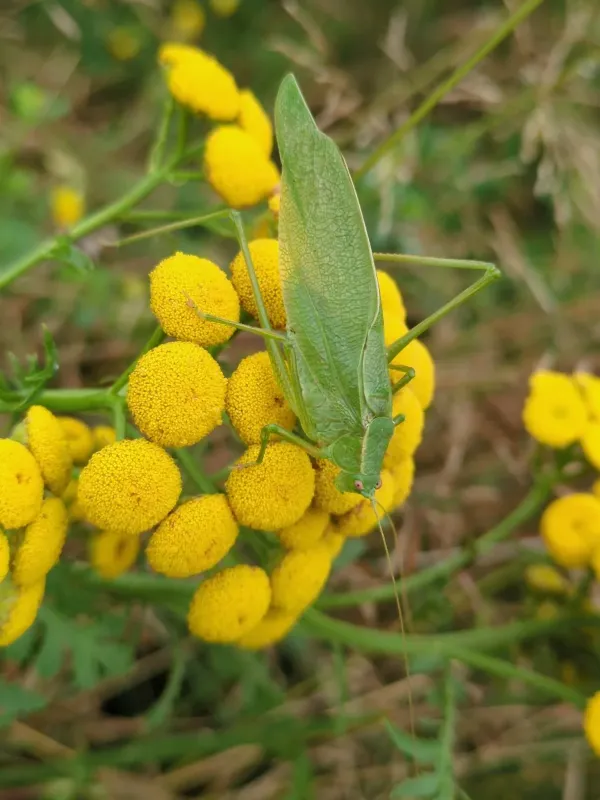
The Northern bush katydid Scudderia pistillata is a member of the order Orthoptera and the family Tettigoniidae. This insect features a bright green coloration, which provides excellent camouflage among foliage.
Adult specimens are characterized by a slender body and long, thin legs adapted for jumping. Their wings are translucent with distinct veining, closely mimicking the appearance and texture of a leaf.
They possess a powerful chewing mouthpart designed for consuming plant tissues. Females are equipped with a specialized sickle-shaped ovipositor used to deposit eggs directly into plant leaves or stems.
Nymphs resemble smaller, wingless versions of the adults. Throughout their development, they undergo several molting stages, gradually increasing in size and eventually reaching maturity.
These insects are primarily nocturnal, which often makes them difficult to detect. During the day, they remain motionless on the undersides of leaves or deep within dense shrubs.
What it damages
This species is a polyphage, meaning it feeds on a wide variety of plant types. It frequently damages fruit trees, berry bushes, and various vegetable crops found in gardens and farms.
The primary damage occurs when these insects feed on leaves, flower buds, and tender shoots. High population densities can lead to significant yield losses and stunted plant development.
Young seedlings are particularly vulnerable, as the loss of leaf area reduces the plant's ability to photosynthesize, weakening it against environmental stresses and pathogens.
Ornamental plants may also suffer, leading to reduced aesthetic value for landscaping and gardening. This often necessitates additional maintenance and corrective measures.
While the Northern bush katydid is not typically as devastating as locusts, localized infestations can significantly degrade the market quality of produce.
When it appears
The life cycle of the Northern bush katydid is strictly synchronized with the growing season. They overwinter primarily as eggs, deposited within plant tissues.
Nymphs emerge in late spring as temperatures rise consistently. This period coincides with the flush of new vegetative growth, providing ample food for the developing insects.
Adult activity peaks in mid-summer, which is the period when they are most numerous and actively reproducing throughout orchards and fields.
By late summer and early autumn, females begin laying eggs to ensure the survival of the next generation. After this cycle, adult populations naturally decline as temperatures drop.
Climatic factors, such as humidity levels and temperature fluctuations, play a critical role in the survival rate of the nymphs and the overall success of each generation.
Signs of infestation
The first sign of an infestation is the presence of irregular holes in leaves. Unlike the smooth edges left by some caterpillars, katydid feeding often leaves ragged or serrated margins.
The presence of the pest can often be confirmed by their characteristic song, which occurs during the evening hours as males call to attract potential mates.
Damage to flowers manifests as chewed petals and impaired ovaries, which can result in fruit deformation or the total loss of blossoms on fruit-bearing trees.
Frass (excrement) found on leaves below the feeding area is a clear indication that a population is actively feeding in the upper canopy of the plant.
The presence of egg-laying sites inside leaf tissue appears as small swellings or bumps. Identifying these signs in autumn helps in planning future preventative measures.
Control measures
The primary control method is maintaining a clean growing area by removing weeds, which serve as reservoirs for the pest at the beginning of the season.
Biological control, including the use of entomopathogenic fungi, can effectively suppress katydid populations without harming beneficial pollinators or natural predators.
In cases of significant infestation, localized application of contact insecticides may be necessary. Treatments should be performed in the evening when the insects are most active.
Encouraging natural predators such as birds, praying mantises, and ground beetles is a key component of sustainable pest management to keep populations in check.
Autumn sanitation, including the pruning and disposal of infested plant material, is highly effective at destroying egg clutches and reducing the following year's population.
Taxonomy
- Latin name
- Scudderia pistillata
- Order
- Orthoptera (locusts)
- Family
- Tettigoniidae
- EPPO code
- SCUDPI
Discussion
No discussions yet — be the first.