
Mexican bush katydid
Scudderia mexicana
Description
How to identify
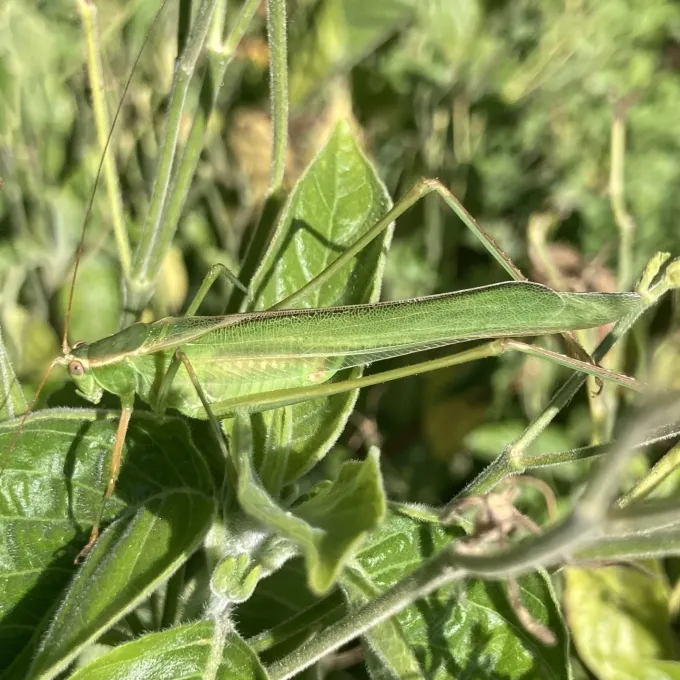
The Mexican bush katydid (Scudderia mexicana) is a species of insect belonging to the family Tettigoniidae, characterized by its vibrant green color which provides camouflage among foliage.
Adults possess elongated, powerful hind legs adapted for jumping and well-developed wings, enabling them to move across fields and gardens with ease.
The species is distinguished by its exceptionally long, thread-like antennae, which serve as sensory organs for navigation and finding food sources within dense vegetation.
As a member of the order Orthoptera, it undergoes incomplete metamorphosis, meaning the young nymphs resemble miniature, wingless adults, gradually developing through successive molts.
The overwintering strategy involves laying eggs directly into plant tissues or soil, which shields the developing embryos from winter frost and predation until spring emerges.
What it damages
This katydid acts as a generalist herbivore, capable of feeding on a wide range of horticultural, ornamental, and agricultural plant species across its range.
Feeding primarily on foliage, the insect consumes the edges of leaves, causing irregular, ragged edges that significantly reduce the plant's capacity for photosynthesis.
In nursery settings, heavy infestations can severely stunt the growth of young plants, leading to irreversible loss of vigor and structural integrity of the crop.
Beyond direct tissue consumption, these insects create entry points for secondary pathogens, often leading to subsequent fungal or bacterial decay in damaged tissues.
For ornamental flowers, the aesthetic damage caused by feeding marks significantly reduces the marketability and commercial value of the produced crop.
Signs of infestation
Visible signs of infestation include ragged leaf margins and irregular holes in the center of leaves, resulting from the insect's distinct chewing patterns.
The presence of frass, or insect droppings, on the leaf surfaces below feeding areas is a clear indicator of recent activity and the presence of the pest.
The loud, rhythmic chirping or buzzing sounds made by males during dusk and nighttime hours often betray their presence even when the insects are well-hidden.
During daylight, careful inspection of the undersides of leaves or protected plant crevices may reveal the presence of stationary nymphs resting before the evening feeding period.
Surface scars or shallow gouges on young fruit or tender stems provide additional evidence of the katydid's feeding habits during periods of high population density.
Control measures
Integrated pest management starts with systematic monitoring of crops to detect early arrivals before they establish a breeding population within the field.
Cultural control measures, such as maintaining weed-free zones and clearing brush near production areas, are essential to remove preferred habitats and oviposition sites.
In greenhouse or tunnel production, physical barriers like fine-mesh screens on vents and windows are highly effective in excluding adult katydids from sensitive areas.
When population levels exceed economic thresholds, the application of targeted insecticides is necessary to suppress the population and prevent widespread crop damage.
Biological controls, including encouraging natural predators or using insect-specific pathogens, offer a sustainable approach to long-term management of this pest species.
Taxonomy
- Latin name
- Scudderia mexicana
- Order
- Orthoptera (locusts)
- Family
- Tettigoniidae
- EPPO code
- SCUDME
Discussion
No discussions yet — be the first.