
Fork-tailed bush katydid
Scudderia furcata
Description
How to identify
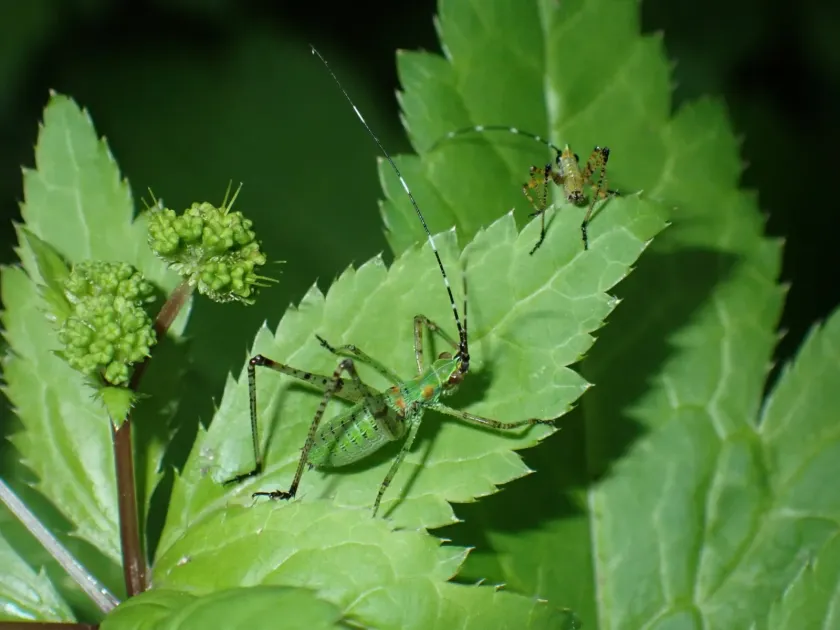
The fork-tailed bush katydid (Scudderia furcata) is a member of the Tettigoniidae family. These insects are known for their vibrant green coloration, which provides excellent camouflage within foliage.
Adult katydids reach about 3-4 centimeters in length. They are characterized by long, thread-like antennae and, in males, a unique fork-like shape of the cerci, which gives the species its common name.
Equipped with powerful hind legs, these insects are excellent jumpers. While they possess wings and are capable of flight, they typically rely on short, sudden bursts of motion to move between host plants.
Females are equipped with a sickle-shaped ovipositor, which they use to insert eggs directly into plant tissues. This behavior makes the eggs well-hidden from predators and environmental hazards.
They are primarily nocturnal. During the day, they remain largely inactive, clinging to the underside of leaves and relying on their green color to remain undetected by birds and other predators.
What it damages
Both nymphs and adults of Scudderia furcata are polyphagous, feeding on a wide range of plants. They primarily target fresh, succulent foliage, shoots, and developing buds.
The pest is a significant threat to various agricultural crops, including citrus trees, fruit orchards, and many ornamental shrubs like roses. They consume large portions of leaf blades, leaving jagged edges.
Besides leaves, katydids often damage flowers and young fruit sets. This activity can lead to a direct reduction in yields and cosmetic damage that lowers the market value of the crop.
In nurseries, they can cause serious injury by feeding on the apical meristems of young seedlings. This stunts growth and leads to deformed or asymmetrical branching patterns.
Persistent feeding by a large population can significantly weaken an entire plant, making it more susceptible to secondary environmental stresses or opportunistic pathogen attacks.
When it appears
The lifecycle begins with eggs that overwinter within the host plant tissues. Nymphs emerge in the spring once temperatures become consistently warm and food sources are available.
As they grow through the summer, the nymphs pass through several instars. This developmental phase is marked by intensive feeding, which is necessary to support their rapid physical growth.
Adult katydids emerge mid-summer and remain active until late autumn. The peak of their population density is typically observed during the hottest months, specifically July and August.
During the late season, females mate and utilize their ovipositors to deposit eggs into leaf margins or soft stems. This process creates small wounds in the plant tissue, which can cause local necrosis.
The activity of the population declines rapidly following the first frosts. Most adults do not survive the winter, leaving the next generation as eggs protected within the plant material.
Signs of infestation
The most visible sign of an infestation is irregular, ragged holes in the leaves. Unlike other pests that chew in patterns, katydids feed sporadically, leaving uneven margins on the foliage.
A closer inspection of the leaf edges may reveal small, brown, linear scars. These are the sites where the female has inserted her eggs, which can sometimes be mistaken for fungal infections.
At night, the presence of these pests is often revealed by the rhythmic, sharp chirping sounds made by males. This acoustic activity is a clear indicator of a breeding population in the area.
Small, dark, pellet-like frass (excrement) found on leaves or the ground beneath the host plant is another reliable sign of katydid activity during the warmer months.
Stunted growth or missing flower buds in the absence of obvious disease symptoms often point toward insect feeding, particularly when the pest itself is found hiding in the foliage.
Control measures
Cultural control is the first line of defense. Keeping the surrounding area free of weeds and tall grasses reduces the katydid's habitat and alternative food sources during the day.
Hand-picking is effective for small gardens. Inspecting plants in the early morning or late evening, when the insects are less active, allows for the manual removal and destruction of the pests.
Biological control options, such as entomopathogenic fungi, can be used to manage populations without harming beneficial insects. These are most effective when applied during humid conditions.
Chemical intervention should be reserved for severe outbreaks. Use selective insecticides and target applications carefully to minimize impact on non-target species and pollinators, avoiding application during bloom.
Promoting a healthy ecosystem by encouraging birds, spiders, and predatory wasps can help keep katydid populations in check naturally, reducing the need for direct intervention.
Taxonomy
- Latin name
- Scudderia furcata
- Order
- Orthoptera (locusts)
- Family
- Tettigoniidae
- EPPO code
- SCUDFU
Discussion
No discussions yet — be the first.