
Passion vine hopper
Scolypopa australis
Description
How to identify
The passion vine hopper (Scolypopa australis) is a member of the Ricaniidae family within the order Hemiptera. Originally native to Australia, it has become a widespread pest in various regions.
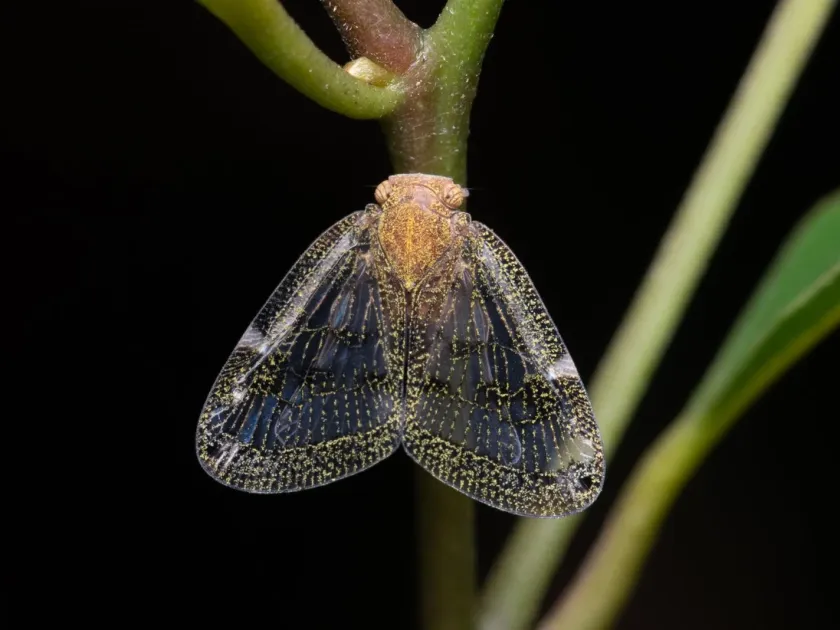
Adult insects are about 6–8 mm long. They are easily recognized by their triangular-shaped wings, which are transparent with prominent brown or black reticulated patterns.
Nymphs, or immature hoppers, possess a distinct appearance characterized by long, white, wax-like filaments attached to their abdomen. This tail-like structure serves as a defensive feature.
These insects are highly agile. While nymphs move by walking or jumping, adults are capable of strong flight, enabling them to move rapidly between host plants within a garden or orchard.
The species is highly adaptable, allowing it to colonize both native vegetation and introduced agricultural crops, making it a persistent challenge for commercial growers.
What it damages
Scolypopa australis is a polyphagous pest, meaning it feeds on a wide range of plants. It is particularly notorious for damaging kiwifruit, passionfruit, citrus, and various ornamental plants.
The primary damage results from both nymphs and adults piercing plant tissues and extracting phloem sap. This feeding process depletes the plant's resources, causing stunted growth and general decline.
In addition to sap extraction, these insects excrete large quantities of honeydew. This sticky substance covers the leaves and fruit, creating a medium for sooty mold to grow.
Sooty mold growth inhibits photosynthesis, leading to reduced plant vigor and lower yields. Furthermore, the presence of the mold and honeydew significantly degrades the cosmetic quality of harvested produce.
Heavy infestations can lead to the wilting of young shoots, premature flower drop, and in extreme cases, the overall dieback of affected branches.
When it appears
The life cycle of the passion vine hopper is univoltine, meaning there is one generation per year. The insect overwinters in the egg stage, which are typically laid in rows under the bark of woody plants.
Nymphs begin to hatch in spring when temperatures become consistently warm. This timing coincides with the period when plants are producing tender new growth, providing optimal food sources.
The nymphal stage lasts for several months, during which they progress through various instars. They are often found in clusters on the undersides of leaves or along succulent stems.
Adults typically emerge in mid-summer. This is the stage most likely to be spotted as they are highly mobile and will quickly hop or fly when disturbed by human activity or wind.
By late autumn, adults mate, and females search for suitable sites on branches to insert their eggs for the next generation, completing the annual cycle.
Signs of infestation
The most recognizable sign of infestation is the presence of white, fluffy wax secretions left by the nymphs. These are often seen on stems and leaf stalks and can be mistaken for other pests.
A sticky, shiny residue on the foliage is a classic indicator of honeydew production. This is often followed by the appearance of a dark, powdery sooty mold growing on the sticky patches.
If you see leaves curling, yellowing, or shoots becoming distorted, it is likely that hoppers are feeding on those parts of the plant. Such physical changes usually occur after prolonged feeding.
An increased presence of ants is a strong indirect sign. Ants are attracted to the sweet honeydew excreted by the hoppers and will actively protect them from predators.
The sudden sound of jumping or the sight of small insects flying away when you brush against a shrub are clear indicators of a mature population inhabiting the plant.
Control measures
Effective management begins with monitoring. Sticky yellow traps can be used to detect the presence of adults and gauge the timing of their emergence for precise control measures.
Cultural control involves pruning infested branches, especially during the dormant season, to remove egg-laying sites. This significantly reduces the overwintering population.
Good weed management is essential. Removing alternative host plants, such as blackberry or woody weeds, around the orchard periphery helps to break the pest's life cycle.
For chemical control, systemic or contact insecticides may be applied when nymphs are most active. Treatment must be timed carefully to ensure maximum contact with the vulnerable immature stages.
- Encourage natural predators like spiders and predatory wasps that feed on eggs and nymphs.
- Use horticultural oils to suffocate nymphs and remove sticky honeydew.
- Maintain plant health with balanced irrigation and nutrients to help plants withstand feeding damage.
Taxonomy
- Latin name
- Scolypopa australis
- Order
- Hemiptera (bugs, aphids, leafhoppers)
- Family
- Ricaniidae
- EPPO code
- SCPPAU
Discussion
No discussions yet — be the first.