
Pochazia
Pochazia
Description
How to identify
Pochazia (specifically the species Pochazia shantungensis) is a member of the Ricaniidae family within the order Hemiptera. These insects are often described as planthoppers due to their jumping behavior and overall appearance.
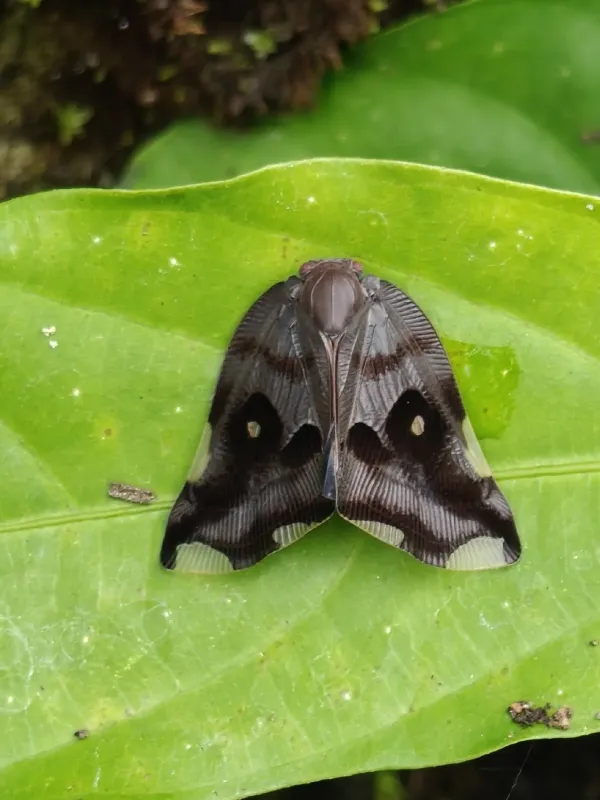
Adult insects are typically dark-colored, often appearing black, with mottled, semi-transparent patterns on their wings. They usually measure about 10–12 mm in length when at rest.
The nymphs (immature stages) are easily recognizable by the long, waxy white filaments extending from the tip of their abdomen, which may look like tufts of white fluff or cotton.
Females lay their eggs inside the bark of young shoots. These eggs are well-hidden and protected from environmental stress during the dormant winter period.
The life cycle consists of egg, five nymphal instars, and the adult stage. In temperate climates, they typically complete one generation per year, although conditions may vary.
What it damages
Pochazia is a significant polyphagous pest, meaning it feeds on a wide range of woody plants, shrubs, and various perennial crops, causing distress to the host plant.
Primary hosts include grapevines, apple trees, pear trees, peach trees, and numerous ornamental plants. Their presence is often detected in orchards and vineyards.
The insects feed by piercing the plant tissue and sucking the phloem sap. This continuous feeding weakens the plant, stunts its growth, and makes it susceptible to other pathogens.
During feeding, the pest excretes honeydew, a sugary substance that coats the leaves. This serves as a substrate for the rapid growth of sooty mold, which turns the leaves black.
Heavy infestations lead to significant yield losses in fruit production. In extreme cases, young trees or sensitive nursery stock can be severely stunted or even killed by the insect pressure.
When it appears
The pest overwinters in the egg stage, safely embedded under the bark of host plants. Eggs begin to hatch in the spring as temperatures consistently rise above the threshold.
Nymphal activity is most prominent from late spring to early summer. During this time, they gather on the undersides of leaves and on tender shoots to feed.
Adults emerge during mid-summer. This period is marked by the highest activity levels, as the insects disperse to new areas and initiate the mating process.
A second surge in activity often occurs in late summer or early autumn, corresponding to the final feeding phase and the process of female egg-laying.
As autumn transitions into winter, adult populations decline rapidly due to the cooling weather, leaving only the overwintering egg stages to persist until the following season.
Signs of infestation
The presence of white, cottony, or waxy filaments on the underside of leaves or along shoots is the most characteristic sign that a Pochazia infestation is present.
Honeydew accumulation on the surface of leaves creates a sticky texture, which is a clear indicator of heavy sap-sucking activity by the nymphal and adult populations.
Black sooty mold growth on leaves is a secondary symptom. While it does not feed on the plant directly, it effectively blocks sunlight, severely hindering the plant's photosynthesis.
Physical inspection of stems may reveal small, irregular fissures or slight swellings on the bark, indicating the precise locations where the eggs were deposited.
General signs of plant stress, such as yellowing of leaves, leaf curling, and stunted shoot growth, are common symptoms in areas with high pest densities.
Control measures
Sanitary pruning is a critical practice; removing and burning infested branches helps reduce the population by destroying the eggs hidden within the bark.
Managing the canopy density by pruning improves light penetration and air circulation, creating a less favorable environment for the insects to colonize.
Biological control measures, such as the use of fungal pathogens or horticultural oils, can be effective in reducing nymph populations without the use of harsh chemicals.
Systemic or contact insecticides are typically applied when nymphal populations are at their peak or when adult activity is first observed to prevent further spread.
Monitoring with yellow sticky traps is an essential component of integrated pest management, allowing for the precise timing of control measures based on actual insect flight activity.
Taxonomy
- Latin name
- Pochazia
- Order
- Hemiptera (bugs, aphids, leafhoppers)
- Family
- Ricaniidae
- EPPO code
- POCZSP
Discussion
No discussions yet — be the first.