
Euricania facialis
Euricania facialis
Description
How to identify
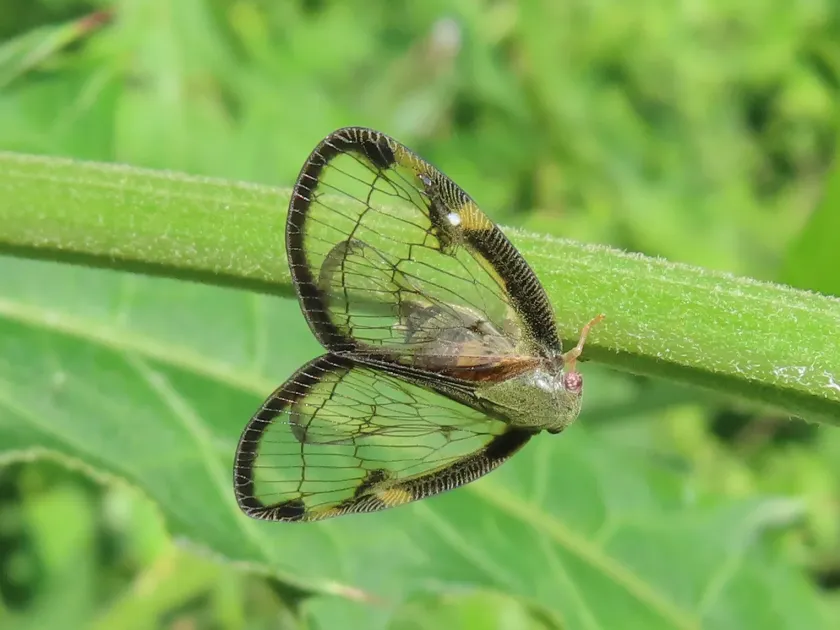
Euricania facialis belongs to the family Flatidae, commonly known as flatid planthoppers. These insects are easily recognized by their roof-like wings, which feature intricate, mesh-like venation that camouflages them against tree bark.
Adult insects typically measure 8–10 mm in length. Their coloration ranges from dark brown to black, often with whitish or translucent markings on the wings, providing an excellent disguise in shaded canopy areas.
The nymphs are distinct due to their thick covering of white, waxy filaments. This substance resembles small tufts of cotton or lint, which serves as a protective barrier against moisture loss and predators.
Eggs are oval and smooth, usually deposited by females into the soft tissue of young shoots or crevices in the bark. The egg stage is the primary overwintering phase, allowing the species to survive low winter temperatures.
The lifecycle consists of egg, five nymphal instars, and the adult stage. In temperate climates, the species may complete one or two generations per year, depending on the heat units and environmental conditions.
What it damages
This species is a generalist feeder that attacks a wide variety of woody plants and shrubs. It is particularly notorious in viticulture, where it feeds on vines, causing significant stress to both foliage and developing clusters.
Common hosts include fruit trees like apple, pear, and peach, as well as various wild bushes. The nymphs and adults pierce the plant tissue to suck sap, weakening the plant's overall vascular system.
Euricania facialis acts as a vector for various phytoplasmas, which are dangerous pathogens. The transmission of these diseases leads to chronic decline, reduced yields, and eventually the death of the plant if left untreated.
The insects excrete large amounts of honeydew while feeding. This sticky substance encourages the growth of sooty mold, which coats the leaves, blocks sunlight, and severely limits the plant's photosynthetic capacity.
In cases of heavy infestation, plants experience early leaf drop and deformed fruit development. Affected vines often fail to mature properly before winter, leading to reduced frost tolerance and potential tissue dieback.
When it appears
Nymphs typically emerge from overwintering eggs in late spring, around May, coinciding with the rapid growth of new plant shoots. This is the period when they are most vulnerable to contact treatments.
The peak feeding phase for nymphs occurs throughout June and July. During this time, they remain relatively stationary, feeding on the undersides of leaves and young, succulent stems of the host plants.
Adults emerge in mid-summer, usually in July or August. Unlike the flightless nymphs, the adults are highly mobile, capable of jumping and flying to new host plants, which facilitates the rapid spread of the infestation.
Oviposition takes place in late summer and autumn. Females carefully select sheltered sites for egg-laying, ensuring that the next generation is protected from the coming autumn rains and cold spells.
Weather patterns significantly influence population dynamics, with warm, humid summers favoring outbreaks. Agronomists recommend consistent scouting throughout the season to detect the initial colonization before it spreads.
Signs of infestation
The most reliable sign of an infestation is the presence of white, cotton-like masses on the undersides of leaves. These are colonies of nymphs protected by their waxy secretions.
A sticky residue, known as honeydew, on leaves and stems is a hallmark sign of a planthopper presence. This sticky film often attracts ants, whose constant activity on a plant can point to hidden insect colonies.
The development of black sooty mold on the foliage is a secondary symptom of the honeydew accumulation. This makes the leaves look dirty and dull, and significantly reduces the plant's vigor.
Adults are easily observed if the foliage is disturbed; they perform sharp jumps to escape potential threats. Their presence on fruit clusters can be identified by uneven ripening or stunted berry development.
General plant decline, including chlorosis, leaf yellowing, and stunted growth of terminal shoots, serves as a late-stage warning sign of a long-term infestation that needs immediate intervention.
Control measures
Integrated Pest Management (IPM) for this species relies on mechanical and chemical approaches. Pruning and destroying heavily infested branches can physically remove egg clusters and reduce future populations.
Yellow sticky traps are highly effective for monitoring adult populations. By placing these traps in susceptible areas, growers can track the timing of adult emergence and time their insecticide applications accordingly.
Systemic insecticides are the preferred choice when targeting the nymphal stages. It is crucial to ensure thorough coverage, especially on the undersides of the leaves where the nymphs reside.
Encouraging natural predators, such as ladybugs, spiders, and parasitic wasps, is essential for long-term suppression. Avoiding broad-spectrum pesticides helps maintain these natural biological control agents.
- Maintaining good air circulation through proper pruning and canopy management.
- Keeping orchards and vineyards free of weeds that harbor the pests.
- Using horticultural oils during the dormant season to suffocate overwintering eggs.
- Focusing scouting efforts on the edges of fields where adults first land.
Taxonomy
- Latin name
- Euricania facialis
- Order
- Hemiptera (bugs, aphids, leafhoppers)
- Family
- Ricaniidae
- EPPO code
- EURNFA
Discussion
No discussions yet — be the first.