
Pochazia shantungensis
Pochazia shantungensis
Description
How to identify
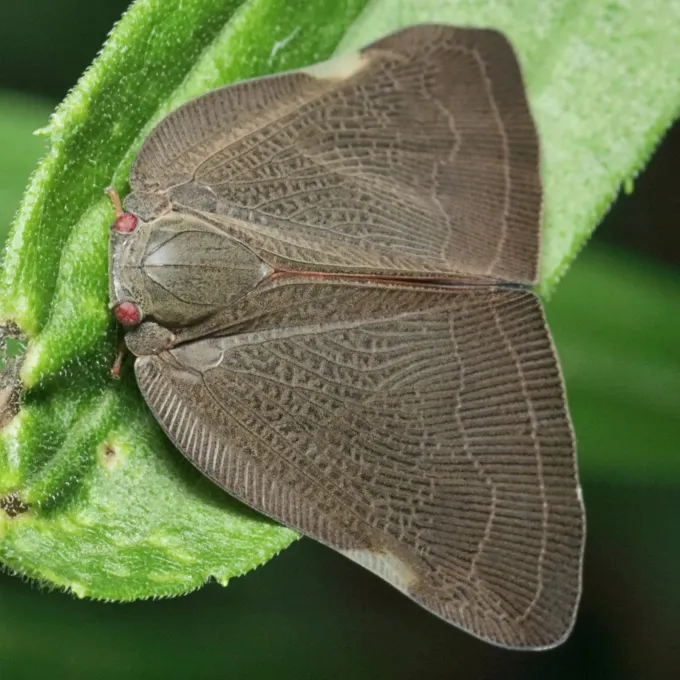
Pochazia shantungensis, commonly known as a type of planthopper, belongs to the family Flatidae. Adults typically measure about 10–12 mm in length and possess dark wings with distinct white stripes and translucent patches.
The insect's body is covered with a characteristic waxy secretion, which serves as a protective layer against environmental factors. Nymphs appear as small, fluffy white masses due to the dense waxy filaments covering their bodies.
Adults are highly mobile and possess strong hind legs, allowing them to jump rapidly when threatened. This jumping behavior often makes them difficult to catch or monitor effectively during field inspections.
The species exhibits high ecological plasticity, enabling it to adapt to various climates and colonize new environments rapidly. It has become a significant concern for both fruit orchards and nursery production.
Morphologically, adults are easily recognized by their roof-like wing posture when at rest. This specific resting position, combined with their unique color pattern, helps agriculturalists distinguish them from other common insects.
What it damages
This pest is a broad polyphage that affects a wide variety of crops, including apples, pears, grapes, persimmons, and various tea plants. It is also known to infest many types of ornamental and forest trees.
Damage is caused by both nymphs and adults feeding on plant sap. By piercing the plant tissue, they extract nutrients, which leads to the weakening of the host and stunted growth of shoots.
Infected plants often exhibit wilting, reduced vigor, and distorted leaf development. Severe infestations can significantly lower the overall yield and degrade the quality of the harvested produce.
Pochazia shantungensis can act as a vector for various phytoplasmal diseases, which are catastrophic for plant health. Even without disease transmission, the mechanical damage to young tissues is often irreversible.
The accumulation of honeydew secreted by these insects promotes the growth of sooty mold. This black fungal coating covers leaves, effectively blocking photosynthesis and further weakening the plant's metabolic processes.
When it appears
The life cycle typically consists of one generation per year. The insect overwinters in the egg stage, with females laying eggs beneath the bark of young twigs or within cracks in the plant stem.
In the spring, as temperatures rise, the eggs hatch into nymphs. These nymphs immediately begin to feed on the sap of young shoots, moving through several stages of development during the spring and early summer.
The nymphal stage includes five distinct instars, after which the insects transition into adults in mid-summer. This period marks the beginning of the adult reproductive phase and peak activity.
Summer months are characterized by the highest population density, as adults actively migrate between host plants. This is the critical window for monitoring and implementing necessary control measures.
By late summer and early autumn, the adults focus on mating and egg-laying for the following season. The speed of the cycle is highly dependent on ambient temperature, making seasonal weather trends key factors in outbreaks.
Control measures
Managing Pochazia shantungensis requires an integrated pest management approach. The most effective cultural practice is the pruning and immediate destruction of infested twigs containing egg clutches.
Yellow sticky traps are highly recommended for monitoring and mass trapping adults, which helps to reduce the overall population pressure in the garden. Maintaining weed-free zones around the orchard also helps prevent infestation.
Chemical control involving systemic insecticides is often necessary when nymphal populations exceed economic thresholds. Targeted spraying during the early nymphal stage provides the best results for population suppression.
Biological control methods involve encouraging natural enemies, such as parasitic wasps and predatory insects, which can help keep populations in check naturally. Reducing chemical reliance preserves these beneficial organisms.
- Apply systemic insecticides during the peak of nymphal emergence.
- Prune and burn infested wood to eliminate overwintering eggs.
- Use yellow sticky traps to capture adults and monitor activity.
- Encourage local biodiversity to promote natural predator populations.
Taxonomy
- Latin name
- Pochazia shantungensis
- Order
- Hemiptera (bugs, aphids, leafhoppers)
- Family
- Ricaniidae
- EPPO code
- POCZSH
Discussion
No discussions yet — be the first.