
Ricania
Ricania
Description
How to identify
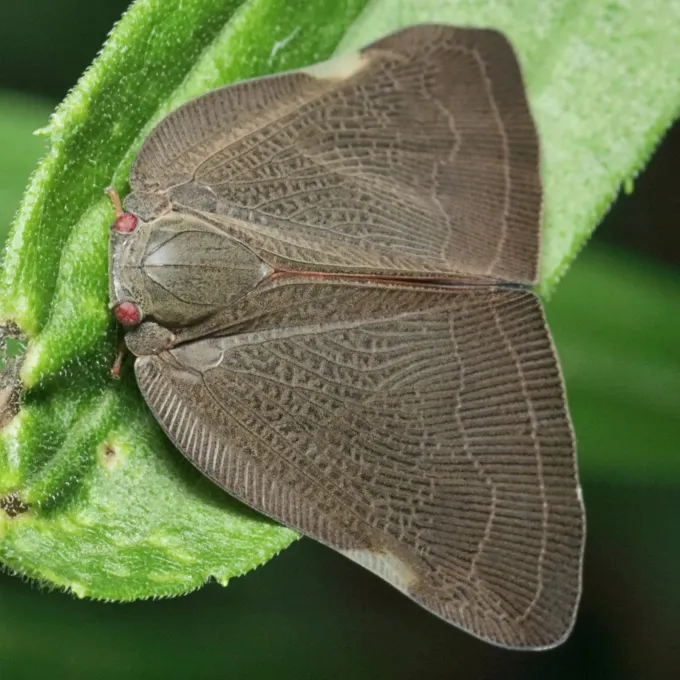
Ricania, specifically Ricania japonica, belongs to the order Hemiptera and the family Ricaniidae. This planthopper insect resembles a small moth and has characteristic broad wings with a reticulated pattern that fold roof-like when at rest.
Adults reach a size of about 8–10 millimeters. The coloration of the imago varies from dark brown to almost black, which allows them to effectively camouflage themselves on the bark of trees and shrubs.
The nymphs of Ricania differ significantly from the adults in appearance. They are whitish or yellowish in color and covered with specific wax filaments that give them a fluffy look and protect them from predators.
The nymphs move by jumping, using their powerful hind legs. Like the adults, they are active consumers of plant sap, which makes them dangerous at all stages of their life cycle.
The eggs of this pest are usually laid under the bark of thin plant branches, making them visually inconspicuous and significantly complicating the detection of the infestation at an early stage.
What it damages
Ricania is a polyphagous pest, meaning it has a wide range of host plants. The list of its victims includes both fruit trees and ornamental shrubs, as well as berry crops.
Grapes are the most frequent target and often suffer from massive attacks. The pest also actively infests apple, pear, peach, citrus trees, and many species of forest trees.
In addition to woody and shrub crops, Ricania can attack vegetable plants and even perennial herbs if they are growing near the breeding site of the pest.
High adaptability allows this insect to quickly colonize new territories, moving from wild plant species to cultivated plantings in orchards and industrial plantations.
The main danger is the high population density, which, under favorable conditions, is capable of completely destroying the yield of certain crops by depleting their vital resources.
When it appears
The Ricania life cycle is generally annual. The species overwinters in the egg stage, which is found under the bark of host plants, providing reliable protection against low temperatures.
Mass hatching of nymphs from eggs begins in late spring, usually in May, and continues until early summer. During this period, the insects feed most actively in preparation for metamorphosis.
The transformation of nymphs into adults (imago) is spread over time and occurs in mid-summer. It is in July and August that the peak population of flying adult insects is observed.
Females begin laying overwintering eggs in late summer and early autumn. During this period, the pest's activity gradually decreases as the first cold weather approaches.
The overall population dynamics strongly depend on regional climatic conditions: a warm and mild winter significantly increases the survival rate of eggs, leading to a population outbreak the following spring.
Signs of infestation
The main sign of infestation is the presence of white waxy deposits on young shoots and leaves, left behind by nymphs after they suck the sap.
Leaves on affected plants begin to curl, turn yellow, and fall off prematurely. In the areas of the bites, there is often deformation of young tissues, which slows their growth.
Sooty mold fungi often grow on the honeydew secreted by the nymphs. The appearance of a black coating on the leaf surface is a sure sign of a pest colony presence.
The plants themselves lose turgor, look stunted, and lag in development. Under severe infestation, shoots may die, and trees or shrubs become susceptible to secondary infections.
Adults are easily detected by shaking the branches — they fly away in large numbers, creating a characteristic noise that resembles the rustling of dry leaves or the movement of a large number of winged insects.
Control measures
Combating Ricania begins with agronomic measures. Regular pruning and destruction of damaged branches, where females have laid eggs, are recommended to limit the population for the next year.
An effective monitoring method is the use of yellow sticky traps. They allow for the timely detection of the start of mass adult flight and help adjust the timing of insecticide applications.
The use of chemical plant protection products is most effective during the nymph hatching period. Systemic and contact-stomach insecticides approved for use on specific crops are applied.
It is important to rotate products with different modes of action to prevent the development of resistant insect populations, as Ricania quickly adapts to frequent treatments with the same substance.
In the context of biological control, the use of entomophages is possible if they are present in the region. It is also worth monitoring the cleanliness of the plot, removing weeds that may serve as additional reservoirs for the pest.
Taxonomy
- Latin name
- Ricania
- Order
- Hemiptera (bugs, aphids, leafhoppers)
- Family
- Ricaniidae
- EPPO code
- RICASP
Discussion
No discussions yet — be the first.