
Eastern gray squirrel
Sciurus carolinensis
Description
How to identify
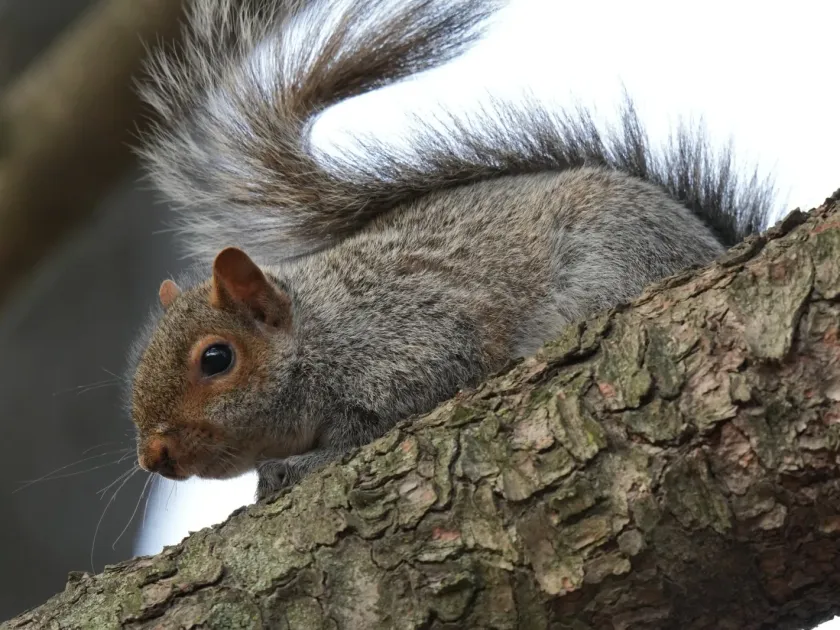
The Eastern gray squirrel (Sciurus carolinensis) is a rodent of the Sciuridae family, characterized by its medium size and long, bushy tail.
Adult squirrels typically have a body length of 23–30 cm, with fur that varies from gray to brownish-gray, featuring a white or pale underbelly.
They are agile climbers with strong claws and muscular limbs, allowing them to navigate vertical tree trunks and building facades with remarkable speed.
These animals are highly intelligent and social, showing great behavioral flexibility when adapting to different urban or agricultural environments.
In many regions, they are considered an invasive species due to their ability to outcompete native wildlife and cause significant ecological disturbance.
What it damages
The most severe agricultural damage involves the stripping of bark from trees, particularly during the spring when the sap begins to flow.
This debarking process damages the phloem and xylem, weakening the tree, causing branch dieback, and potentially leading to the death of the entire plant.
Squirrels are major pests in orchards, as they consume fruits, nuts, and seeds, resulting in substantial yield losses for farmers and gardeners.
They also cause damage to ornamental plants by pruning buds and young shoots, which interferes with the development and aesthetic quality of the vegetation.
Additionally, they often gnaw on plastic irrigation tubing, electrical wiring, and house structures, leading to costly property damage and maintenance issues.
When it appears
The Eastern gray squirrel is active year-round, as they do not hibernate and must continuously forage to meet their energy requirements.
Early spring is a critical period for bark damage, as food sources are scarce and tree sap provides a highly desired nutritional supplement.
Reproductive activity peaks in late winter and summer, which increases the pressure on local food supplies as adults work to feed their young.
Summer and autumn are marked by intense foraging on ripening fruits and nuts, aligning with the peak harvest times for many agricultural crops.
Squirrels also focus on storing food in caches during the autumn months, which may involve digging up vegetable beds and garden patches.
Signs of infestation
The most evident sign of infestation is the presence of large patches of exposed inner bark on tree branches and main stems.
Signs of feeding, such as discarded nut shells, half-eaten fruits, and freshly cut twigs, are frequently found clustered beneath the canopy.
Gnaw marks on wood exhibit a characteristic pattern of parallel grooves, which are distinct from the chaotic damage caused by other larger animals.
Large, spherical nests made of sticks, leaves, and moss, known as dreys, are often visible in the crotches of trees or near the trunk.
Small, dark, pellet-like droppings are another indicator of their presence, particularly in areas where they frequently forage or congregate.
Control measures
Physical barriers such as sheet metal guards placed around tree trunks are highly effective at preventing squirrels from climbing into the canopy.
- Installing wire mesh or netting to protect sensitive crops and individual fruit trees from foraging.
- Applying taste-aversion repellents to bark or plants to make the food source unpalatable.
- Removing debris and ensuring that fallen fruits are cleared daily to reduce attractants.
- Using live traps to capture and relocate nuisance squirrels to more suitable habitats away from the garden.
- Sealing potential entry points in buildings to prevent them from nesting within structures near agricultural land.
Ultrasonic deterrents can be employed as a supplementary measure to create an uncomfortable acoustic environment for the pests.
A combination of physical exclusion and landscape management is the most successful strategy for mitigating squirrel-related damage.
Taxonomy
- Latin name
- Sciurus carolinensis
- Order
- Rodents
- Family
- Sciuridae
- EPPO code
- SCIUCA
Discussion
No discussions yet — be the first.